
Biodegradation of Phenolby Microorganisms in Sediment-Slurry under Aerobic Denitrification
Article Sidebar
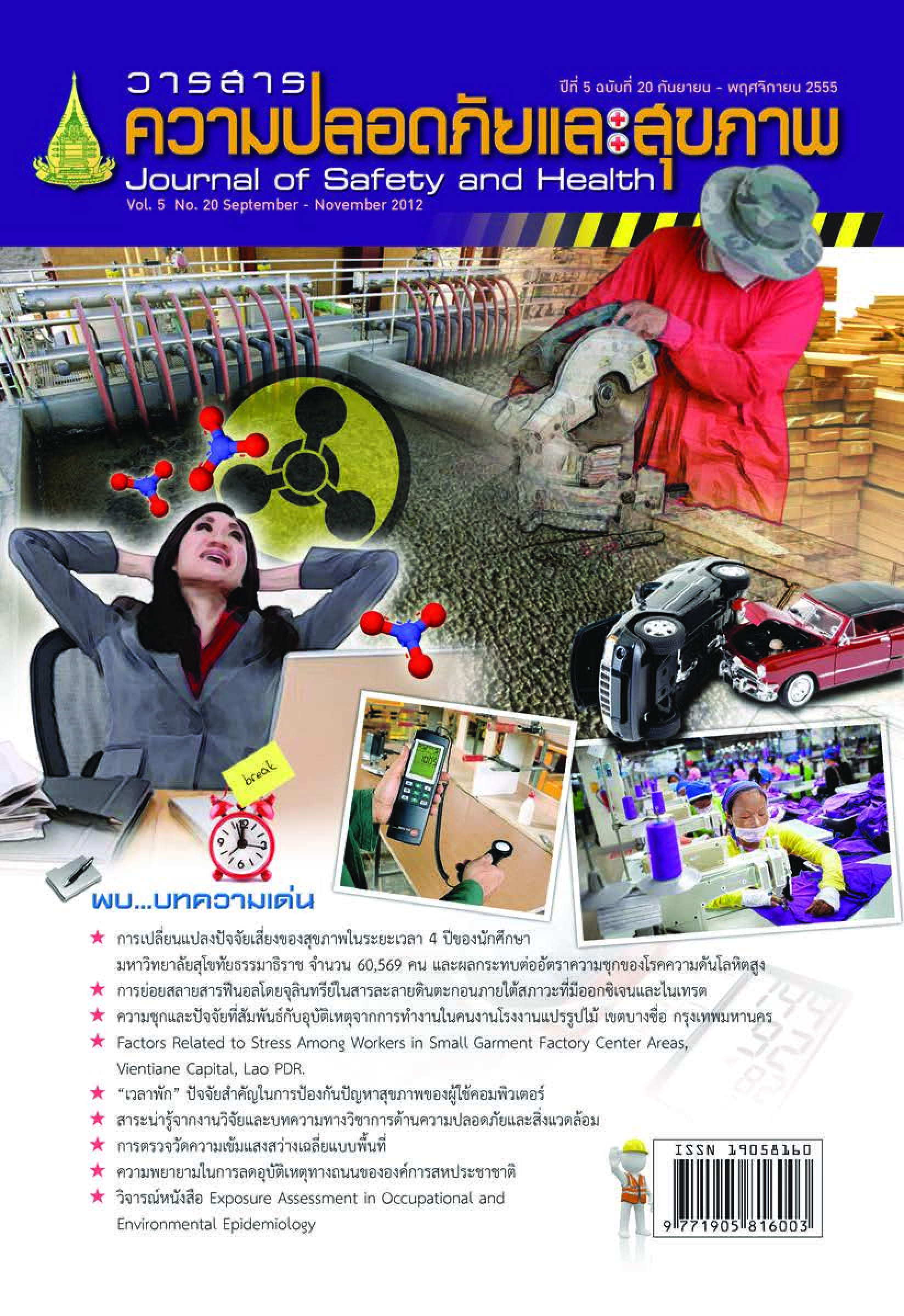
Main Article Content
Abstract
In this study, biodegradation of phenol by microorganisms in rice-paddy sediment-slurry which consisted of nitrate (0.031 mM) and nitrite (0.028 mM) was investigated under aerobic denitrifying conditions. In active culture, 0.1 mM phenol which was applied in the first and the second time was biodegraded within 3 and 2 days, respectively. Then 0.3 mM phenol was reapplied into all treatments, the chemical was biodegraded for more than 5 days of the experiment. The detected metabolite of phenol biodegradation was p-hydroxybenzoate which was monitored at day 3, 6 and 9 with the concentration less than 0.01 mM. Furthermore, these microorganisms in sediment-slurry were able to transform nitrate to nitrite.
Article Details

This work is licensed under a Creative Commons Attribution-NonCommercial-NoDerivatives 4.0 International License.
Journal of Safety and Health is licensed under a Creative Commons Attribution-NonCommercial-NoDerivatives 4.0 International (CC BY-NC-ND 4.0) licence, unless otherwise stated.
References
มนัส สุวรรณ (2532) นิเวศวิทยากับการพัฒนาเศรษฐกิจ. กรุงเทพฯ: โอเดียนสโตร์.
สุบัณฑิต นิ่มรัตน์ และสุกานดา เกื้อกิจกูล (2546) การ ย่อยสลาย p-Hydroxybenzoate โดยใช้ mixed cultureภายใต้สภาวะที่มีออกซิเจน.การประชุมวิชาการ ครั้งที่ 41 มหาวิทยาลัยเกษตรศาสตร์, กรุงเทพฯ, วันที่ 3 - 5 กุมภาพันธ์ 2546.
Association of Official American Chemists [AOAC]. (2002). Official methods of analysis. Association of Official American Chemists, MD.
Basha, K.M., Rajendran, A., & Thangavelu, V. (2010). Recent advances in the biodegradation of phenol: A review. Asian Journal of Experimental Biological Science, 1 (2), 219 - 234.
Bertani, I., Kojic, M., & Venturi, V. (2001). Regulation of the p-hydroxybenzoic acid hydroxylase gene (pobA) in plant-growth-promoting Pseudomonas putida WC358. Microbiology, 147, 1611 - 1620.
Caflan Karasu Benli, A., Sarikaya, R., Sepici Dincel, A., Selvi, M., Sahin, D., & Erkoc, F. (2007). Investigation of acute toxicity of (2,4- dichlorophenoxy) acetic acid (2,4-D) herbicide on crayWsh (Astacus leptodactylus Esch. 1823). Pesticide Biochemistry and Physiology, 88, 296 - 299.
Chakraborty, S., Bhattacharya, T., Pael, T.N., & Tiwari, K.K. (2010). Biodegradation of phenol by native microorganism isolated from coke processing wastewater. Journal of Environmental Biology, 31, 293 - 296.
Chen, Y.-X., Liu, H., & Chen, H.-L. (2003). Characterization of phenol biodegradation by Comamonas testosterone ZD4-1 and Pseudomonas aeruginisa ZD4-3. Biomedical and Environmental Science, 16, 163 - 172.
Dehkordi, F.N., Gharavi, S., & Soudi, M.R. (2012). Phenol Biodegradation by Two Bacterial Isolates from Agricultural Soil. Congress Portal for Ardabil University of Medical Sciences,The 13th Iranian & The Second International Congress of Microbiology.
Gayathri,K.V. & Vasudevan, N. (2010).Enrichment of phenol degrading moderately halophilic bacteria consortium from saline environment, Journal of Boiremediation & Biodegradation, 1 (1), 1 - 6.
Healy, J.B. & Young, L.Y. (1979). Anaerobic biodegradation of eleven aromatic compounds to methane. Applied and Environmental Microbiology, 38 (1), 84 - 89.
Latha, S. & Mahadevan, A. (1997). Review: Role of rhizobia in the degradation of aromatic substances. World Journal of Microbiology & Biotechnology, 13, 601 - 607.
Mutzel, A., Reinscheid, U.M., Antranikian, G., & Muller,R. (1996). Isolation and characterization of a thermophilic bacillus strain, that degrades phenol and cresol as sole carbon source at 700 C. Applied Microbiol Biotechnol, 46, 593 - 596.
Nair, C.I., Jayachadran,K., & Shashidhar,S. (2008). Biodegradation of phenol. African Journal of Biotechnilogy, 7 (25), 4951 - 4958.
Nakazawa, H., Takahashi, N., Inoue, K., Ito, Y., Goto, T., Kato, K., Yoshimura, Y., & Oka, H. (2004). Rapid and simultaneous analysis of dichlorvos, malathion, carbaryl, and 2,4-dichlorophenoxy acetic acid in citrus fruit by flow-injection ion spray ionization tandem mass spectrometry. Talanta, 64, 899 - 905.
Riazika, B., Abbes, B., Messaoud, C., & Soufi, K. (2010). Phenol and benzoic acid degradation by Pseudomonas aeruginosa. Journal of Water Resource and Protection, 2, 788 - 791.
Sarikaya, R. & Selvi, M. (2005). Investigation of acute toxicity of (2,4-dichlorophenoxy) acetic acid (2,4-D) herbicide on larvae and adult Nile tilapia (Oreochromis niloticus L.). Environmental Toxicology and Pharmacology, 20, 264 - 268.
Schwarzenbach,R.P., Gschwend,P.M., & Imboden, D.M. (1993). Environmental organic chemistry (1st ed). New York: John Wiley & Sons, Inc.
Shourian, M., Noghabi, K.A., Zahiri, H.S., Bagheri, T., Karballaei, G., Mollaei, M., Rad, I., Ahadi, S., Raheb, J., & Abbasi, H. (2009). Efficient phenol degradation by a newly characterized Pseudomonas sp. SA01 isolated from pharmaceutical wastewaters. Desalination, 246 (3), 577 - 594.
Stickland, J.D.H. & Parson, T.R. (1972). A practical handbook of seawater analysis (2nd ed.). Ottawa: Fisheries Research Board of Canada Bulletin.
Trabue, S.L., Ogram, A.V., & Ou, L.-T. (2001). Dynamics of carbofuran-degrading microbial communities in soil during three successive annual applications of carbofuran. Soil Biology & Biochemistry, 33, 75 - 81.
van Schie, P.M. & Young, L.Y. (1998). Isolation and characterization of phenol-degrading denitrifying bacteria. Applied and Environmental Microbiology, 64 (7), 2432 - 2438.
Varsha, Y.M., Deepthi CH, N., & Chenna, S. (2011). Anemphasis onxenobioticdegradation in environmental clean up. Journal of Boiremediation & Biodegradation, 11, 1 - 10.
Zhang, X. & Wiegel, J. (1994).Reversible conversion of 4 - hydroxybenzoate and phenol by Clostridium hydroxybenzoicum. Applied and Environmental Microbiology, 60 (11), 4128 - 4185.
