
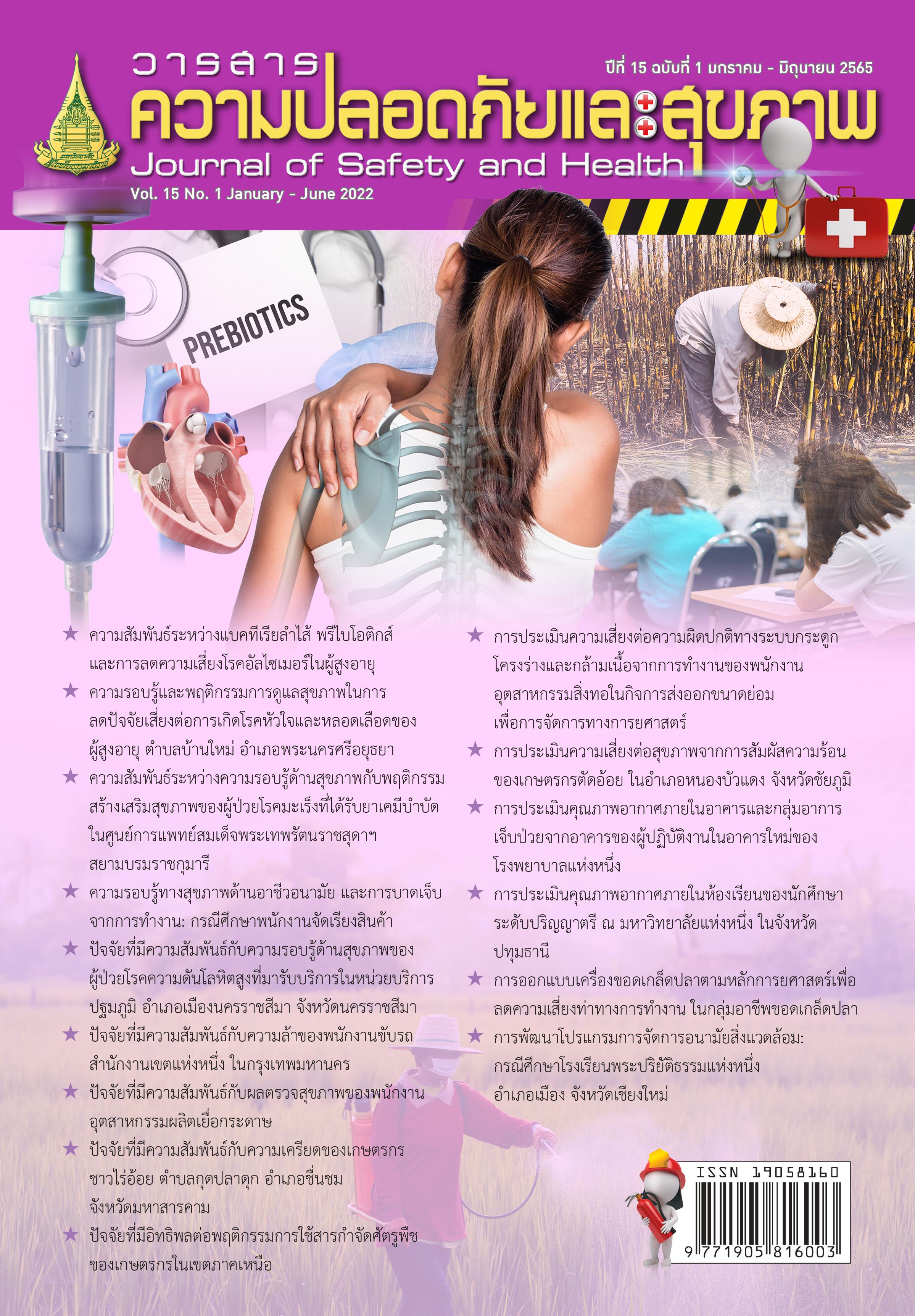
Links between Gut Bacteria, Prebiotic, and Reduction in Risk of Alzheimer’s Disease in the Elderly
Article Sidebar
Main Article Content
Abstract
The alteration of gut microbial composition or gut dysbiosis in the elderly can cause Alzheimer’s disease which is related to directional gut-brain axis communication. Some bacteria can produce neurotoxin metabolite products in the gut which affect the inflammation and neuron impairment in the central nervous system (CNS) through various pathways. Diet is the significant factor that affects the conversion of gut bacteria composition. Prebiotics or fiber consumption from vegetables, fruits, and cereals can activate short-chain fatty acid bacteria or probiotic bacteria. They can produce anti-inflammation metabolites and decrease the epithelial permeability of neurotoxic metabolites. Understanding the association between gut bacteria, prebiotic, and Alzheimer’s disease should provide the guideline to prevent the risk of Alzheimer’s disease which causes by gut dysbiosis in the elderly.
Article Details

This work is licensed under a Creative Commons Attribution-NonCommercial-NoDerivatives 4.0 International License.
Journal of Safety and Health is licensed under a Creative Commons Attribution-NonCommercial-NoDerivatives 4.0 International (CC BY-NC-ND 4.0) licence, unless otherwise stated.
References
ก้องเกียรติ กูณฑ์กันทรากร. (2561). ภาวะสมองเสื่อมและโรคอัลไซเมอร์. ธรรมศาสตร์เวชสาร, 18(3), 442-468.
วิชัย เอกพลากร.(2557). รายงานการสำรวจสุขภาพประชาชนโดยการตรวจร่างกาย ครั้งที่ 5 พ.ศ. 2557.นนทบุรี:สถาบันวิจัยระบบสาธารณสุข.
สำนักงานสถิติแห่งชาติ.(2561). รายงานการสำรวจประชากรสูงอายุในประเทศไทย พ.ศ.2560
อัญชลี ศรีจำเริญ.(2561). อาหารและโภชนาการ การป้องกันกลไกบกพร่อง.กรุงเทพมหานคร: สำนักพิมพ์แห่งจุฬาลงกรณ์มหาวิทยาลัย.
Carabotti, M., Scirocco, A., Maselli, M.A. , & Severi, C. (2015). The gut-brain axis: interactions between enteric microbiota, central and enteric nervous systems. Annals of Gastroenterology. 28(2), 203-209.
Conte, C., Sichetti, M.,& Traina, G. (2020). Gut–Brain Axis: Focus on neurodegeneration and mast cells. Applied Sciences. 10 (1828), 2-19.
Dalile, B., Oudenhove, L.V., Vervliet, B., & Verbeke, K. (2019). The role of short- chain Fatty acids in microbiota–gut–brain communication. Nature Reviews gastroenterology & hepatology. 16 (2019): 461-478.
Dinan, T.G., Stilling, R.M., Stanton, T., & Cryan, J.F. (2015). Collective unconscious: How gut microbes shape human behavior. Journal of Psychiatric Research. 63(2015), 1-9.
Feng, W., Ao, H., & Peng, C. (2018). Gut microbiota, Short-chain fatty acids, and herbal medicines. Frontiers in pharmacology. 9(2018), 1-12.
Kowalski, K., & Mulak, A. (2019). Brain-gut microbiota axis in Alzheimer’s disease. Journal of neurogastroenterol Motil. 25(1), 48-60.
Martínez Leo, E.E., & Segura Campos, M.R. (2020). Effect of ultra-processed diet on gut microbiota and thus its role in neurodegenerative diseases. Nutrition. 71(2020), 1-7.
Long, J.M., & Holtzman, D.M. (2019). Alzheimer Disease: An Update on Pathobiology and Treatment Strategies. Cell. 179(2), 312-339.
Parker, A., Fonseca, S., & Carding, S.R. (2020). Gut microbes and metabolites as modulators of blood-brain barrier integrity and brain health. Gut Microbes. 11(2), 135–157.
Rinninella, E., Raoul, P., Cintoni, M., Franceschi, F., Miggiano, G.A.D., Gasbarrini, A., & Mele, M.C. (2019). What is the Healthy Gut Microbiota Composition? A Changing Ecosystem across Age, Environment, Diet, and Diseases. Microorganisms. 7(14), 17-22.
Rothschild, D., Weissbrod, O., Barkan, E., et al. (2018). Environment dominates over host genetics in shaping human gut microbiota. Nature. 555, 210–215.
Sarkar, S.R., & Banerjee, S. (2019). Gut microbiota in neurodegenerative disorders. Journal of Neuroimmunology. 328 (2019), 98–104.
Silva, Y.P., Bernardi, A., & Luiz, R. (2020). The role of short-chain fatty acids from gut microbiota in gut-brain communication. Frontiers endocrinology. 11(2020), 1-14.
Thursby, E., & Juge, N.(2017). Introduction to the human gut microbiota. Biochemical Journal. 474(11), 1823–1836.
Vinolo, M.A.R., Rodrigues, H.G., Nachbar, R.T., & Curi, R. (2011). Regulation of inflammation by short chain fatty acids. Nutrients. 3(10), 858-876.
Westfall, S., Lomis, N., Kahouli, I., Dia, S.Y., Singh, S.P., & Prakash, S. (2017). Microbiome, probiotic and neurodegenerative diseases deciphering the gut brain axis. Cellular and Molecular Life Sciences. 2017 (74), 3769-3787.
Wu, W., Kong, Q., Tian, P., Zhai, Q., Wang, G., Liu, X., Zhao, J., Zhang, H., Lee, Y.K., & Chen, W. (2020). Targeting Gut Microbiota Dysbiosis: Potential Intervention Strategies for Neurological Disorders. Engineering. 6(4), 415-423.
Zhao, Y., Jaber, V., & Lukiw, W.J. (2017). Secretory products of the human GI tract microbiome and their potential impact on Alzheimer's disease (AD): Detection of lipopolysaccharide (LPS) in AD hippocampus. Front Cellular and Infection Microbiology. 7(318): 1-9.
