
Lighting in The Workplace
Article Sidebar
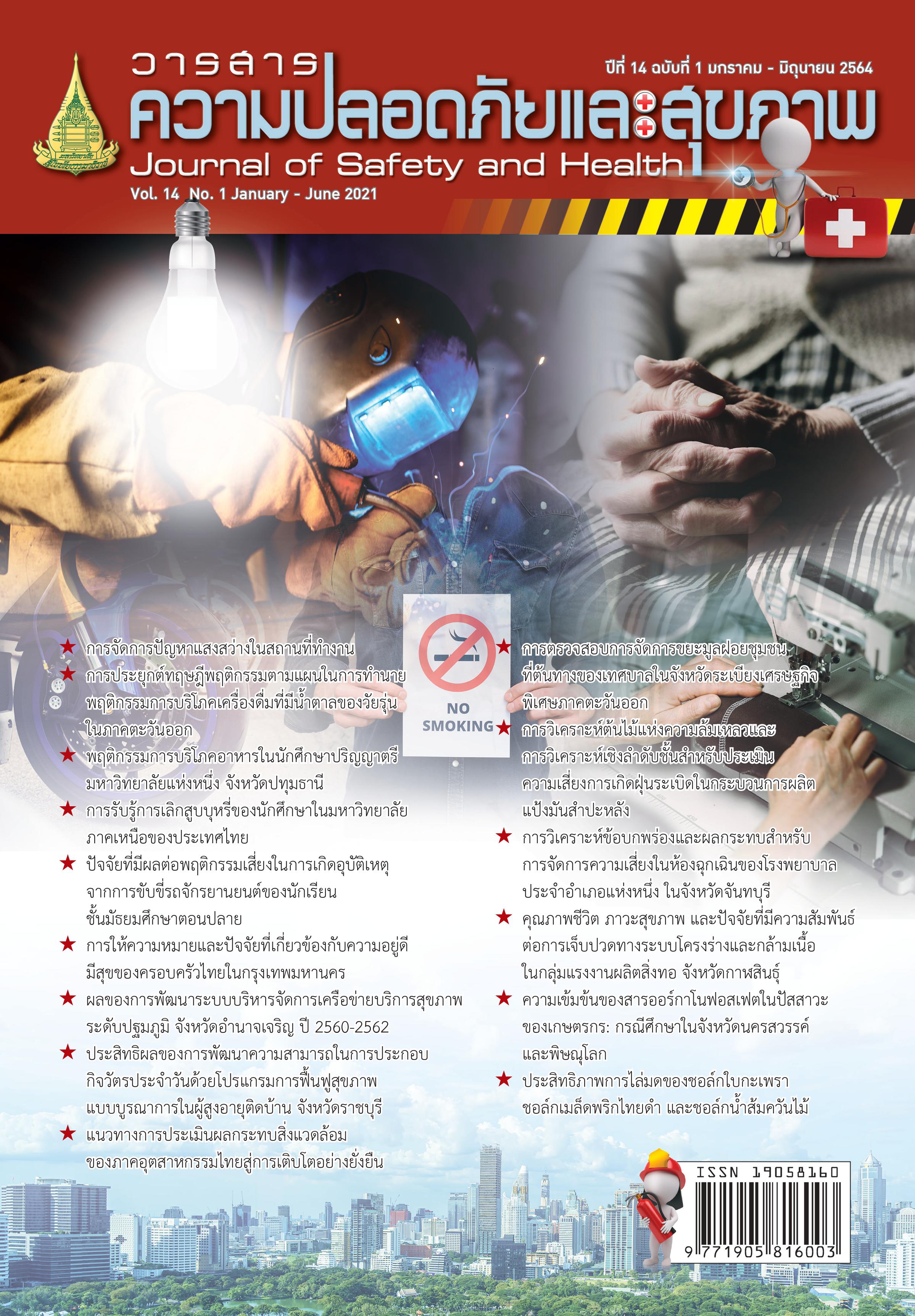
Main Article Content
Abstract
Lighting plays an important role of the human work. Poor lighting can lead eye pain, eye fatigue and headache. On the other hand, too much lighting can cause eye discomfort, sore eye, eye fatigue, headache, accident and reduce the eye capability of workers. The design of the workplace lighting system aims to allow workers to see hazards clearly, reduce the exposure of too much or poor lighting and increase the work efficiency. Employers must provide the appropriate lighting for the task because adequate lighting allows workers to concentrate better on their work which increases productivity. In addition, adequate lighting also reduces potential eye health problems of workers. The evaluation of lighting intensity is important in ensuring proper health and safety performance of workers. If the lighting in the workplace does not meet the lighting standards, the employers will use the measurement results to consider for further improvement.
Article Details
Journal of Safety and Health is licensed under a Creative Commons Attribution-NonCommercial-NoDerivatives 4.0 International (CC BY-NC-ND 4.0) licence, unless otherwise stated.
References
ประกาศกรมสวัสดิการและคุ้มครองแรงงาน เรื่อง มาตรฐานความเข้มของแสงสว่าง. (2561, 21 กุมภาพันธ์). ราชกิจจานุเบกษา. เล่มที่ 135 ตอนพิเศษ 39ง. หน้า 15.
ประกาศกรมสวัสดิการและคุ้มครองแรงงาน เรื่อง หลักเกณฑ์ วิธีการตรวจวัดและการวิเคราะห์สภาวะการทำงานเกี่ยวกับระดับความร้อน แสงสว่าง หรือเสียง รวมทั้งระยะเวลาและประเภทกิจการที่ต้องดำเนินการ. (2561, 12 มีนาคม). ราชกิจจานุเบกษา. เล่มที่ 135 ตอนพิเศษ 57ง. หน้า 11-16.
ปัญจ์ปพัชรพร บุญพร้อม, สุคนธ์ ขาวกริบ, สิทธิพันธ์ ไชยนันท์. (2562). การตรวจวัดสิ่งคุกคามในสภาพแวดล้อมการทำงานของพนักงานโรงงานซักฟอกย้อม เครื่องนุ่งห่มแห่งหนึ่งในจังหวัดสมุทรสาคร. วารสารสมาคมสถาบันอุดมศึกษาเอกชนแห่งประเทศไทย ในพระราชูปถัมภ์ สมเด็จพระเทพรัตนราชสุดาฯ สยามบรมราชกุมาร. 8(1), 18-33.
พจน์ ภาคภูมิ พงษ์สิทธิ์ บุญรักษา การประเมินแสงสว่างในสถานที่ทำงานในช่วงเวลากะกลางวันและกลางคืนของโรงงานผลิต ชิ้นส่วนรถจักรยานยนต์แห่งหนึ่งในจังหวัดชลบุรี. (2561). วารสารวิจัยสาธารณสุขศาสตร์ มหาวิทยาลัยขอนแก่น. 11(1), 78-85.
Fitzgerald, BW. (2018). Using Hawkeye from the Avengers to communicate on the eye. Advances in physiology education. 42(1), 90-98.
Gramatikov, B., Irsch, K, Guyton, D. (2013). Pupil Size Dynamics During the First Minutes of Dark Adaptation While Fixating on a Target. Investigative Ophthalmology & Visual Science. 54(15), 4374.
Harb, F., Hidalgo, MP., Martau, B. (2015). Lack of exposure to natural light in the workspace is associated with physiological, sleep and depressive symptoms. Chronobiology International. 32(3), 368-375.
Joshi, S. M. (2008). The sick building syndrome. Indian journal of occupational and environmental medicine. 12(2), 61-64.
Knez, I. (2001). Effects of colour of light on nonvisual psychological process. Journal of Environmental Psychology. 21(2), 201-208.
Leblebici, D. (2012). Impact of workplace quality on employee’s productivity: Case study of a bank in Turkey. Journal of Business Economics and Finance. 1, 1, 38–49.
Olympus corporation. 2020. Sources of Visible Light. Retrieved March 3, 2020, from https://www.olympus-lifescience.com/en/microscope-resource/primer/lightandcolor/lightsourcesintro/
Rea, M., Figueiro, M., Bullough, J. (2002). Circadian photobiology: an emerging framework for lighting practice and research. Lighting Research & Technology. 34(3), 177-187.
Rostron, J. (2008). Sick building syndrome: A review of causes, consequences and remedies. Journal of Retail & Leisure Property. 7(4), 291-303.
Sliney, DH. (2016). What is light? The visible spectrum and beyond. Eye (Lond). 30(2), 222-229.
Stone, PT. (2009). A model for the explanation of discomfort and pain in the eye caused by light. Lighting Research & Technology. 41(2), 109–121.
van Bommel, W., van den Beld, G. (2004). Lighting for work: a review of visual and biological effects. Lighting Research & Technology. 36(4), 255-266.
Wessolowski, N., Koenig, H., Schulte-Markwort, M., & Barkmann, C. (2014). The effect of variable light on the fidgetiness and social behavior of pupils in school. Journal of Environmental Psychology. 39, 101–108.
Zele, A. J., Maynard, M. L., Joyce, D. S., & Cao, D. (2014). Effect of rod-cone interactions on mesopic visual performance mediated by chromatic and luminance pathways. Journal of the Optical Society of America. A, Optics, image science, and vision, 31(4), A7-A14.
