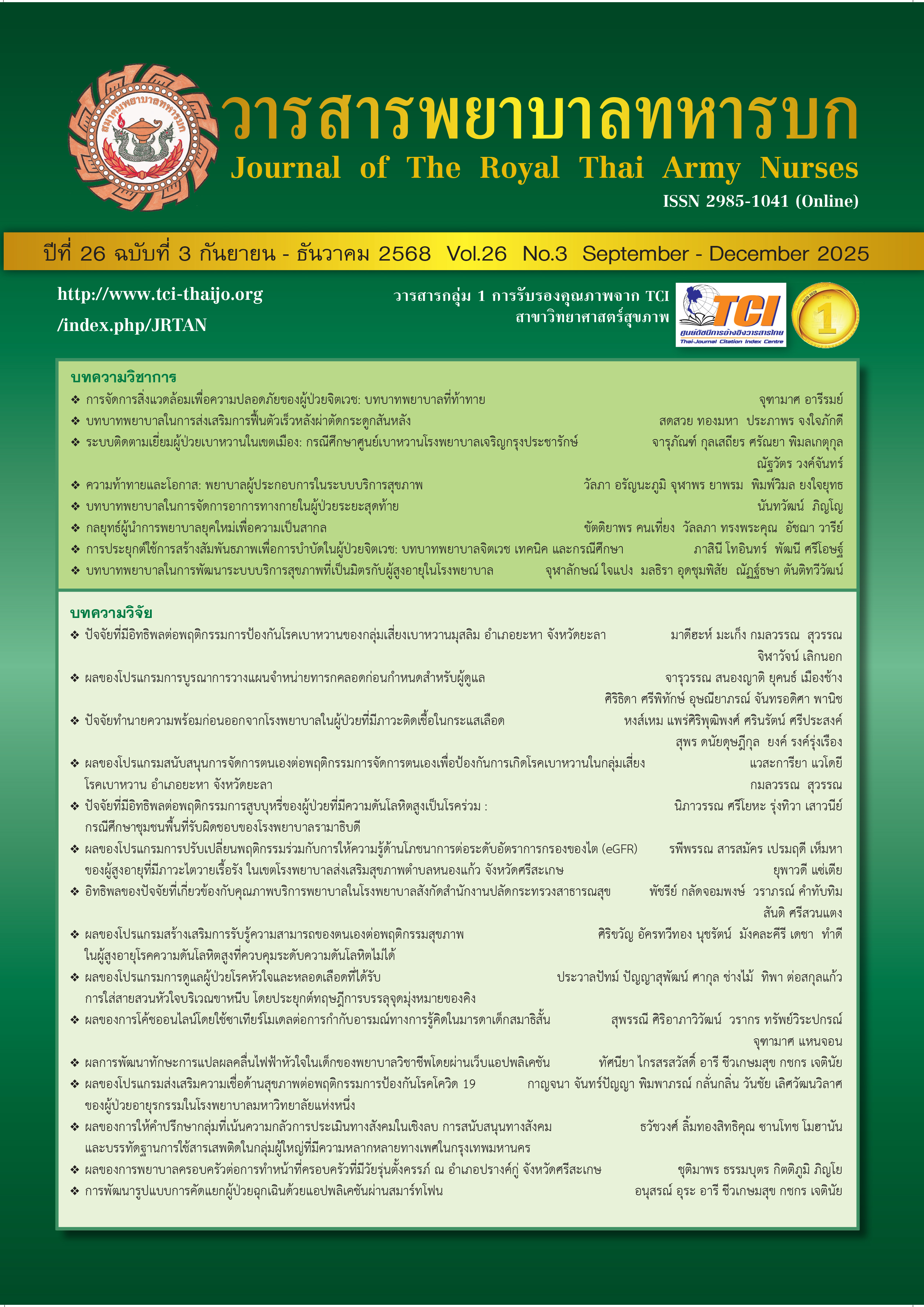
บทบาทพยาบาลในการพัฒนาระบบบริการสุขภาพ ที่เป็นมิตรกับผู้สูงอายุในโรงพยาบาล
คำสำคัญ:
บทบาทพยาบาล, ผู้สูงอายุ, ระบบบริการสุขภาพที่เป็นมิตรกับผู้สูงอายุ, โรงพยาบาลบทคัดย่อ
ประเทศไทยกำลังก้าวเข้าสู่สังคมผู้สูงอายุอย่างสมบูรณ์ ประชากรผู้สูงอายุที่เพิ่มขึ้นมักมีโรคประจำตัวที่ต้องได้รับการดูแลอย่างต่อเนื่องในโรงพยาบาล ระบบบริการแบบเดิมสำหรับผู้สูงอายุเป็นการดูแลที่แยกส่วนตามสาขาความเชี่ยวชาญและอาการ มากกว่าเป็นไปตามเป้าหมายชีวิตและความต้องการเฉพาะของผู้ป่วย ทำให้ประเด็นสำคัญเกี่ยวกับผู้สูงอายุ ได้รับการประเมินและจัดการไม่ครบถ้วนหรือไม่ประสานกันในทุกจุดบริการ ดังนั้นพยาบาลจึงควรมีการพัฒนารูปแบบการดูแลที่ตอบสนองต่อความต้องการเฉพาะของผู้สูงอายุ บทความนี้นำเสนอบทบาทของพยาบาลในการจัดระบบบริการสุขภาพที่เป็นมิตรกับผู้สูงอายุในโรงพยาบาล (4Ms) ซึ่งเน้นการดูแลใน 4 ด้าน คือ 1) การดูแลที่เน้นสิ่งสำคัญ (What Matters) 2) การดูแลเรื่องการใช้ยาอย่างเหมาะสม (Medication) 3) การดูแลสุขภาพจิตและการทำงานของสมอง (Mentation) และ 4) การส่งเสริมความสามารถในการเคลื่อนไหว (Mobility) เพื่อให้สอดคล้องกับปัญหาสุขภาพที่พบได้บ่อยในผู้สูงอายุที่เข้ารับการรักษา
นอกจากนั้นบทความนี้ได้นำเสนอการบูรณาการระบบบริการสุขภาพที่เป็นมิตรกับผู้สูงอายุในโรงพยาบาลกับกระบวนการ พยาบาลใน 5 ขั้นตอน (การประเมิน การวินิจฉัย การวางแผน การปฏิบัติ และการประเมินผล) เพื่อให้พยาบาลสามารถประยุกต์ แนวคิดระบบบริการสุขภาพที่เป็นมิตรกับผู้สูงอายุในโรงพยาบาลไปใช้ในการดูแลผู้สูงอายุได้ครอบคลุม รวมถึงกลยุทธ์สู่ความสำเร็จ สำหรับผู้บริหารทางการพยาบาลในการพัฒนาระบบบริการสุขภาพที่เป็นมิตรกับผู้สูงอายุของโรงพยาบาล เพื่อการพัฒนาและจัดการระบบบริการสุขภาพที่เป็นมิตรกับผู้สูงอายุที่ยั่งยืน อันจะช่วยให้ผู้สูงอายุในสังคมไทยมีสุขภาวะที่ดี
Downloads
เอกสารอ้างอิง
Bureau of Elderly Health, Department of Health. Annual report of the Bureau of Elderly Health for fiscal year 2024. Nonthaburi: Bureau of Elderly Health, Department of Health;2025. (in Thai)
Enhancing Capacity for Burden of Disease Study in Thailand Project, International Health Policy Program Foundation. National and provincial life expectancy and healthy life expectancy of the Thai population, 2019–2022. Bangkok: International Health Policy Program Foundation;2025. (in Thai)
Aekplakorn W, editor. The 6th Thai National Health Examination Survey, 2019-2020. Bangkok: Graphic and Design Publishing;2021. (in Thai)
Bunnag S, Aekplakorn W, Triyamanirat K, & Phansila N. Analysis of health status, burden of disease and health service needs in Thai elderly. Bangkok: Department of Medical Service;2020. (in Thai)
Vatcharavongvan P, Prasert V, Ploylearmsang C, & Puttawanchai V. Prevalence and Factors that Influence Potentially Inappropriate Medication Use among Thai Elderly in Primary Care Settings. Canadian Geriatrics Journal. 2021; 24(4): 332-40.
Kriangkraipetch B. Prevalence of Drug Interactions in Elderly Patients at Ambulatory Care in Chonburi Hospital. Chonburi Hospital Journal. 2022; 47(2): 129-38. (in Thai)
Manjavong M, Limpawattana P, Chindaprasirt J, & Wareechai P. Trends and Mortality Predictors of Delirium Among Hospitalized Older Adults: A National 5-Year Retrospective Study in Thailand. Geriatrics (Basel). 2025; 10(4): 1-11.
World Health Organization. National Programs for Age-Friendly Cities and Communities: A Guide. Geneva: World Health Organization; 2023.
Gleason LJ, & Thompson K. Age-Friendly Health Systems: From metrics to meaningful change. Journal of the American Geriatrics Society. 2024; 72(S3): S79-81.
World Health Organization. Decade of healthy aging: baseline report. Geneva: World Health Organization;2021.
Bureau of Elderly Health, Department of Health. Guidelines for driving the elderly group policy on age-friendly communities/cities for the fiscal year 2021. Nonthaburi: Bureau of Elderly Health, Department of Health;2021. (in Thai)
The John A. Hartford Foundation. Age-friendly health systems initiative. New York: The John A. Hartford Foundation;2025.
Fulmer T, Pelton L, & Zhang J. Age-Friendly Health Systems: A guide to using the 4Ms while caring for older adults. Boston: Institute for Healthcare Improvement;2022.
Institute for Healthcare Improvement. AgeFriendly Health Systems: Guide to Using the 4Ms in the Care of Older Adults. Boston: Institute for Healthcare Improvement;2020.
Harnyoot, O. Nursing process and implications. Journal of The Royal Thai Army Nurses. 2014; 15(3): 137-43. (in Thai)
Mate K, Fulmer T, Pelton L, Berman A, Bonner A, Huang W, et al. Evidence for the 4Ms: Interactions and outcomes across the care continuum. Journal of Aging and Health. 2021; 33(7-8): 469-81.
Emery-Tiburcio EE, Mack L, Zonsius MC, Carbonell E, & Newman M. The 4Ms of an age-friendly health system: an evidence-based framework to ensure older adults receive the highest quality care. Home Healthcare Now. 2022; 40(5): 252-7.
Pettis J. Nurses leading the way to age-friendly care using the 4Ms model. Geriatric Nursing. 2020; 41(2): 195-7.
American Geriatrics Society. American Geriatrics Society 2023 updated AGS Beers Criteria® for potentially inappropriate medication use in older adults. Journal of the American Geriatrics Society. 2023; 71(7): 2052-81.
Pohnert AM, Dolansky MA, & Patterson A. Implementing and leading the Age-Friendly Health Systems 4Ms Framework in nursing practice: A competency-based approach. Nurse Leader. 2025; 23(1): 62-6.
ดาวน์โหลด
เผยแพร่แล้ว
รูปแบบการอ้างอิง
ฉบับ
ประเภทบทความ
สัญญาอนุญาต
ลิขสิทธิ์ (c) 2025 วารสารพยาบาลทหารบก

อนุญาตภายใต้เงื่อนไข Creative Commons Attribution-NonCommercial-NoDerivatives 4.0 International License.
บทความหรือข้อคิดเห็นใดใดที่ปรากฏในวารสารพยาบาลทหารบกเป็นวรรณกรรมของผู้เขียน ซึ่งบรรณาธิการหรือสมาคมพยาบาลทหารบก ไม่จำเป็นต้องเห็นด้วย
บทความที่ได้รับการตีพิมพ์เป็นลิขสิทธิ์ของวารสารพยาบาลทหารบก
The ideas and opinions expressed in the Journal of The Royal Thai Army Nurses are those of the authors and not necessarily those
of the editor or Royal Thai Army Nurses Association.