
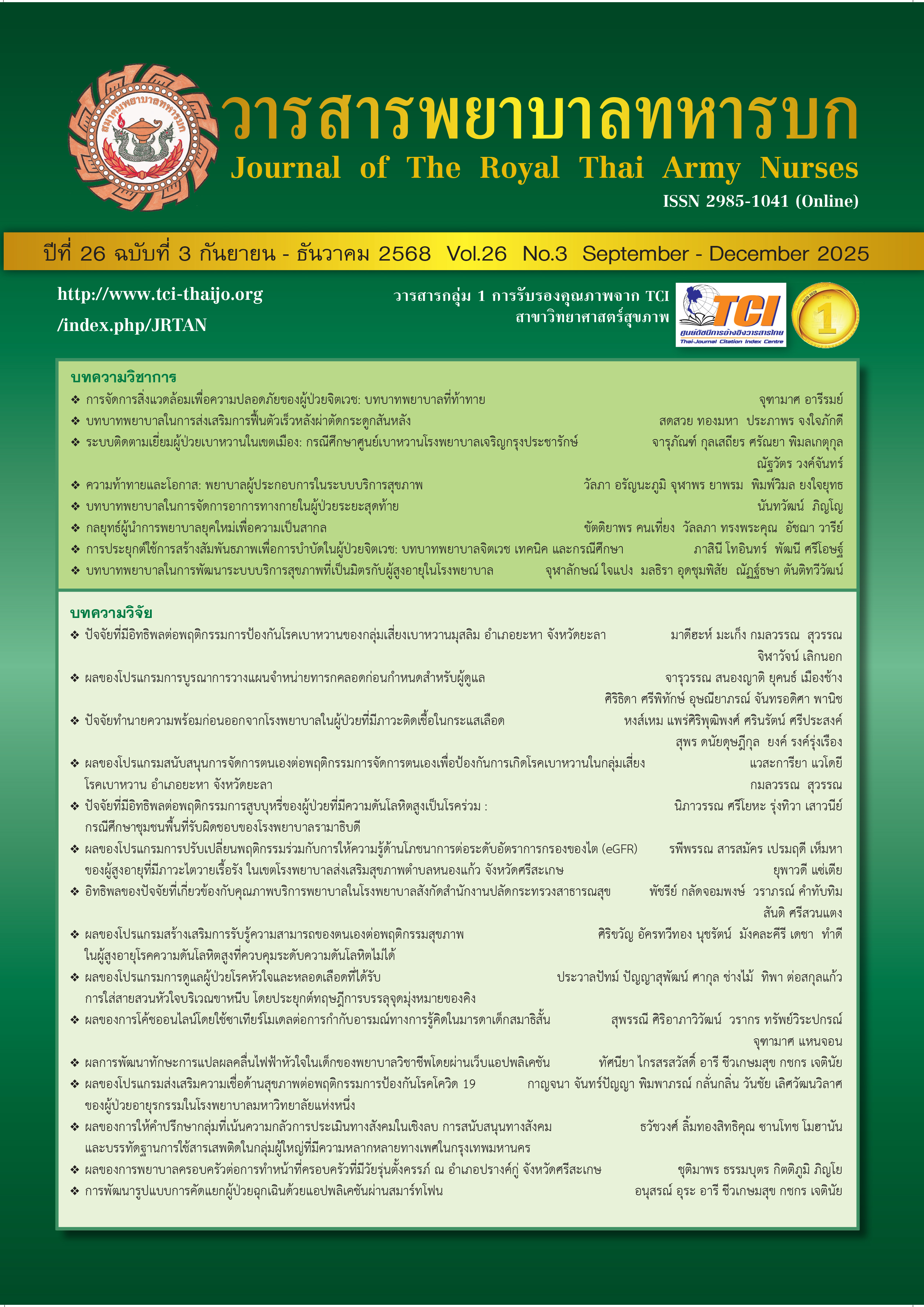
ปัจจัยทำนายความพร้อมก่อนออกจากโรงพยาบาลในผู้ป่วยที่มีภาวะติดเชื้อในกระแสเลือด
คำสำคัญ:
ภาวะติดเชื้อในกระแสเลือด, ความพร้อมก่อนออกจากโรงพยาบาล, คุณภาพการสอนก่อนออกจากโรงพยาบาลบทคัดย่อ
การวิจัยนี้เป็นการศึกษาปัจจัยทำนายของ ความเปราะบาง ความรู้สึกไม่แน่นอนในความเจ็บป่วย การรับรู้ความรุนแรง ของโรค คุณภาพการสอนก่อนออกจากโรงพยาบาล ต่อความพร้อมก่อนออกจากโรงพยาบาลในผู้ป่วยภาวะติดเชื้อในกระแสเลือด กลุ่มตัวอย่างคือผู้ป่วยติดเชื้อในกระแสเลือดที่เข้ารับการรักษาในแผนกผู้ป่วยใน โรงพยาบาลศิริราช จังหวัดกรุงเทพมหานคร จำนวน 107 ราย โดยใช้แบบสอบถามข้อมูลส่วนบุคคล แบบสอบถามการรับรู้ความพร้อมก่อนจำหน่ายออกจากโรงพยาบาลฉบับย่อ แบบสอบถามคุณภาพการสอนก่อนออกจากโรงพยาบาลฉบับย่อ แบบสอบถามการรับรู้ความรุนแรงของโรค แบบสอบถามความรู้สึกไม่แน่นอนในการเจ็บป่วยสำหรับผู้ใหญ่ฉบับย่อ แบบสอบถามภาวะเปราะบางทางสุขภาพ วิเคราะห์ด้วยสถิติเชิงพรรณนา และสถิติถดถอยเชิงพหุคูณ ผลการศึกษาพบว่า กลุ่มตัวอย่างมีความพร้อมก่อนออกจากโรงพยาบาล ร้อยละ 63.3 โดยปัจจัยทั้งหมดสามารถร่วมกันอธิบายความแปรปรวนของความพร้อมก่อนออกจากโรงพยาบาลได้ร้อยละ 8.3 ปัจจัยที่มีอำนาจการทำนายความพร้อมก่อนออกจากโรงพยาบาลได้อย่างมีนัยสำคัญทางสถิติ ได้แก่ คุณภาพการสอนก่อนออกจากโรงพยาบาล (ß = .848, p <.05) และการรับรู้ความรุนแรงของโรค (ß = .080, p <.05) โดยบุคลากรสุขภาพควรมีการสอนก่อนออกจากโรงพยาบาลโดยเฉพาะ หรือพัฒนาโปรแกรมที่ส่งเสริมการสอน ประเมินการรับรู้ความรุนแรงของโรค ในผู้ป่วยที่มีภาวะติดเชื้อในกระแสเลือด เพื่อเตรียมให้ผู้ป่วยเกิดความพร้อมก่อนออกจากโรงพยาบาล
Downloads
เอกสารอ้างอิง
Rudd KE, Johnson SC, Agesa KM, Shackelford KA, Tsoi D, & Kievlan DR. Global, regional, and national sepsis incidence and mortality, 1990–2017: analysis for the Global Burden of Disease Study. Lancet. 2020;395(10219): 200-11.
Ruksuanjik T, Bunnan N, & Soraserd O. Development of the care model for sepsis patients using the fast-track service system, Kae Dam Hospital, Maha Sarakham Province. Journal of Mahasarakham Provincial Public Health Office. 2024;8(16):198-212. (in Thai)
Prescott HC, Langa KM, & Iwashyna TJ. Readmission diagnoses after hospitalization for severe sepsis and other acute medical conditions. Journal of the American Medical Association. 2015;313(10):1055-7.
Slikke JW, Feron F, Hovingh GK, Bekker CL, & Zeegers MP. Post-sepsis syndrome: A systematic review of long-term outcomes in sepsis survivors. Journal of Critical Care. 2020;60:190-5. doi:10.1016/j.jcrc.2020.09.011.
Wilairat A, Thongkhamrod R, & Prasertsri N. The development of sepsis patients caring model at inpatient unit, Pathumratchawongsa Hospital. Journal of The Royal Thai Army Nurses. 2023;24(1):378-87. (in Thai)
Alarslan G, Mennes R, Kieft R, & Heinen M. Patients involvement in the discharge process from hospital to home: A patient’s journey. Journal of advanced nursing. 2024;80(2044):2462-74.
Lilleheie I, Debesay J, Bye A, & Bergland A. Experiences of elderly patients regarding participation in their hospital discharge: A qualitative metasummary. British medical journal. 2019;9:e025789. doi:10.1111/jan.15984.
Klinpudtan N, Tongma S, Klinchet N, & Srithumsuk W. Nurses’ role in home care for older adults with frailty. Journal of The Royal Thai Army Nurses. 2022;23(2):50-7. (in Thai)
Mishel MH. Reconceptualization of the uncertainty in illness theory. journal of nursing scholarship. 1990;22(4):256-62. doi:10.1111/j.1547-5069.1990.tb00225.x.
Chaipadung N, Sriprasong S, Saneha C, & Dumavibhat C. Predicting factors of readiness for hospital discharge in patients with heart failure. Nursing Science Journal of Thailand. 2022;41(1):73-86. (in Thai)
Weiss ME, Sawin KJ, Gralton K, Johnson N, Klingbeil C, & Lerret S. Discharge readiness profiles and transitions from hospital to home. Journal of Hospital Medicine. 2019;14(8):482-9. doi:10.12788/jhm.3205.
Meleis AI, editor. Transitions Theory: Middle-Range and Situation-Specific Theories in Nursing Research and Practice. New York: Springer Publishing Company; 2010.
Ortuño R, García-Mochón L, Ocaña-Riola R, Muñoz-Pérez MA, González-Revilla F, & Redondo-Sendino Á. Frailty assessment in older adults using the Frailty Trait Scale. Revista Española de Geriatría Gerontología. 2010;45(5):245-8.doi:10.1016/j.regg.20107.04.
Mishel MH. Reconceptualization of the uncertainty in illness theory. journal of nursing scholarship. 1990;22(4):256-62. doi:10.1111/j.1547-5069.1990.tb00225.x.
Nau DP, Ellis JJ, Kline-Rogers EM, Mallya U, Eagle KA, & Erickson S. Gender and perceived severity of cardiac disease: evidence that women are tougher. American Journal of Medicine. 2005;118(11):1256-61. doi:10.1016/j.amjmed.2005.08.006.
Weiss M, Piacentine L, Lokken L, Ancona J, Archer J, & Gresser S. Perceived readiness for hospital discharge in adult medical-surgical patients. Clinal Nurse Specialist. 2007;21(1): 31-42. doi:10.1097/00002800-200701000-00008.
Nau DP, Ellis JJ, Kline-Rogers EM, Mallya U, Eagle KA, & Erickson S. Gender and perceived severity of cardiac disease: evidence that women are tougher. American Journal of Medicine. 2005;118(11):1256-61. doi:10.1016/j.amjmed.2005.08.006.
Mishel MH. Reconceptualization of the uncertainty in illness theory. journal of nursing scholarship. 1990;22(4):256-62. doi: 10.1111/j.1547-5069.1990.tb00225.x.
Ortuño R, García-Mochón L, Ocaña-Riola R, Muñoz-Pérez MA, González-Revilla F, & Redondo-Sendino Á. Frailty assessment in older adults using the Frailty Trait Scale. Revista Española de Geriatría Gerontología. 2010;45(5):245-8.doi:10.1016/j.regg.20107.04.
Wayo W, Kadsanit K, Konyai J, Chanhuana S, Phromboot R, & Zahuang V. The effects of health literacy enhancement program on health literacy and prevention behavior of hypertension among community-dwelling older adults. Journal of The Royal Thai Army Nurses. 2023;24(1):43-52. (in Thai)
Kosobucka A, Michalski P, Pietrzykowski L, Kasprzak M, Fabiszak T, Felsmann M, & Kubica A. The impact of readiness to discharge from hospital on adherence to treatment in patients after myocardial infarction. Cardiology Journal. 2022;29(4):582-90. doi:10.5603/CJ.a2020.0005.
Cunha AIL, Veronese N, de Melo Borges S, & Ricci NA. Frailty as a predictor of adverse outcomes in hospitalized older adults: A systematic review and meta-analysis. Ageing research reviews. 2019;56:100960. doi:10.1016/j.arr.2019.100960.
Wang L, Chen Y, & Liu Q. Chronic comorbidities increase the risk of bloodstream infections in elderly patients: A multicenter study. BioMed Central Geriatric. 2021;21(1):89. doi:10.1186/s12877-021-02091-6.
Phumivadhana S. Humanized nursing care for patients receiving invasive mechanical ventilator: From concept to practice. Vajira Nursing Journal. 2020;22(1):70-82. (in Thai)
Pickert L, Meyer AM, Becker I, Hee A, Noetzel N, & Brinkkötter P. Role of a multidimensional prognosis in-hospital monitoring for older patients with prolonged stay. International Journal of Clinical Practice. 2021;75(5):e13989. doi:10.1111/ijcp.13989.
Boucher EL, Gan JM, Rothwell PM, Shepperd S, & Pendlebury ST. Prevalence and outcomes of frailty in unplanned hospital admissions: a systematic review and meta-analysis of hospital-wide and general (internal) medicine cohorts. EClinicalMedicine. 2023;59:101947. doi:10.1016/j.eclinm.2023.101947.
Mattingly TJ II, & Nong K. Implementing a health confidence tool at time of discharge. The Patient. 2019;12(2):163-165. doi:10.1007/s40271-018-0343-3.
ดาวน์โหลด
เผยแพร่แล้ว
รูปแบบการอ้างอิง
ฉบับ
ประเภทบทความ
สัญญาอนุญาต
ลิขสิทธิ์ (c) 2025 วารสารพยาบาลทหารบก

อนุญาตภายใต้เงื่อนไข Creative Commons Attribution-NonCommercial-NoDerivatives 4.0 International License.
บทความหรือข้อคิดเห็นใดใดที่ปรากฏในวารสารพยาบาลทหารบกเป็นวรรณกรรมของผู้เขียน ซึ่งบรรณาธิการหรือสมาคมพยาบาลทหารบก ไม่จำเป็นต้องเห็นด้วย
บทความที่ได้รับการตีพิมพ์เป็นลิขสิทธิ์ของวารสารพยาบาลทหารบก
The ideas and opinions expressed in the Journal of The Royal Thai Army Nurses are those of the authors and not necessarily those
of the editor or Royal Thai Army Nurses Association.