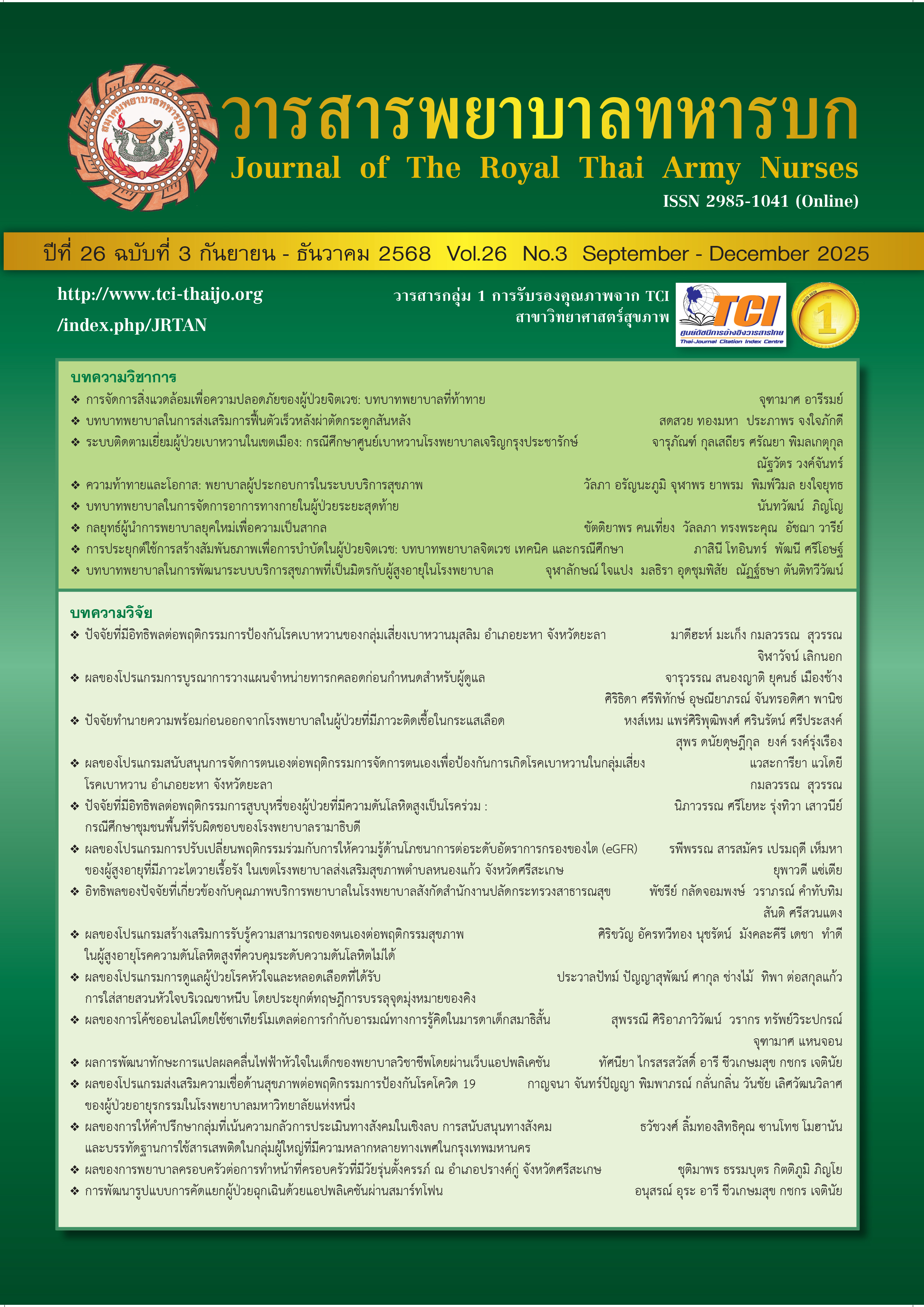
ผลของโปรแกรมส่งเสริมความเชื่อด้านสุขภาพต่อพฤติกรรมการป้องกันโรคโควิด 19 ของผู้ป่วยอายุรกรรมในโรงพยาบาลมหาวิทยาลัยแห่งหนึ่ง
คำสำคัญ:
การติดเชื้อทางเดินหายใจ, โควิด19, โปรแกรมส่งเสริมความเชื่อด้านสุขภาพ, พฤติกรรมการป้องกันโรคบทคัดย่อ
การวิจัยกึ่งทดลองแบบสองกลุ่มวัดก่อนหลังนี้ มีวัตถุประสงค์ เพื่อศึกษาผลของโปรแกรมส่งเสริมความเชื่อด้านสุขภาพต่อพฤติกรรมการป้องกันโรคโควิด 19 ของผู้ป่วยอายุรกรรม จำนวน 52 ราย แบ่งเป็นกลุ่มทดลองและกลุ่มควบคุม กลุ่มละ 26 ราย เก็บรวบรวมข้อมูล โดยใช้แบบสอบถามข้อมูลทั่วไป และแบบสอบพฤติกรรมการป้องกันโรคโควิด 19 วิเคราะห์ข้อมูลโดยใช้สถิติ เชิงพรรณนา สถิติทดสอบวิลคอกซัน และสถิติแมนวิทนีย์ยู
ผลการศึกษาพบว่า กลุ่มทดลองและกลุ่มควบคุมอายุอยู่ในช่วงอายุ 61 ปี เป็นเพศหญิง และเพศชายเท่ากัน มีการศึกษาระดับประถมศึกษามากที่สุด มีโรคประจำตัวคือ โรคระบบหัวใจและหลอดเลือดมากที่สุด และส่วนใหญ่เคยได้รับวัคซีนป้องกันโรคโควิด 19 หลังได้รับโปรแกรมใน 4 สัปดาห์ กลุ่มทดลองมีคะแนนพฤติกรรมการป้องกันโรคโควิด 19 เพิ่มขึ้นจาก 32.00 เป็น 36.00 คะแนน จากคะแนนเต็ม 40 คะแนน (p<.001) กลุ่มควบคุมมีคะแนนไม่แตกต่างกันโดยมีคะแนนมัธยฐานเท่ากัน คือ 32.50 คะแนน และเมื่อเปรียบเทียบคะแนนมัธยฐานของพฤติกรรมระหว่างกลุ่ม พบว่า คะแนนมัธยฐานการปฏิบัติทั้งสองกลุ่ม ไม่แตกต่างกันทางสถิติ ทั้งก่อนและหลังการทดลอง ดังนั้นโปรแกรมที่พัฒนาขึ้นครั้งนี้สามารถนำไปเป็นเครื่องมือในการป้องกันการติดเชื้อระบบทางเดินหายใจในผู้ป่วยกลุ่มอื่น หรือผู้ป่วยโรคอุบัติใหม่-อุบัติซ้ำที่มีวิถีทางการแพร่กระจายเชื้อแบบเดียวกันได้
Downloads
เอกสารอ้างอิง
Hu, B, Guo, H, Zhou, P, & Shi, Z-L. Characteristics of SARS-CoV-2 and COVID-19. Nature, Reviews Microbiology. 2021 19(1):141–54.
Djaharuddin I, Munawwarah S, Nurulita A, Ilyas M, Tabri NA, & Lihawa N. Comorbidities and mortality in COVID-19 patients. Gaceta sanitaria. 2021;35(2):530–32.
Song SH, Chen TL, Deng LP, Zhang YX, Mo PZ, & Gao SC Clinical characteristics of four cancer patients with SARS-CoV-2 infection in Wuhan. Infectious Diseases of Poverty. 2020;9(1):1-8.
Belsky JA, Tullius BP, Lamb MG, Sayegh R, Stanek JR, & Auletta JJ COVID-19 in immunocompromised patients: A systematic review of cancer, hematopoietic cell and solid organ transplant patients. Journal of Infection. 2021;82(3): 329–38.
Mantovani A, Byrne CD, Zheng MH & Targher G “Diabetes As a Risk Factor for Greater COVID-19 Severity and In-hospital Death: A Metaanalysis of Observational Studies.” Nutrition, Metabolism and Cardiovascular Diseases, 2020;30(8): 1236-48,
Leung JM, Niikura M, Yang CWT, & Sin DD. COVID-19 and COPD. The European Respiratory Journal. 2020;56(2):1-9.
Yong SJ. Long COVID or post-COVID-19 syndrome: Putative pathophysiology, risk factors, and treatments. Infectious Disease. 2021;53(10): 737-54.
Gunnell D, Appleby L, Arensman E, Hawton K, John A, Hapor N, et al. Suicide risk and prevention during the COVID-19 pandemic. Lancet Psychiatry. 2020;7(6):468-71.
Sompunga W, & Phuipha T. Stress and Depression in COVID-19 Pandemic among the People Sisaket Province. Journal of The Royal Thai Army Nurses 2023;24(1):172-81. (In Thai)
Matheson NJ & Lehner. “How Does SARS-CoV-2 Cause COVID-19?” Science, 2020;369(6503): 510-11.
Chaemchoi N, Bulsathaporn A, Bunyagidj C. COVID-19: Prevention under Environmental Health Perspective. Journal of Health Science. 2021;30(2):376-88. (In Thai)
Ahn JY, An S, Sohn Y, Cho Y, Hyun JH, Baek YJ, et al. Environmental contamination in the isolation rooms of COVID-19 patients with severe pneumonia requiring mechanical ventilation or high-flow oxygen therapy. The Journal of Hospital Infection, 2020;106(3): 570–76.
Fillmore NR, La J, Szalat RE, Tuck DP, Nguyen V, Yildirim, et al. Prevalence and outcome of COVID-19 infection in cancer patients: A national veterans’ affairs study. Journal of the National Cancer Institute. 2020; 113(6):691–8.
Department of Disease Control, Ministry of Public Health. The Department of Disease Control advises people who are gradually returning after New Year to adhere to the D-M-H-T-T principles to protect themselves from COVID-19; 2021. (In Thai)
Bojola F, Taye W, Samuel H, Mulatu B, Kawza A, & Mekuria et al. Non-communicable diseases (NCDs) and vulnerability to COVID-19: The case of adult patients with hypertension or diabetes mellitus in Gamo, Gofa, and South Omo zones in Southern Ethiopia. PLos One. 2022;17(1):1-19.
Ruengrueharn P, Kedthingma W, & Phakdeekul W. Prevention Behaviors of coronavirus disease 2019 (COVID-19) of Elderly with diabetes mellitus in Sakon Nakhon province. Research and Development Health System Journal. 2022;15(2):254-68. (In Thai)
Mekinrat R, Wattananandkul U. & Thummathai Factors predicting practices in prevention of COVID-19 and impacts among population in Chiang Mai, Thailand. Medicina. 2020;58(4): 1-13. (In Thai)
Ma L, Liu H, Tao Z, Jiang N, Wnag S & Jiang X. Knowledge, beliefs/attitudes, and practices of rural residents in the prevention and control of COVID-19: An online questionnaire survey. American Journal of Tropical Medicine and Hygiene. 2020;103(6):2357–67.
Becker MH, Drachman RH, & Kirscht JP. A new approach to explaining sick-roIe behavior in low-income populations. American Journal of Public Health. 1974;64(3):205-16.
Chusri O, Sanprakhon P, & Wongwisadkul S. The effects of self-protective behavior modification program for older adults with chronic disease in urbanized community, Bangkok. Journal of Health and Nursing Research. 2018;34(3): 77-88. (In Thai)
Saiyasith.P, Mangkarakeree.N, & Tamdee, D. Effects of a Health Belief Enhancing Program on Perception and Coronavirus 2019 Vaccination Receiving Among Elderly Population in Savannakhet Province, LAO PDR. Journal of The Royal Thai Army Nurses 2024; 25(1):248-56. (In Thai)
Burn, N., & Grove, S. K. The practice of nursing research: Appraisal, synthesis, and generation of evidence (6th ed.). Elsevier. 2009
Glomjai T, Kaewjiboon J, & Chachvarat T. Knowledge and Behavior of People regarding Self-care Prevention from Novel Coronavirus 2019 (COVID-19). Journal of Nursing and Health Research. 2020;21(2):29-39. (In Thai)
Greathouse FR, Nagia ST, Rayyan MS, & Bailey BA. Revelations from the clinic: Protective behaviors and perceptions among people at high risk for severe illness from COVID-19. Journal of Primary Care and Community Health. 2021; 12(1):1-6
ดาวน์โหลด
เผยแพร่แล้ว
รูปแบบการอ้างอิง
ฉบับ
ประเภทบทความ
สัญญาอนุญาต
ลิขสิทธิ์ (c) 2025 วารสารพยาบาลทหารบก

อนุญาตภายใต้เงื่อนไข Creative Commons Attribution-NonCommercial-NoDerivatives 4.0 International License.
บทความหรือข้อคิดเห็นใดใดที่ปรากฏในวารสารพยาบาลทหารบกเป็นวรรณกรรมของผู้เขียน ซึ่งบรรณาธิการหรือสมาคมพยาบาลทหารบก ไม่จำเป็นต้องเห็นด้วย
บทความที่ได้รับการตีพิมพ์เป็นลิขสิทธิ์ของวารสารพยาบาลทหารบก
The ideas and opinions expressed in the Journal of The Royal Thai Army Nurses are those of the authors and not necessarily those
of the editor or Royal Thai Army Nurses Association.