
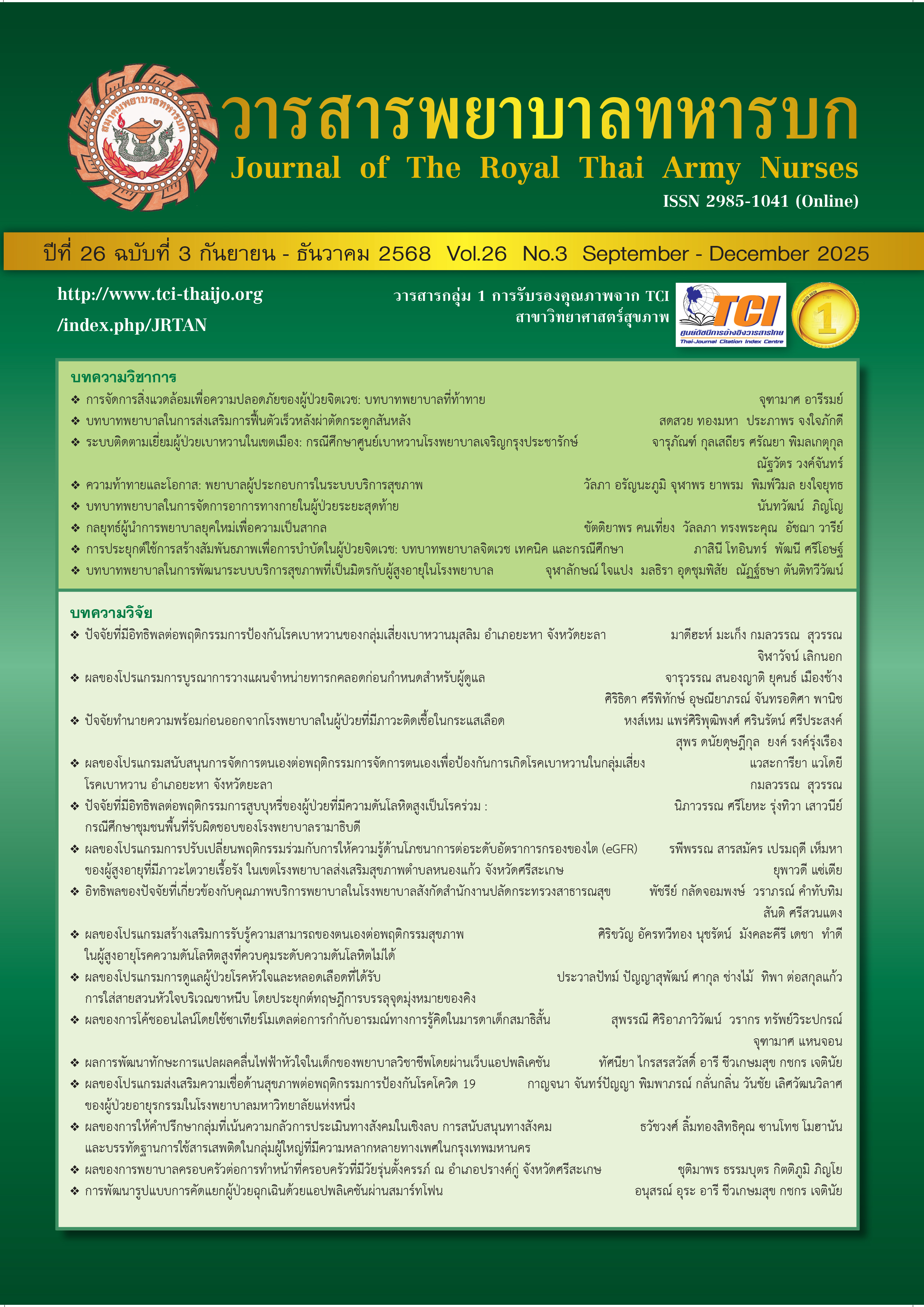
Factors influencing the Diabetes Prevention Behaviors Among Muslim Prediabetes in Yaha District, Yala Province
Keywords:
Factors Influencing, Prevention Behaviors, Muslim PrediabetesAbstract
This predictive descriptive study aimed to identify factors influencing diabetes preventive behaviors among prediabetic Muslims in Yaha District, Yala Province. A total of 383 participants were selected using proportionate stratified random sampling based on the population of individuals at risk of diabetes in each health service unit. The research instruments included a general and health status questionnaire, a health belief questionnaire, and a diabetes preventive behavior questionnaire. The content validity indices of these instruments were .91, .98, and .99, respectively, with a Cronbach’s alpha coefficient of .84. Data were analyzed using descriptive statistics, Pearson’s correlation coefficient, and stepwise multiple regression analysis.
The results revealed that overall health beliefs were positively correlated with diabetes preventive behaviors at a low level (r = .298, p < .001). Perceived susceptibility and perceived benefits were moderately positively correlated with preventive behaviors (r = .326, p < .001), while perceived barriers were negatively correlated at a low level (r = –.221, p < .001). The analysis revealed that perceived susceptibility, perceived benefits, and perceived barriers together significantly predicted 15.6% of the variance in diabetes preventive behaviors (R = .403, Seest = 10.985, p < .01). Therefore, promoting awareness of risk and benefits, along with reducing perceived barriers, can help enhance diabetes preventive behaviors and serve as a guideline for developing culturally appropriate health promotion strategies suitable for the target communities.
Downloads
References
World Health Organization. Diabetes 2024. Geneva, fiscal year 2025. World Health Organization; 2025.
Diabetes Association of Thailand. Clinical Practice Guideline for Diabetes 2023. Bangkok: Srimuang Printing; 2023. (in Thai)
Khan RMM, Chua ZJY, Tan JC, Yang Y, Liao Z, & Zhao Y. From pre-diabetes to diabetes: diagnosis, treatments and translational research. Medicina. 2019;55(9):1-30.
International Diabetes Federation. IDF Diabetes Atlas: 11th ed. Brussels, fiscal year 2025. International Diabetes Federation; 2025.
Ministry of Public Health. Prevalence rate of diabetes 2025 in Thailand, Health Area 12, Yala Province, Yaha District, fiscal year 2025. Health Data Center: HDC; 2025. (in Thai)
Ministry of Public Health. Population aged 35 years and over screened and at risk for diabetes in Thailand, Health Area 12, Yala Province, Yaha District, fiscal year 2025. Health Data Center: HDC; 2025. (in Thai)
Mezil SA, & Abed BA. Complication of diabetes mellitus. Annals of the Romanian Society for Cell Biology. 2021;25(3):1546-56.
National Statistical Office Thailand. The 2021 Health Behavior of Population Survey. Bangkok: Statistical Forecasting Division, National Statistical Office 2021. (in Thai)
Division of Non-Communicable Diseases. Annual report 2024. Bangkok: Aksorn Graphic and Design Publishing; 2024. (in Thai)
Yala Provincial Administration Organization. General Conditions and Basic Information of Yala Province 2025. Yala Province, fiscal year 2025. Yala Provincial Administration Organization; 2025. (in Thai)
Phaitrakoon J, & Chulakarn N. Cultural understanding of health in Thai elderly Muslims. Journal of Naradhiwas Universiy. 2016;8(2):142-52. (in Thai)
Padela AI, & Zaidi D. The Islamic tradition and health inequities: A preliminary conceptual model based on a systematic literature review of Muslim health-care disparities. Avicenna Journal of Medicine. 2018;8(1):1-13.
Phaitrakoon J, Rassameepong S, Jirarattanawanna N, Vattanaamorn S, Boontem P, & Chulakarn N. Assessment of Dietary and Exercise Behavior of aging Muslims in Thailand. Journal of Islamic Studies. 2017;5(1):16-23.
Soynahk C, Kompayak J, & Punthasee P. A study of health belief model and the risk of type 2 diabetes in working Muslim populations. Journal of The Royal Thai Army Nurses. 2018;19(Supplement_1):267-77. (in Thai)
Becker MH. The health belief model and personal health behavior. Health education monographs. 1974;2(4):324-473.
Kaewjongprasit P. A Study of Factors related to Health Behaviors of People with Risk of Diabetes in Uthaithani. Journal of MCU Nakhonthad. 2023;10(10):327-36. (in Thai)
Hutapea D. Perceived Benefits, Perceived Barriers, and Treatment Adherence Among Indonesian Older Adults with Type 2 Diabetes Mellitus [M. Sc. Thesis]. Thailand: Prince of Songkla University. 2016.
Afrasiabi F, Aeen FB, & Jahromi MK. Applying the health belief model in identifying individual understanding towards prevention of type 2 diabetes. International Journal of Public Health. 2022;11(4):1267-72.
Srethamma K. Outcome of the Group Activities and Health Belief Model to Self-care Behaviors with Pre-diabetes in Roi-Et. Journal of Research and Health Innovative Development. 2020;1(3):171-90. (in Thai)
Messina J, Campbell S, Morris R, Eyles E, & Sanders C. A narrative systematic review of factors affecting diabetes prevention in primary care settings. PLoS One. 2017;12(5): 1-20.
Thanathiti T, & Chamroonsawasdi K. The Health Belief Model and Self-Care Behavior Influencing on Health Preventive Behavior in a Senior Club, Bangtoey Sub-District, Samphran District, Nakhon Pathom Province. Humanities, Arts and Social Sciences Studies. 2016;16(1):55-76.
Huang Y, Wang T, Wang H, Zeng Y, & Xie L. Health beliefs mediates the association between the number of non-communicable diseases and preventive behaviors in middle-aged and older adults in southern China. Aging Clinical and Experimental Research. 2025;37(1):37-49.
Thato R. Nursing Research: Concepts to Application (4 th Edition). Bangkok: Chulalongkorn University Press; 2018. (in Thai)
Gray JR, Grove SK, & Sutherland S. Burns and Grove’s the practice of nursing research: Appraisal, synthesis, and generation of evidence. 8thed. St. Louis (MO): Elsevier Health Sciences; 2016.
Downloads
Published
How to Cite
Issue
Section
License
Copyright (c) 2025 Journal of The Royal Thai Army Nurses

This work is licensed under a Creative Commons Attribution-NonCommercial-NoDerivatives 4.0 International License.
บทความหรือข้อคิดเห็นใดใดที่ปรากฏในวารสารพยาบาลทหารบกเป็นวรรณกรรมของผู้เขียน ซึ่งบรรณาธิการหรือสมาคมพยาบาลทหารบก ไม่จำเป็นต้องเห็นด้วย
บทความที่ได้รับการตีพิมพ์เป็นลิขสิทธิ์ของวารสารพยาบาลทหารบก
The ideas and opinions expressed in the Journal of The Royal Thai Army Nurses are those of the authors and not necessarily those
of the editor or Royal Thai Army Nurses Association.