
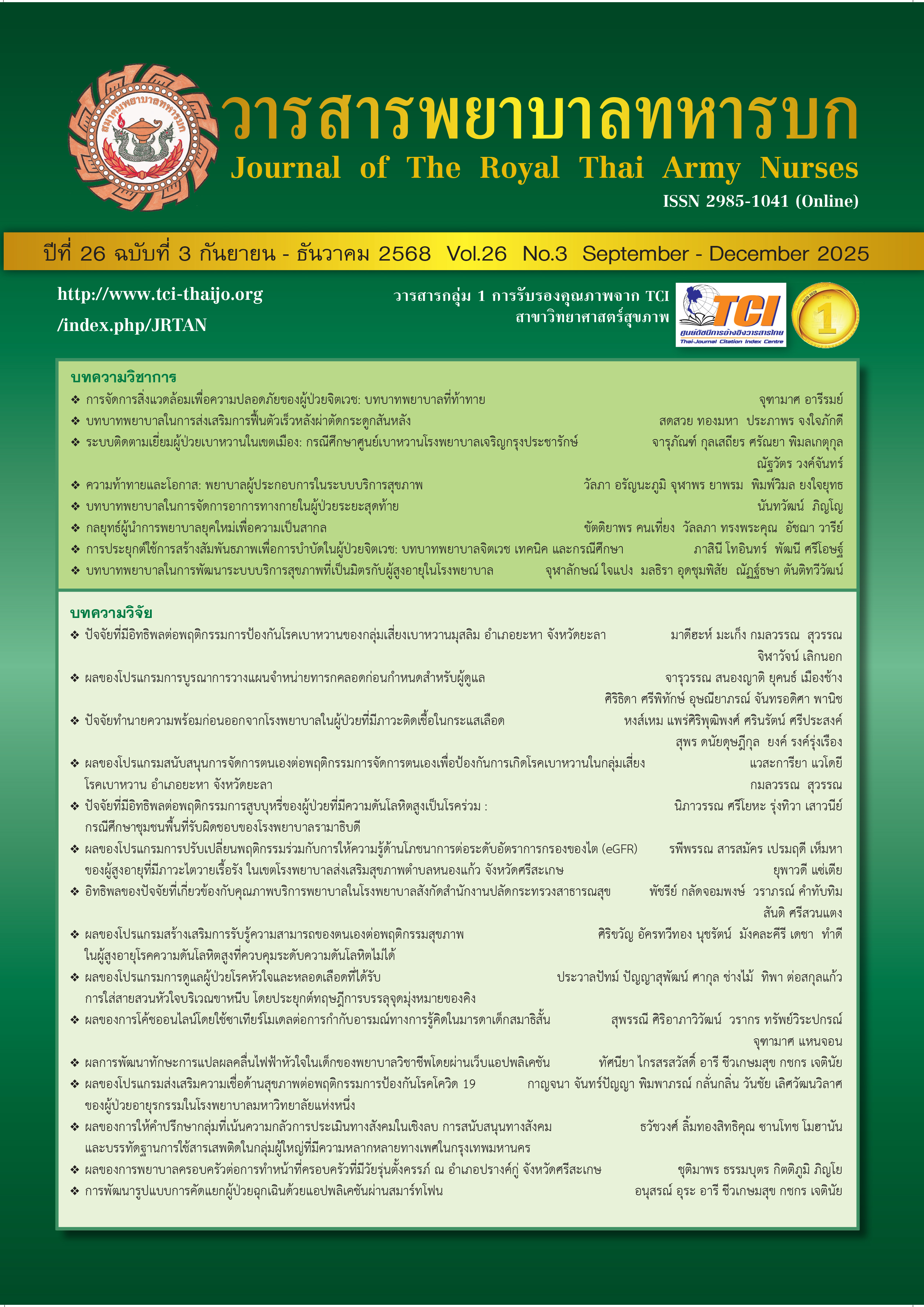
The Effect of Health Behavior and Nutrition Care Process on Estimated Glomerular Filtration Rate (eGFR) in Older Person with Chronic Kidney Disease at Subdistrict Health Promoting Hospital Nong-keaw Sisaket Province
Keywords:
Older Persons, Chronic Disease, Health BehaviorAbstract
This quasi-experimental study with a two-group pretest-posttest design aimed to study the effects of health behavior and nutrition care programs on estimated Glomerular Filtration Rate (eGFR) in older adults with chronic kidney disease at Subdistrict Health Promoting Hospital Nong-Keaw, Sisaket Province. The sample consisted of 30 older adults with chronic kidney disease stages 1 to 4. Participants were selected through purposive sampling and divided into two groups of 15 each: an experimental and control. The groups were matched based on gender, age, and education level. The experimental group received the health behavior and nutrition care program for six weeks. Research instruments included health behavior and nutrition care program, demographic questionnaire, Mini-Mental State Examination - Thai version 2002, Barthel’s Index of Activities of Daily Living, Questionnaire on Perception of Food Consumption Behavior with a reliability score of .94, and an assessment form for estimated glomerular filtration rate (eGFR). The data were analyzed using percentage, mean, standard deviation, and t-tests with a significance level at .05. The results showed that tolder adults with chronic kidney failure in the experimental group had significant increase in eGFR after the intervention. Moreover, the eGFR of experimental groups was significantly higher than that of the control group after the intervention.
Downloads
References
Aartsen M, & Jylha M. Onset of loneliness in older adults: Results of a 28-year prospective study. European Journal of Ageing. 2011; 8(1): 31-8.
Bekhet AK, & Zauszniewski JA. Mental health of elders in retirement communities: Is loneliness a key factor. Archives of Psychiatric Nursing. 2012; 26(3): 214-24.
Burns N, & Grove SK. Study guide for the practice of nursing research conduct, critique andutilization. 5th ed. St. Louis: Elsevier Saunders; 2004.
Cobb S. Social support as a moderator of life stress. Psychosomatic Medicine. 1976; 38(5): 300-14.
Graves SB, & Larki, E. Lessons from Erikson. Journal of Intergenerational Relationships. 2006; 4(2): 61-71.
Hacihasanoglu R, Yildirim A, & Karakurt P. Loneliness in elderly individuals, level of dependence in activities of daily living (ADL) and influential factors. Archives of Gerontology and Geriatrics. 2012; 54(1): 61-6. (in Thai)
Hawkley LC, Preacher JT, & Cacioppo JT. Loneliness impairs daytime functioning but not sleep duration. Health Psychology. 2010; 29(2): 124-9.
Hicks TJ. What is your life like now? Loneliness and elderly individuals residing in nursing homes. Journal of Gerontological Nursing. 2000; 26(8): 15-9.
Newall NEG, Chipperfield JG, & Bailis DS. Predicting stability and change in loneliness in later life. Journal of Social and Personal Relationships. 2013; 31(3): 1-17.
Promjun T. Depress loneliness and self-esteem of the elderly in Bangkae home and private homes for the aged in Bangkok. (thesis). Bangkok : Chulalongkorn University; 2013. (in Thai)
Russell D. UCLA loneliness scale (version 3): Reliability, validity, and factor structure. Journal of Personality Assessment. 1996; 66(1): 20-40.
Sihasidhi S. Relationships between body mass index daily – living practice health care access social support and health status and blood sugar level in type 2 diabetes patients. (thesis). Bangkok: Chulalongkorn University;
(in Thai)
Pérez-Torres A, González García ME, OssorioGonzález M, Álvarez García L, Bajo MA, Del Peso G, et al. The effect of nutritional interventions on long-term patient survival in advanced chronic kidney disease. Nutrients. 2021; 13(2): 121-5.
Paes-Barreto JG, Silva MI, Qureshi AR, Bregman R, Cervante VF, Carrero, et al. Can renal nutrition education improve adherence to a low-protein diet in patients with stages 3 to 5 chronic kidney disease? Journal of Renal Nutrition. 2013; 23(3): 164-71.
Rolf K, & Januszko O. Risk factors for a higher dietary acid load (potential renal acid load) in free-living elderly in Poland. Nutrients. 2024; 16(19): 1-14.
Rusli C, Bukhari A, N AT, As’ad S, & Rasyid H. Nutrition therapy in critically ill overweight elderly patient with heart failure, myocardial infarction, pneumonia, and chronic kidney disease. Journal of Nutritional Science and Vitaminology. 2020; 66(Supplement): S25-31.
Doi T, Noto T, Mita T, Nagahara D, Yuda S, Hashimoto A, et al. Prognostic value of nutritional parameters in systolic heart failure with renal dysfunction. PLoS One. 2022; 17(5): 1-13.
Varitsakul R. Dietary management for slow progression in patients with diabetic kidney disease. Journal of The Royal Thai Army Nurses. 2014;15(1):22-8. (in Thai)
Morante JJH, Sánchez-Villazala A, Cutillas RC, & Fuentes MC. Effectiveness of a nutrition education program for the prevention and treatment of malnutrition in end-stage renal disease. Journal of Renal Nutrition. 2014; 24(1): 22-9.
Dehghan T, Mohsenpour MA, Karimi M, Mehrabi M, Zare M, Akbarzadeh M, et al. Educational intervention based on the extended parallel process model improves adherence to diabetic diet and glycaemic control indices: A randomised, double-blind, controlled, factorial field trial. British Journal of Nutrition. 2024; 131(12): 2068-79.
Crespo-Escobar P, Vázquez-Polo M, van der Hofstadt M, Nuñez C, Montoro-Huguet MA, Churruca I, et al. Knowledge gaps in glutenfree diet awareness among patients and healthcare professionals: A call for enhanced nutritional education. Nutrients. 2024; 16(15): 1-17.
Downloads
Published
How to Cite
Issue
Section
License
Copyright (c) 2025 Journal of The Royal Thai Army Nurses

This work is licensed under a Creative Commons Attribution-NonCommercial-NoDerivatives 4.0 International License.
บทความหรือข้อคิดเห็นใดใดที่ปรากฏในวารสารพยาบาลทหารบกเป็นวรรณกรรมของผู้เขียน ซึ่งบรรณาธิการหรือสมาคมพยาบาลทหารบก ไม่จำเป็นต้องเห็นด้วย
บทความที่ได้รับการตีพิมพ์เป็นลิขสิทธิ์ของวารสารพยาบาลทหารบก
The ideas and opinions expressed in the Journal of The Royal Thai Army Nurses are those of the authors and not necessarily those
of the editor or Royal Thai Army Nurses Association.