
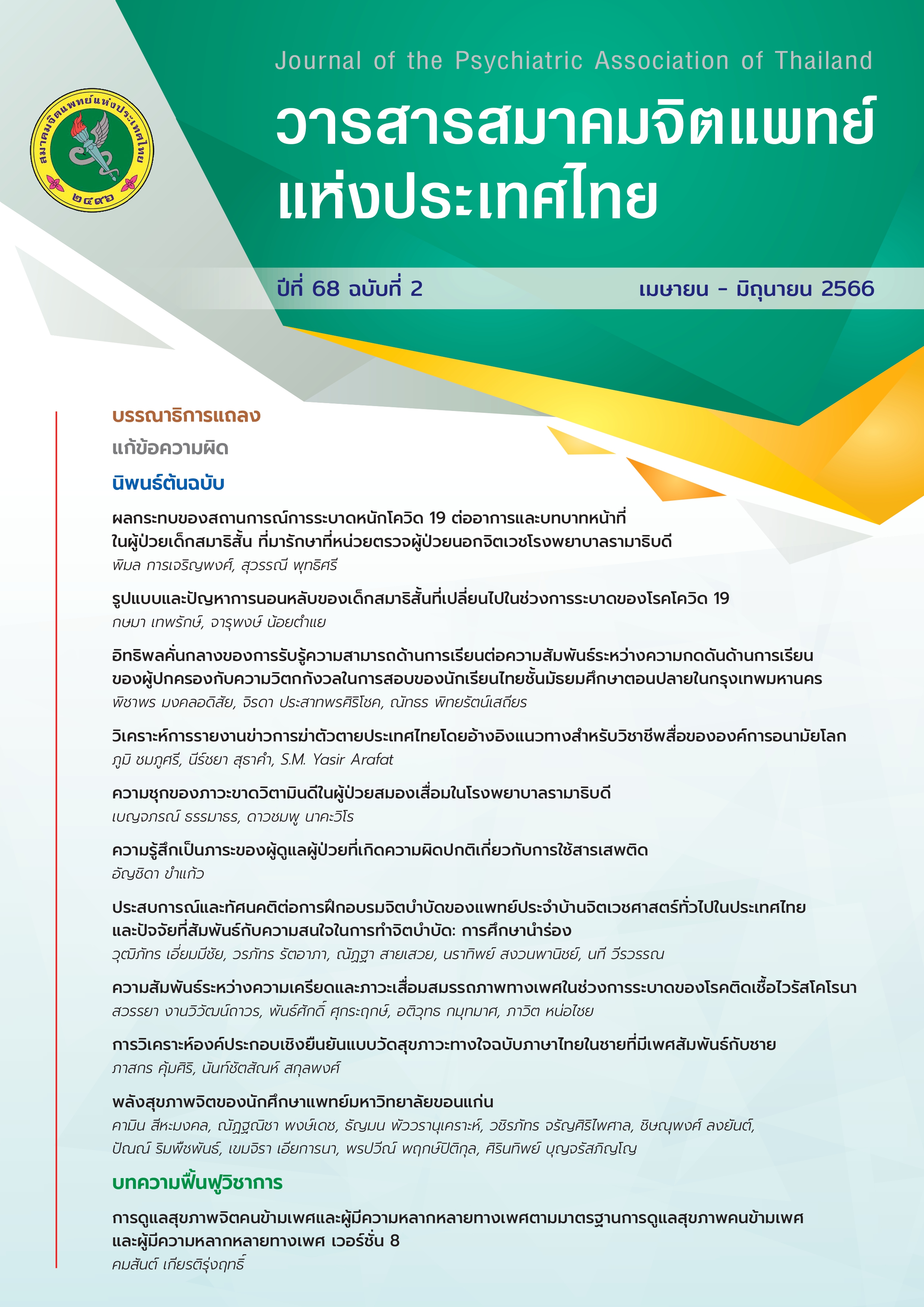
ความรู้สึกเป็นภาระของผู้ดูแลผู้ป่วยที่เกิดความผิดปกติเกี่ยวกับการใช้สารเสพติด
Article Sidebar
Main Article Content
บทคัดย่อ
วัตถุประสงค์ เพื่อศึกษาความรู้สึกเป็นภาระของผู้ดูแลและศึกษาปัจจัยที่มีความสัมพันธ์กับความรู้สึกเป็นภาระของผู้ดูแลผู้ป่วยที่เกิดความผิดปกติเกี่ยวกับการใช้สารเสพติดที่แผนกจิตเวช โรงพยาบาลสมเด็จพระเจ้าตากสินมหาราช
วิธีการศึกษา เป็นการศึกษาเชิงพรรณนาสำรวจแบบภาคตัดขวาง กลุ่มตัวอย่างคือผู้ดูแลของผู้ป่วยที่เกิดความผิดปกติเกี่ยวกับการใช้สารเสพติดที่ได้รับการวินิจฉัยโดยจิตแพทย์จำนวน 64 คน โดยผู้ดูแลและผู้ป่วยต้องมีอายุมากกว่า 18 ปี ผู้ดูแลต้องทำหน้าที่มากกว่า 6 เดือน ส่วนผู้ป่วยต้องได้รับการรักษาเป็นผู้ป่วยนอกหรือผู้ป่วยในของแผนกจิตเวช โรงพยาบาลสมเด็จพระเจ้าตากสินมหาราชในช่วงพฤษภาคม - ตุลาคม 2565 เครื่องมือวิจัยประกอบด้วย ข้อมูลทั่วไปของผู้ดูแลและผู้ป่วย แบบวัดภาระในการดูแลของผู้ดูแล Zarit Burden Interview (ฉบับภาษาไทย) และแบบประเมินระดับความรุนแรงของโรคความผิดปกติเกี่ยวกับการใช้สารเสพติด (SUDST)
ผลการศึกษา กลุ่มตัวอย่างทั้งหมด 64 คน พบว่าผู้ดูแลไม่รู้สึกเป็นภาระถึงเป็นภาระน้อยจำนวน 50 คน (ร้อยละ78.1) และรู้สึกเป็นภาระปานกลางถึงเป็นภาระมากจำนวน 14 คน (ร้อยละ21.9) ผู้ดูแลส่วนใหญ่เป็นเพศหญิง อายุเฉลี่ย 47.65 ปี สถานภาพสมรส เป็นบิดา-มารดา มีงานทำและมีประสบการณ์ที่ไม่ดีในการดูแลผู้ป่วย (ร้อยละ 35.9) ได้แก่ ถูกพูดจาหยาบคายหรือข่มขู่ร้อยละ 21.9 ถูกทำร้ายร่างกายร้อยละ 9.4 และไม่ร่วมมือในการดูแลร้อยละ 28.1 ส่วนผู้ป่วยส่วนใหญ่เป็นเพศชาย อายุเฉลี่ย 33.62 ปี มีความรุนแรงการติดสารเสพติดระดับสูง(ร้อยละ 59.4) และเคยเข้ารับการรักษาเป็นผู้ป่วยใน (ร้อยละ 48.4) จากการวิเคราะห์ปัจจัยที่สัมพันธ์กับความรู้สึกเป็นภาระปานกลางถึงเป็นภาระมากด้วย logistic regression ได้แก่ การเคยถูกผู้ป่วยทำร้ายร่างกาย(adjusted OR 32.549, 95%, CI 2.709-391.041, p=0.006) และประวัติที่ผู้ป่วยเคยรับการรักษาเป็นผู้ป่วยใน (adjusted OR 6.417, 95%CI 1.228-33.525, p=0.028)
สรุป การศึกษานี้พบว่ากลุ่มตัวอย่างส่วนใหญ่ไม่รู้สึกเป็นภาระถึงเป็นภาระน้อยในการดูแลและปัจจัยที่สัมพันธ์กับความรู้สึกเป็นภาระในการดูแลระดับปานกลางถึงมาก คือ การเคยถูกผู้ป่วยทำร้ายร่างกายและประวัติที่ผู้ป่วยเคยรับการรักษาเป็นผู้ป่วยใน ความรู้สึกเป็นภาระในการดูแลอาจก่อให้เกิดปัญหาทางสุขภาพของผู้ดูแลได้ ดังนั้นแพทย์ควรตระหนักและประเมินภาวะดังกล่าวเพื่อลดอัตราการเกิดการเจ็บป่วยหรือความรุนแรงของโรคลง โดยอ้างอิงจากการศึกษานี้หากผู้ดูแลมีประวัติเคยถูกทำร้ายหรือผู้ป่วยเคยรับการรักษาแบบผู้ป่วยใน ควรได้รับการเฝ้าระวังและคัดกรองปัญหาทางด้านสุขภาพกายและจิตเพื่อลดการเจ็บป่วยที่จะตามมาและมีการดูแลที่ถูกต้อง
Article Details

อนุญาตภายใต้เงื่อนไข Creative Commons Attribution-NonCommercial-NoDerivatives 4.0 International License.
บทความที่ส่งมาเพื่อพิจารณา ต้องไม่เคยตีพิมพ์หรือได้รับการตอบรับให้ตีพิมพ์ในวารสารฉบับอื่น และต้องไม่อยู่ระหว่างการส่งไปพิจารณาในวารสารอื่น
เอกสารอ้างอิง
Thiraphon Singlor. ‘More people are using drugs, and there are more drugs, and more types of drugs, than ever ’ [Internet]. Bangkok: Centre for SDG Research and Support: SDG Move; 2022 [cited 2023 Mar 16]. Available from: https://www.sdgmove.com/2022/06/24/report-unodc-drug-east-southeast-asia-2022/
American Psychiatric Association. Substance-related and addictive disorders. In: American Psychiatric Association, editor. Diagnostic and Statistical Manual of Mental Disorders. 5th ed. Arlington(VA): American Psychiatric Association Publishing; 2013. p. 481-589.
United Nations Office on Drugs and Crime (UNODC). World drug report 2020. Place unknown: United Nations publication; 2020.
Bethesda (MD). Common comorbidities with substance use disorders research report [Internet]. place unknown: National Institutes on Drug Abuse (US); 2018 [cited 2023 Mar 20]. Available from: https://www.ncbi.nlm.nih.gov/books/NBK571451/
Mueser KT, Gottlieb JD, Cather C, Glynn SM, Zarate R, Smith MF, et al. Antisocial personality disorder in people with co-occurring severe mental illness and substance use disorders: clinical, functional, and family relationship correlates. Psychosis 2012;4(1):52–62.
Armstrong TD, Costello EJ. Community studies on adolescent substance use, abuse, or dependence and psychiatric comorbidity. J Consult Clin Psychol 2002;70(6): 1224–39.
Ross S, Peselow E. Co-occurring psychotic and addictive disorders. Clin Neuropharmacol 2012; 35(5): 235–43.
Hannah Ritchie and Max Roser. Drug use [Internet]. Place unknown: Our World in Data; 2019 [cited 2022 Mar 16]. Available from: https://ourworldindata.org/drug-use
Ayakdas Dagli D, Baysan Arabaci L, Tas Soylu G, Buyukbayram Arslan A. Relationship between caregivers’ care burden and their social functioning perceptions toward addicted patients: a cross-sectional survey. Florence Nightingale J Nurs 2021;29(3):353–60.
Vadher S, Desai R, Panchal B, Vala A, Ratnani IJ, Rupani MP, et al. Burden of care in caregivers of patients with alcohol use disorder and schizophrenia and its association with anxiety, depression and quality of life. Gen Psychiatr 2020;33(4); e100215.
Vaishnavi R, Karthik MS, Balakrishnan R, Sathianathan R. Caregiver burden in alcohol dependence syndrome. J Addict 2017;2017:1–6.
Swaroopachary R, Kalasapati L, Ivaturi S, Reddy C. Caregiver burden in alcohol dependence syndrome in relation to the severity of dependence. Arch Ment Health 2018;19(1):19–23.
Kaur A, Mahajan S, Deepti SS, Singh T. Assessment of role of burden in caregivers of substance abusers: a study done at Swami Vivekananda Drug De-addiction Centre, Govt. Medical College, Amritsar. Int J Community Med Public Health 2018;5(6):2380-2383.
Ólafsdóttir J, Hrafnsdóttir S, Orjasniemi T. Depression, anxiety, and stress from substance-use disorder among family members in Iceland. Nordisk Alkohol Nark 2018;35(3):165–78.
Daley DC. Family and social aspects of substance use disorders and treatment. J Food Drug Anal 2013;21(4): S73–6.
Lander L, Howsare J, Byrne M. The impact of substance use disorders on families and children: from theory to practice. Soc Work Public Health 2013; 28(3–4):194–205.
Mauri MC, Cirnigliaro G, Piccoli E, Vismara M, de Carlo V, Girone N, et al. Substance abuse associated with aggressive/violent behaviors in psychiatric outpatients and related psychotropic prescription. Int J Ment Health Addict [Internet]. 2022[cited 2023 Mar 20]; Available from: https://doi.org/10.1007/s11469-022-00842-w
Noghani F, Seyedfatemi N, Karimirad MR, Akbarzadeh A, Hasanpour-Dehkordi A. Health related quality of life in family caregivers of patients suffering from mental disorders. J Clin Diagn Res 2016;10(11): VC05–9.
Sharma A, Sharma A, Gupta S, Thapar S. Study of family burden in substance dependence: a tertiary care hospital-based study. Indian J Psychiatry 2019;61(2):131–8.
Kittirattanapaiboon P, Tantirangsee N, Chutha W, Tanaree A, Kwansanit P, Assanangkornchai S. Prevalence of mental disorders and mental health problems: Thai national mental health survey 2013. J Ment Health Thai 2017;25(1):1-19.
พระราชบัญญัติให้ใช้ประมวลกฎหมายยาเสพติด พ.ศ.2564.[สืบค้นเมื่อ 28 มีนาคม 2566]. ราชกิจจานุเบกษา เล่ม 138 ตอนที่ 73ก (ลงวันที่ 8พฤศจิกายน พ.ศ.2564). สืบค้นจาก: https://ratchakitcha.soc.go.th/documents/17186429.pdf
Whitlatch CJ, Zarit SH, von Eye A. Efficacy of interventions with caregivers: a reanalysis. Gerontologist 1991; 31(1):9–14.
Zarit SH, Zarit JM. Instructions for the burden interview. Technical Document, University Park (PA): Pennsylvania State University; 1987.
Zarit SH, Zarit JM. The memory and behavior problems checklist and the burden interview. University Park (PA): The Pennsylvania State University, Gerontology Center; 1990.
Orawan Silpakit, Chatchawan Silpakit, Rossukon Chomchuen. Psychometric study of the Thai version of Zarit Burden Interview in psychiatric caregivers. J Ment Health Thai 2015; 23(1):12-23.
Pinyopornpanish K, Pinyopornpanish M, Wongpakaran N, Wongpakaran T, Soontornpun A, Kuntawong P. Investigating psychometric properties of the Thai Version of the Zarit Burden Interview using Rasch model and confirmatory factor analysis. BMC Res Notes. 2020;13(1):120.
Saengduenchai S, Nilaban S, Singhtho T, Ranuwattananon A. The Development of Substance Use Disorder Screening Test (SUDST) according to the Fifth Edition of Diagnostic and Statistical Manual of Mental Disorders[Internet]. Nonthaburi(TH): The Graphico systems; 2020 [cited 2022 Apr 14]. Available from: http://www.pmnidat.go.th/thai/downloads/research/64/63-1.pdf
Afridi F, Dinkelman T, Mahajan K. Why Are Fewer Married Women Joining the Work Force in India? A Decomposition Analysis over Two Decades. J Popul Econ 2018;31:783-818.
Income - Expenditure Statistics Group SSDNSO. THE 2021 HOUSEHOLD SOCIO-ECONOMIC SURVEY WHOLE KINGDOM[Internet]. Bangkok: Text and Journal Publication; 2022[cited 2022 Dec 22]. Available from: http://www.nso.go.th/sites/2014en/Pages/survey/Social/Household/The-2017-Household-Socio-Economic-Survey.aspx
Gruber KJ, Taylor MF. A Family Perspective for Substance Abuse: Implications from the Literature. J Soc Work Pract Addict 2006;6(1-2):1–29.
