
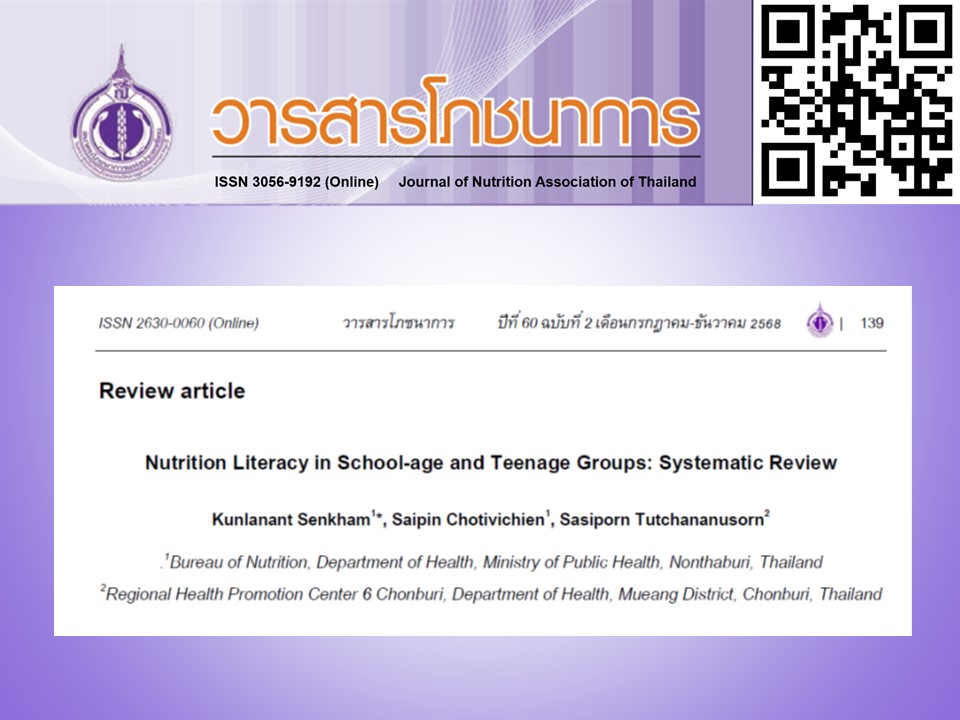
ความรอบรู้ด้านโภชนาการในเด็กวัยเรียนและวัยรุ่น: การทบทวนวรรณกรรมอย่างเป็นระบบ
คำสำคัญ:
ความรอบรู้ด้านโภชนาการ, เด็กวัยเรียนและวัยรุ่น, การทบทวนวรรณกรรมอย่างเป็นระบบบทคัดย่อ
การวิจัยนี้มีวัตถุประสงค์เพื่อรวบรวมและสังเคราะห์หลักฐานเชิงประจักษ์เกี่ยวกับระดับ แนวทาง ผลลัพธ์ และปัจจัยที่เกี่ยวข้องกับการสร้างเสริมความรอบรู้ด้านโภชนาการ (Nutrition Literacy: NL) ในเด็กวัยเรียนและวัยรุ่น โดยดำเนินการทบทวนวรรณกรรมอย่างเป็นระบบตามแนวทาง PRISMA 2020 และประเมินคุณภาพงานวิจัยด้วยเกณฑ์ของ Joanna Briggs Institute (JBI) จากการสืบค้นฐานข้อมูล PubMed, ScienceDirect, Springer Nature Link และศูนย์ดัชนีการอ้างอิงวารสารไทย (TCI) กลุ่ม 1–2 ครอบคลุมช่วงปี พ.ศ. 2563–2567 พบงานวิจัยที่เกี่ยวข้องทั้งหมด 306 เรื่อง และมีงานวิจัยที่ผ่านเกณฑ์คุณภาพเพื่อนำมาวิเคราะห์และสังเคราะห์ข้อมูลจำนวน 31 เรื่อง ผลการศึกษาพบว่างานวิจัยส่วนใหญ่มาจากประเทศในภูมิภาคเอเชีย และมีการศึกษาเชิงภาคตัดขวางเป็นหลัก ขณะที่การศึกษาเชิงทดลองและการพัฒนาโปรแกรมยังมีจำนวนจำกัด เด็กวัยเรียนและวัยรุ่นส่วนใหญ่มีความรอบรู้ด้านโภชนาการอยู่ในระดับต่ำถึงปานกลาง โดยมิติด้านความรู้มีคะแนนสูงกว่ามิติด้านทักษะอย่างสม่ำเสมอ โดยเฉพาะความรอบรู้เชิงหน้าที่และความรอบรู้เชิงวิพากษ์ เช่น การอ่านฉลากอาหาร การประเมินความน่าเชื่อถือของข้อมูล และการนำข้อมูลไปใช้ในการตัดสินใจด้านอาหาร ความรอบรู้ด้านโภชนาการที่สูงขึ้นมีความสัมพันธ์เชิงบวกกับคุณภาพอาหาร ความหลากหลายของอาหาร การยึดมั่นในรูปแบบอาหารที่ดีต่อสุขภาพ และพฤติกรรมสุขภาพบางประการ เช่น การมีกิจกรรมทางกายและการนอนหลับที่เพียงพอ ขณะที่ความสัมพันธ์กับดัชนีมวลกายยังพบไม่สม่ำเสมอ ปัจจัยส่งเสริมที่สำคัญ ได้แก่ ระดับการศึกษาของบิดามารดา โดยเฉพาะมารดา สภาพแวดล้อมอาหารในครัวเรือนและโรงเรียนที่เอื้อต่อสุขภาพ การจัดการเรียนรู้แบบลงมือปฏิบัติ และการสนับสนุนทางสังคม ในทางตรงกันข้าม ปัจจัยอุปสรรคที่พบอย่างสม่ำเสมอ ได้แก่ ความไม่มั่นคงทางอาหาร ความเหลื่อมล้ำทางสังคมและเศรษฐกิจ การเข้าถึงข้อมูลโภชนาการที่ถูกต้องและเข้าใจง่ายอย่างจำกัด อิทธิพลของสื่อและการตลาดอาหารที่ไม่ดีต่อสุขภาพ รวมถึงหลักสูตรการเรียนการสอนที่เน้นความรู้เชิงทฤษฎีมากกว่าการพัฒนาทักษะเชิงปฏิบัติ ผลการสังเคราะห์ชี้ให้เห็นว่าการส่งเสริมความรอบรู้ด้านโภชนาการในเด็กวัยเรียนและวัยรุ่นควรมุ่งเน้นการพัฒนาทักษะควบคู่กับความรู้ ผ่านการบูรณาการความร่วมมือระหว่างครอบครัว โรงเรียน และนโยบายสภาพแวดล้อมอาหาร เพื่อสนับสนุนพฤติกรรมการบริโภคที่เหมาะสม ลดความเสี่ยงของโรคไม่ติดต่อเรื้อรัง และเสริมสร้างสุขภาวะอย่างยั่งยืนในระยะยาว
เอกสารอ้างอิง
Wrottesley SV, Venter F, Vorster HH, Smuts CM, Mchiza ZJ, et al. Nutritional status of school-age children and adolescents in low- and middle-income countries across seven global regions: a synthesis of scoping reviews. Public Health Nutr. 2023; 26(1):63-95. doi: 10.1017/S1368980022000350.
World Health Organization. Assessing the existing evidence base on school food and nutrition policies: a scoping review. Geneva: World Health Organization; 2021. Licence: CC BY-NC-SA 3.0 IGO. [cited 2025 Jan 20]. Available from: https://iris.who.int/bitstream/handle/10665/341097/9789240025646-eng.pdf?sequence=1&isAllowed=y.
Amoadu M, Abraham SA, Adams AK, Akoto-Buabeng W, Obeng P, Hagan JE Jr. Risk Factors of Malnutrition among In-School Children and Adolescents in Developing Countries: A Scoping Review. Children (Basel). [serial on the Internet]. 2024 [cited 2025 Jan 20]. Available from: https://pmc.ncbi.nlm.nih.gov/articles/PMC11049343/. doi: 10.3390/children11040476.
Gibbs HD, Chapman-Novakofski K. A Review of Health Literacy and Its Relationship to Nutrition Education. Top Clin Nutr. 2012;27(4):325–33. doi:10.1097/TIN.0b013e31826f8dc5.
Urstad KH, Andersen MH, Larsen MH, Hamilton Larsen M, Råheim Borge C, Helseth S, et al. Definitions and measurement of health literacy in health and medicine research: a systematic review. BMJ Open. 2022;12:e056294. doi:10.1136/bmjopen-2021-056294.
Hawkins M, Belson SI, McClave R, Kohls L, Little S, Snelling A. Healthy Schoolhouse 2.0 Health Promotion Intervention to Reduce Childhood Obesity in Washington, DC: A Feasibility Study. Nutrients. 2021;13(9):2935. doi:10.3390/nu13092935.
Bozkurt O, Yildiran H. The Effect of Multi-Strategy Nutrition Education Programs on Hedonic Hunger and Nutrition Status in Adolescents. Children (Basel). 2024;11(10):1188. doi:10.3390/children11101188.
นันทภัทร์ เฉลียวศักดิ์, ศิวานันท์ ฐิติกุลพัฒนาวดี. ความรอบรู้ด้านโภชนาการและการสร้างเสริมสุขภาพวัยรุ่น ด้วยโปรแกรมปรับเปลี่ยนพฤติกรรม 3 Self ตามหลัก PROMISE Model. วารสารวิชาการศิลปศาสตร์ประยุกต์. 2566;16(1):1-15.
วลัยพร กาฬภักดี, ศรีสุรางค์ เคหะนาค, กันธิมา ศรีหมากสุก, ปุรินทร์ ศรีศศลักษณ์. ความรอบรู้ด้านสุขภาพเกี่ยวกับภาวะโภชนาการเกินของนักเรียนระดับประถมศึกษา โรงเรียนในสังกัดเทศบาลเมืองสุพรรณบุรี จังหวัดสุพรรณบุรี. วารสารสาธารณสุขล้านนา. 2565;18(1):80–91.
Cochrane. Cochrane Handbook for Systematic Reviews of Interventions. Chapter IV [monograph on the Internet]. London (UK): Cochrane; [cited 2025 Oct 25]. Available from: https://www.cochrane.org/authors/handbooks-and-manuals/handbook/current/chapter-iv
Page MJ, McKenzie JE, Bossuyt PM, Boutron I, Hoffmann TC, Mulrow CD, et al. PRISMA 2020 explanation and elaboration: updated guidance and exemplars for reporting systematic reviews. BMJ. 2021 Mar;372:n160. doi:10.1136/bmj.n160
Shitie AA, Bitew ZW, Diriba G, Seid G, Eshetu K, Chekol MT, et al. Tuberculosis incidence in patients with chronic kidney disease: a systematic review and meta-analysis. Int J Infect Dis. 2022;122:188–201. doi:10.1016/j.ijid.2022.05.046
จำเนียร จวงตระกูล, อรพินท์ บุญสิน, จารุกัญญา อุดานนท์, ลัดดาวัลย์ สำราญ. การวิเคราะห์ข้อมูลการวิจัยเชิงคุณภาพแบบการวิเคราะห์แก่นสาร: แนวทางปฏิบัติสำหรับนักวิจัยใหม่. วารสารสมาคมรัฐประศาสนศาสตร์แห่งประเทศไทย. 2567;6(2):15-27.
Hayba N, Khalil C, Allman-Farinelli M. Enabling Better Nutrition and Physical Activity for Adolescents from Middle Eastern Backgrounds: Focus Groups. Nutrients. 2021;13(9):3007. doi:10.3390/nu13093007.
Samruayruen K, Kitreerawutiwong N. Exploration of the definition and components of food and nutrition literacy among junior secondary school students: a qualitative study. BMC Nutr. 2022;8(1):27. doi:10.1186/s40795-022-00519-6
Doustmohammadian A, Omidvar N, Keshavarz-Mohammadi N, Eini-Zinab H, Amini M, Abdollahi M, et al. Low food and nutrition literacy (FNLIT): a barrier to dietary diversity and nutrient adequacy in school age children. BMC Res Notes. 2020;13(1):286. doi:10.1186/s13104-020-05123-0.
Khorramrouz F, Doustmohammadian A, Eslami O, Khadem-Rezaiyan M, Pourmohammadi P, Amini M, et al. Relationship between household food insecurity and food and nutrition literacy among children of 9-12 years of age: a cross-sectional study in a city of Iran. BMC Res Notes. 2020;13(1):433. doi:10.1186/s13104-020-05280-2.
Ahmadpour M, Omidvar N, Doustmohammadian A, Rahimiforoushani A, Shakibazadeh E. Children Food and Nutrition Literacy - a New Challenge in Daily Health and Life, the New Solution: Using Intervention Mapping Model Through a Mixed Methods Protocol. J Med Life. 2020;13(2):175-82.
Egg S, Wakolbinger M, Reisser A, Schätzer M, Wild B, Rust P. Relationship between nutrition knowledge, education and other determinants of food intake and lifestyle habits among adolescents from urban and rural secondary schools in Tyrol, Western Austria. Public Health Nutr. 2020;23(17):3136-47. doi:10.1017/S1368980020000488.
Ashoori M, Omidvar N, Eini-Zinab H, Shakibazadeh E, Doustmohamadian A, Abdar-Esfahani B, et al. Food and nutrition literacy status and its correlates in Iranian senior high-school students. BMC Nutr. 2021;7(1):19.
Ayer Ç, Ergin A. Status of nutritional literacy in adolescents in the semi-rural area in Turkey and related factors. Public Health Nutr. 2021;24(12):3870-8. doi:10.1017/S1368980021002366
Karpouzis F, Lindberg R, Walsh A, Shah S, Abbott G, Lai J, et al. Evaluating OzHarvest’s primary-school Food Education and Sustainability Training (FEAST) program in 10–12-year-old children in Australia: protocol for a pragmatic cluster non-randomized controlled trial. BMC Public Health. 2021;21(1):967. doi:10.1186/s12889-021-10302-0
Taleb S, Itani L. Nutrition literacy among adolescents and its association with eating habits and BMI in Tripoli, Lebanon. Diseases. 2021;9(2):25. doi:10.3390/diseases9020025.
Liu T, Su X, Li N, Sun J, Ma G, Zhu W. Development and validation of a food and nutrition literacy questionnaire for Chinese school-age children. PLoS One. 2021;16(1):e0244197. doi:10.1371/journal.pone.0244197.
Doustmohammadian A, Omidvar N, Keshavarz-Mohammadi N, Eini-Zinab H, Amini M, Abdollahi M. The association and mediation role of Food and Nutrition Literacy (FNLIT) with eating behaviors, academic achievement and overweight in 10–12 years old students: a structural equation modeling. Nutr J. 2022;21(1):45. doi:10.1186/s12937-022-00796-8.
Naigaga DA, Pettersen KS, Henjum S, Guttersrud Ø. Relating aspects of adolescents’ critical nutrition literacy at the personal level. Nutrire. 2022;47:1. doi:10.1186/s41110-021-00149-1.
Raffoul A, Gibbons B, Boluk K, Neiterman E, Hammond D, Kirkpatrick SI. “Maybe a little bit of guilt isn’t so bad for the overall health of an individual”: a mixed-methods exploration of young adults’ experiences with calorie labelling. BMC Public Health. 2022;22:938. doi:10.1186/s12889-022-13364-w.
Zeng M, Zhu Y, Cai Z, Xian J, Li S, Wang T, et al. Nutrition Literacy of Middle School Students and Its Influencing Factors: A Cross-Sectional Study in Chongqing, China. Front Public Health. 2022;10:807526. doi:10.3389/fpubh.2022.807526.
Yurtdaş Depboylu G, Kaner G, Süer M, Kanyılmaz M, Alpan D. Nutrition literacy status and its association with adherence to the Mediterranean diet, anthropometric parameters and lifestyle behaviours among early adolescents. Public Health Nutr. 2023;26(10):2108-17. doi:10.1017/S1368980023001830.
Ashoori M, Soltani S, Clark CC, Eini-Zinab H, Shakibazadeh E, Doustmohamadian A, et al. Food and nutrition literacy: a predictor for diet quality and nutrient density among late adolescents. Turk J Pediatr. 2023;65(2):290-300. doi:10.24953/turkjped.2022.607.
Mengi Çelik Ö, Karacil Ermumcu MS, Ozyildirim C. Turkish version of the 'food and nutrition literacy questionnaire for Chinese school-age children' for school-age adolescents: a validity and reliability study. BMC Public Health. 2023;23(1):1807. doi:10.1186/s12889-023-16732-2.
AlBaloul AH, AlKhalidi MM, AlAjmi H. Nutrition literacy profile among adolescents in Kuwait: a cross-sectional study. Front Public Health. 2024;12:1453484. doi:10.3389/fpubh.2024.1453484.
Dallant T, Bozonnet A, Delarocque-Astagneau E, Gautier S, Koné A, Grasteau V, et al. Development and evaluation of a food literacy questionnaire for schoolchildren in France. Appetite. 2024;199:107420. doi:10.1016/j.appet.2024.107420.
Hashemzadeh M, Akhlaghi M, Akbarzadeh M, Nabizadeh K, Heidarian Miri H, Kazemi A. Nutrition literacy and eating habits in children from food-secure versus food-insecure households: a cross-sectional study. Medicine (Baltimore). 2024;103(39):e39812. doi:10.1097/MD.0000000000039812.
Xu Q, Hu Z, Zeng M, Su Y, Jiang K, Li S, et al. Relationships among Sleep Time, Physical Activity Time, Screen Time, and Nutrition Literacy of Adolescents: A Cross-Sectional Study in Chongqing, China. Nutrients. 2024;16(9):1314. doi:10.3390/nu16091314.
Mengi Çelik Ö, Ekici EM, Yılmaz S, Metin ZE. Evaluation of the relationship between nutrition literacy, Mediterranean diet compliance, ecological footprint and sustainable environmental attitudes in adolescents. BMC Public Health. 2025;25(1):130. doi:10.1186/s12889-024-20910-1
Amin SM, Dreidi M, Ghallab E, Mohamed SRM, Alrimawi I. The Status of Food and Nutrition Literacy and its determinants among Elementary School students in Egypt: community nursing-led design. BMC Nurs. 2024;23(1):708. doi:10.1186/s12912-024-02342-9.
Ülker İ, Aydın MA, Yıldız M, Gökçay G, Elkoca A, Yıldırım MS, et al. Relationship between microbiota awareness, nutrition literacy, and health literacy among adolescents. Turk J Med Sci. 2024;54:938-48. doi:10.55730/1300-0144.5871.
Wu X, Yu Y, He H, Yu X, Guo D, Zhu W. Individual and family factors correlated with children's fruit consumption. Front Public Health. 2024;12:1399704. doi:10.3389/fpubh.2024.1399704.
Corazza I, Pennucci F, De Rosis S. Promoting healthy eating habits among youth according to their preferences: Indications from a discrete choice experiment in Tuscany. Health Policy. 2021;125(7):947-55. doi:10.1016/j.healthpol.2021.03.014.
Ahmadpour M, Omidvar N, Shakibazadeh E, Doustmohammadian A, Rahimiforoushani A. Development and evaluation of an intervention to improve food and nutrition literacy among Iranian Kurdish primary school children: An application of intervention mapping approach. Front Public Health. 2023;10:1059677. doi:10.3389/fpubh.2022.1059677.
Singtong T, Ivanovitch K, Boonshuyar C. Effects of a Nutrition Literacy Promotion Program on Eating Behavior of Secondary School Students. Thai J Public Health. 2020;50(2):148-60.
วรวุฒิ แสงทอง, สุชาดา นิ่มวัฒนากุล, วรันณ์ธร โพธารินทร์, ศุภรดา มั่นยืน, อลิษา ขุนแก้ว. ผลของโปรแกรมการส่งเสริมความรอบรู้ด้านโภชนาการต่อความรอบรู้ด้านโภชนาการและพฤติกรรมการบริโภคอาหารของสามเณร จังหวัดสุรินทร์. วารสารมหาวิทยาลัยนราธิวาสราชนครินทร์. 2566;15(3):100–117.
Deesamer S, Piaseu N, Maneesriwongul W, Orathai P, Schepp KG. Development and Psychometric Testing of the Thai-Nutrition Literacy Assessment Tool for Adolescents. Pac Rim Int J Nurs Res. 2020;24(1):5-19.
Velardo S. The nuances of health literacy, nutrition literacy, and food literacy. J Nutr Educ Behav. 2015;47(4):385–9. doi:10.1016/j.jneb.2015.04.328.
Truman E, Lane D, Elliott C. Defining food literacy: A scoping review. Appetite. 2017;116:365–71.
Palumbo R. Sustainability of well-being through literacy: The effects of food literacy on health outcomes. Agric Agric Sci Procedia. 2016;8:99–106. doi:10.1016/j.aaspro.2016.02.013
Azevedo Perry E, Thomas H, Samra HR, Edmonstone S, Davidson L, Faulkner A, et al. Identifying attributes of food literacy: A scoping review. Public Health Nutr. 2017;20(13):2406–15. doi:10.1017/S1368980017001276.
Spronk I, Kullen C, Burdon C, O’Connor H. Relationship between nutrition knowledge and dietary intake. Br J Nutr. 2014;111(10):1713–26. doi:10.1017/S0007114514000087.
Guttersrud Ø, Pettersen S. Young adolescents’ engagement in dietary behaviour – the impact of gender, socio-economic status, self-efficacy and scientific literacy. Methodological aspects of constructing measures in nutrition literacy research using the Rasch model. Public Health Nutr. 2014;17(2):1–9. doi:10.1017/S1368980014003152.
Rothman RL, Housam R, Weiss H, Davis D, Gregory R, Gebretsadik T, et al. Patient understanding of food labels: the role of literacy and numeracy. Am J Prev Med. 2006;31(5):391–8. doi:10.1016/j.amepre.2006.07.025
Nutbeam D. Health literacy as a public health goal: a challenge for contemporary health education and communication strategies. Health Promot Int. 2000;15(3):259–67.
Nutbeam D. The evolving concept of health literacy. Soc Sci Med. 2008;67(12):2072–8.
World Health Organization. The double burden of malnutrition: Policy brief. Geneva: WHO; 2017.
Popkin BM, Corvalan C, Grummer-Strawn LM. Dynamics of the double burden of malnutrition and the changing nutrition reality. Lancet. 2020;395(10217):65–74. doi:10.1016/S0140-6736(19)32497-3.
Popkin BM. Nutrition transition and the global diabetes epidemic. Curr Diab Rep. 2015;15(9):64. doi:10.1007/s11892-015-0631-4
Contento IR. Nutrition education: linking research, theory, and practice. 3rd ed. Burlington: Jones & Bartlett Learning; 2016.
World Health Organization. Global action plan for the prevention and control of noncommunicable diseases 2013–2030. Geneva: WHO; 2013.
FAO, WHO, UNICEF. Integrated approaches to nutrition education and food environments. Rome: FAO; 2021.
ดาวน์โหลด
เผยแพร่แล้ว
รูปแบบการอ้างอิง
ฉบับ
ประเภทบทความ
สัญญาอนุญาต
บทความที่เผยแพร่ในวารสารโภชนาการ เป็นลิขสิทธิ์ของสมาคมโภชนาการแห่งประเทศไทยฯ

