
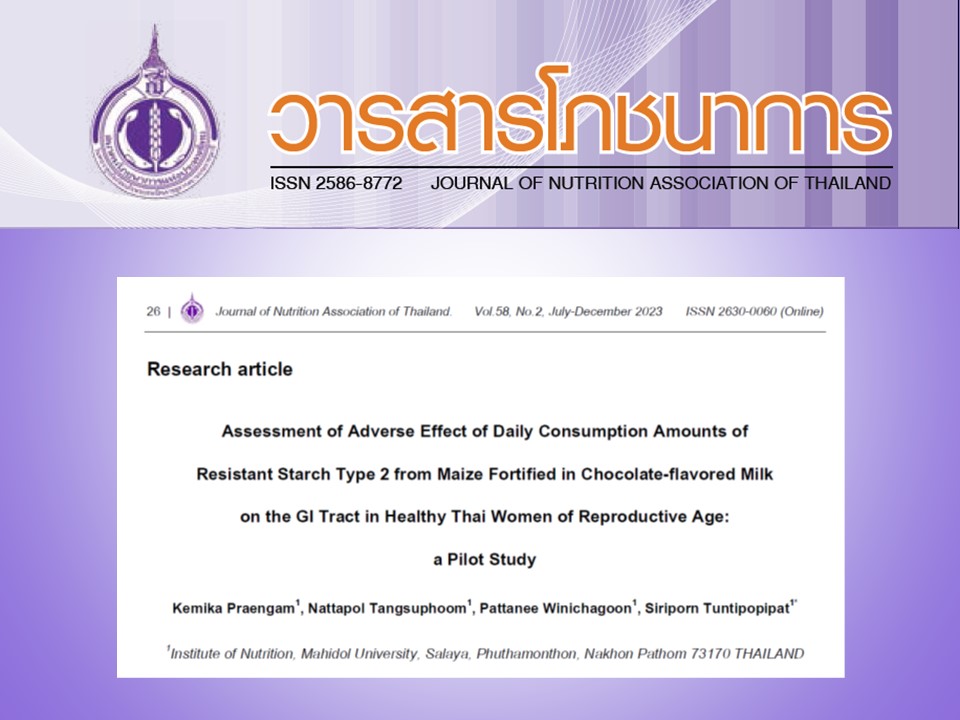
การประเมินผลของปริมาณการบริโภคต่อวันของแป้งอาหารที่ทนต่อ การย่อยชนิดที่ 2 จากข้าวโพดเสริมในนมรสช็อกโกแลตต่อ ระบบทางเดินอาหารในหญิงไทยวัยเจริญพันธุ์สุขภาพดี: การศึกษานำร่อง
คำสำคัญ:
แป้งอาหารที่ทนต่อการย่อยด้วยเอนไซม์, อาการไม่พึงประสงค์ในระบบทางเดินอาหาร, นมรสช็อกโกแลตเสริมแป้งอาหารที่ทนต่อการย่อยด้วยเอนไซม์บทคัดย่อ
แป้งอาหารที่ทนต่อการย่อยด้วยเอนไซม์ (resistant starch; RS) เป็นคาร์โบไฮเดรตที่ไม่ย่อยและไม่ดูดซึมในลำไส้เล็ก แต่มีรายงานประโยชน์ต่อสุขภาพที่หลากหลาย การกินปริมาณมากอาจเกิดอาการไม่พึงประสงค์ต่อทางเดินอาหาร การศึกษานำร่องนี้ประเมินผลของปริมาณการกินต่อวันของ RS ชนิดที่ 2 จากข้าวโพดที่เสริมในนมรสช็อกโกแลตต่อทางเดินอาหาร การศึกษานี้ทำในอาสาสมัครหญิงสุขภาพดี 30 คน โดยให้ดื่มนมรสช็อกโกแลตเสริม RS 30 กรัม/วัน 14 วัน และงดผลิตภัณฑ์ 7 วัน และดื่มผลิตภัณฑ์เดียวกันเสริม RS 40 กรัม/วัน 14 วัน บันทึกอาการไม่พึงประสงค์ของทางเดินอาหารหลังดื่มผลิตภัณฑ์ในวันที่ 3, 7,10 และ 14 ผลการศึกษาพบว่าการดื่มนมรสช็อกโกแลตเสริม RS 30 กรัม/วัน ทำให้มีอาการของทางเดินอาหารน้อยกว่าการดื่มผลิตภัณฑ์เดียวกันเสริม RS 40 กรัม/วัน อาการที่พบมากคือ มีลมในกระเพาะอาหาร ท้องอืด เรอ มีเสียงท้องร้อง น้ำหนักตัวอาสาสมัครและปริมาณอาหารที่กินไม่แตกต่างอย่างมีนัยสำคัญเมื่อเปรียบเทียบกับค่าเริ่มต้น RS ชนิดนี้ละลายน้ำได้ไม่ดีทำให้การยอมรับด้านประสาทสัมผัสต่ำ จึงต้องปรับปริมาณ RS ที่จะเสริมในผลิตภัณฑ์ให้เหมาะสมเพื่อให้มีผลเสียต่อทางเดินอาหารน้อยที่สุด และมีลักษณะทางประสาทสัมผัสเป็นที่ยอมรับ นอกจากนี้ ควรทดลองการเสริม RS ในผลิตภัณฑ์ชนิดอื่นๆ เพื่อเพิ่มทางเลือกให้มีผลิตภัณฑ์ที่มีคุณสมบัติเหมาะสมมากขึ้นเพื่อใช้ในการศึกษาผลเชิงสุขภาพ
เอกสารอ้างอิง
Peters R, Ee N, Peters J, Beckett N, Booth A, Rockwood K, et al. Common risk factors for major noncommunicable disease, a systematic overview of reviews and commentary: the implied potential for targeted risk reduction. Ther Adv Chronic Dis. 2019; 10:2040622319880392.
Budreviciute A, Damiati S, Sabir DK, Onder K, Schuller-Goetzburg P, Plakys G, et al. Management and Prevention Strategies for Non-communicable Diseases (NCDs) and Their Risk Factors. Front Public Health. 2020;8:574111.
Nediani C, Dinu M. Oxidative Stress and Inflammation as Targets for Novel Preventive and Therapeutic Approaches in Non-Communicable Diseases II. Antioxidants (Basel). 2022;11(5).
Rastogi S, Rastogi D. The Epidemiology and Mechanisms of Lifetime Cardiopulmonary Morbidities Associated with Pre-Pregnancy Obesity and Excessive Gestational Weight Gain. Front Cardiovasc Med. 2022;9:844905.
Al-Ani Z, Al-Dulaimy W, Al-Dulaimy K, Al-Haj S, Abdulraheem Y, Al-Maraie A, et al. Postpartum Weight: A Guide for Calculation of the Expected Prepregnancy Weight to Study the Risk of Maternal Overweight and Obesity on Congenital Anomalies. J Obes Weight Loss Ther. 2016;6:1-12.
Birt D, Boylston T, Hendrich S, Jane J-L, Hollis J, Li L, et al. Resistant Starch: Promise for Improving Human Health. Advances in nutrition (Bethesda, Md). 2013;4:587-601.
Drake AM, Coughlan MT, Christophersen CT, Snelson M. Resistant Starch as a Dietary Intervention to Limit the Progression of Diabetic Kidney Disease. Nutrients. 2022;14(21).
Raigond P, Dutt S, Singh B. Resistant Starch in Food. In: Mérillon J-M, Ramawat KG, editors. Bioactive Molecules in Food. Cham: Springer International Publishing; 2019. 815-46.
Hasjim J, Lee S-O, Hendrich S, Setiawan S, Ai Y, Jane J-l. Characterization of a Novel Resistant-Starch and Its Effects on Postprandial Plasma-Glucose and Insulin Responses. Cereal Chem. 2010;87(4):257-62.
Kwak JH, Paik JK, Kim HI, Kim OY, Shin DY, Kim HJ, et al. Dietary treatment with rice containing resistant starch improves markers of endothelial function with reduction of postprandial blood glucose and oxidative stress in patients with prediabetes or newly diagnosed type 2 diabetes. Atherosclerosis. 2012;224(2):457-64.
Tan L-l, Duan W-q, Chen M-x, Mei Y, Qi X-y, Zhang Y. Naturally cultured high resistant starch rice improved postprandial glucose levels in patients with type 2 diabetes: A randomized, double-blinded, controlled trial. Front Nutr. 2022;9:1-7.
Bodinham CL, Smith L, Thomas EL, Bell JD, Swann JR, Costabile A, et al. Efficacy of increased resistant starch consumption in human type 2 diabetes. Endocr Connect. 2014;3(2):75-84.
Keenan MJ, Zhou J, Hegsted M, Pelkman C, Durham HA, Coulon DB, et al. Role of resistant starch in improving gut health, adiposity, and insulin resistance. Adv Nutr. 2015;6(2):198-205.
Dainty SA, Klingel SL, Pilkey SE, McDonald E, McKeown B, Emes MJ, et al. Resistant Starch Bagels Reduce Fasting and Postprandial Insulin in Adults at Risk of Type 2 Diabetes123.J Nutr. 2016;146(11): 2252-9.
Karimi P, Abbasalizad Farhangi M, Sarmadi B, Pourghassem Gargari B, Javid A, Pouraghaei M, et al. The Therapeutic Potential of Resistant Starch in Modulation of Insulin Resistance, Endotoxemia, Oxidative Stress and Antioxidant Biomarkers in Women with Type 2 Diabetes: A Randomized Controlled Clinical Trial. Ann Nutr Metab. 2015;68:85-93.
Vidrine K, Ye J, Martin RJ, McCutcheon KL, Raggio AM, Pelkman C, et al. Resistant starch from high amylose maize (HAM-RS2) and dietary butyrate reduce abdominal fat by a different apparent mechanism. Obesity (Silver Spring). 2014;22(2):344-8.
Robertson MD, Bickerton AS, Dennis AL, Vidal H, Frayn KN. Insulin-sensitizing effects of dietary resistant starch and effects on skeletal muscle and adipose tissue metabolism. Am J Clin Nutr. 2005;82(3):559-67.
Pedersen A, Sandström B, Van Amelsvoort JM. The effect of ingestion of inulin on blood lipids and gastrointestinal symptoms in healthy females. Br J Nutr. 1997;78(2):215-22.
Johnston KL, Thomas EL, Bell JD, Frost GS, Robertson MD. Resistant starch improves insulin sensitivity in metabolic syndrome. Diabet Med. 2010;27(4):391-7.
Mysonhimer AR, Holscher HD. Gastrointestinal Effects and Tolerance of Nondigestible Carbohydrate Consumption. Adv Nutr. 2022;13(6):2237-76.
Englyst HN, Hudson GJ. The classification and measurement of dietary carbohydrates. Food Chem. 1996;57(1):15-21.
Magallanes-Cruz PA, Flores-Silva PC, Bello-Perez LA. Starch Structure Influences Its Digestibility: A Review. J Food Sci. 2017; 82(9):2016-23.
Asp NG, EURESTA., Starch EF-CAoR, Research F-LA-I, Commission of the European Communities. Directorate General XII: Science R, Development. Resistant Starch: Proceedings from the 2nd Plenary Meeting of EURESTA: European FLAIR Concerted Action No. 11 (COST 911): Physiological Implications of the Consumption of Resistant Starch in Man: Macmillan; 1992.
Portincasa P, Bonfrate L, Vacca M, De Angelis M, Farella I, Lanza E, et al. Gut Microbiota and Short Chain Fatty Acids: Implications in Glucose Homeostasis. Int J Mol Sci. 2022;23(3).
Platel K, Shurpalekar KS. Resistant starch content of Indian foods. Plant Foods Hum Nutr. 1994;45(1):91-5.
Chen L, Liu R, Qin C, Meng Y, Zhang J, Wang Y, et al. Sources and intake of resistant starch in the Chinese diet. Asia Pac J Clin Nutr. 2010;19:274-82.
Muir JG, Walker KZ, Kaimakamis MA, Cameron MA, Govers MJ, Lu ZX, et al. Modulation of fecal markers relevant to colon cancer risk: a high-starch Chinese diet did not generate expected beneficial changes relative to a Western-type diet. Am J Clin Nutr. 1998;68(2):372-9.
Brighenti F, Casiraghi MC, Baggio C. Resistant starch in the Italian diet. Br J Nutr. 1998;80(4):333-41.
Tomlin J, Read NW. The effect of resistant starch on colon function in humans. Br J Nutr. 1990;64(2):589-95.
Baghurst KI, Baghurst PA, Record SJ. Dietary fiber, nonstarch polysaccharide, and resistant starch intakes in Australia. In Spiller, G.A. (Ed.). CRC Handbook of Dietary Fiber in Human Nutrition (3rd ed.). CRC Press: 2001. p. 583-91.
Liljeberg Elmståhl H. Resistant starch content in a selection of starchy foods on the Swedish market. Eur J Clin Nutr. 2002;56(6):500-5.
Landon S, Colyer C, Salman H. The resistant starch report: an Australian update on health benefits, measurement and dietary intakes 2013 [Available from: https://www.scribd.com/document/374726324/Resistant-Starch-Report#.
Stewart ML, Nikhanj SD, Timm DA, Thomas W, Slavin JL. Evaluation of the effect of four fibers on laxation, gastrointestinal tolerance and serum markers in healthy humans. Ann Nutr Metab. 2010;56(2):91-8.
van den Heuvel EG, Wils D, Pasman WJ, Bakker M, Saniez MH, Kardinaal AF. Short-term digestive tolerance of different doses of NUTRIOSE FB, a food dextrin, in adult men. Eur J Clin Nutr. 2004;58(7):1046-55.
Grabitske HA, Slavin JL. Gastrointestinal effects of low-digestible carbohydrates. Crit Rev Food Sci Nutr. 2009;49(4):327-60.
Wang M, Wichienchot S, He X, Fu X, Huang Q, Zhang B. In vitro colonic fermentation of dietary fibers: Fermentation rate, short-chain fatty acid production and changes in microbiota. Trends Food Sci Technol. 2019;88:1-9.
Pasman W, Wils D, Saniez MH, Kardinaal A. Long-term gastrointestinal tolerance of NUTRIOSE FB in healthy men. Eur J Clin Nutr. 2006;60(8):1024-34.
White U, Peterson CM, Beyl RA, Martin CK, Ravussin E. Resistant Starch Has No Effect on Appetite and Food Intake in Individuals with Prediabetes. J Acad Nutr Diet. 2020;120(6):1034-41.
Martini MC, Lampe JW, Slavin JL, Kurzer MS. Effect of the menstrual cycle on energy and nutrient intake. Am J Clin Nutr. 1994;60(6):895-9.
ไฟล์ประกอบ
เผยแพร่แล้ว
รูปแบบการอ้างอิง
ฉบับ
ประเภทบทความ
สัญญาอนุญาต
บทความที่เผยแพร่ในวารสารโภชนาการ เป็นลิขสิทธิ์ของสมาคมโภชนาการแห่งประเทศไทยฯ

