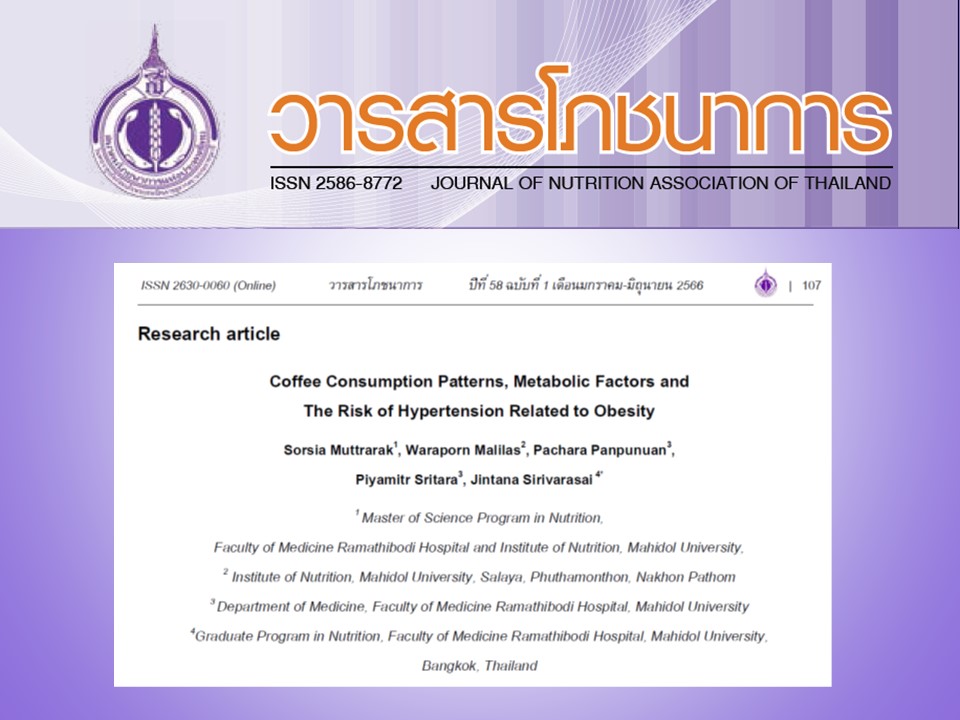
รูปแบบการบริโภคกาแฟ ปัจจัยทางเมแทบอลิค และความเสี่ยงต่อความดันโลหิตสูงที่มีความสัมพันธ์กับภาวะอ้วน
คำสำคัญ:
ภาวะอ้วน, การบริโภคกาแฟ, ความดันโลหิตสูง, ภาวะอ้วนลงพุงบทคัดย่อ
ภาวะอ้วนเป็นสาเหตุสำคัญของกลุ่มโรคอ้วนลงพุง นำไปสู่การเกิดโรคความดันโลหิตสูงและโรคเบาหวาน มีการเสนอแนวทางด้านโภชนาการเพื่อมาปรับใช้กับการจัดการภาวะอ้วนและโรคร่วมอื่นๆ การบริโภคกาแฟ มีรายงานความสัมพันธ์ทั้งในส่วนของการลดและ/หรือเพิ่มความเสี่ยงต่อการเกิดโรคความดันโลหิตสูงในกลุ่มคนที่ดื่มเป็นประจำ การศึกษาครั้งนี้มีวัตถุประสงค์เพื่อศึกษาความสัมพันธ์ระหว่างการบริโภคกาแฟ ตัวชี้วัดทางชีวเคมีและความเสี่ยงต่อการเกิดโรคความดันโลหิตสูงในกลุ่มคนที่มีภาวะอ้วน กลุ่มศึกษาเป็นเพศชายจำนวน 358 คน อายุ 40-60 ปี การวิเคราะห์ข้อมูลในส่วนของข้อมูลส่วนบุคคล ตัวชี้วัดทางชีวเคมี การบริโภคกาแฟตามดัชนีมวลกายและความดันโลหิต (ปกติ, ภาวะก่อนความดันโลหิตสูงและความดันโลหิตสูงระดับ I/II) พบความสัมพันธ์กันระหว่างความดันโลหิตกับดัชนีมวลกาย เส้นรอบเอว ระดับไขมัน กรดยูริค น้ำตาลในเลือดในกลุ่มคนอ้วนที่มีภาวะก่อนความดันโลหิตสูงและความดันโลหิตสูงระดับ I/II (ค่า p values < 0.05) เมื่อเปรียบเทียบกับกลุ่มคนที่ไม่บริโภคกาแฟ พบว่ากลุ่มคนที่บริโภคกาแฟมีระดับความดันโลหิตสูงกว่าอย่างมีนัยสำคัญทางสถิติ การวิเคราะห์ทางสถิติด้วยวิธี Multinomial logistic regression analysis พบปัจจัยสำคัญที่มีผลต่อความเสี่ยงในการเกิดภาวะก่อนความดันโลหิตสูงและความดันโลหิตสูงระดับ I/II ได้แก่ ระดับไตรกลีเซอร์ไรด์ กรดยูริค การบริโภคกาแฟ จำนวนที่บริโภค การเติมน้ำตาลและครีม ทั้งนี้เพื่อเพิ่มความเข้าใจในส่วนของสาเหตุและความสัมพันธ์ในส่วนของการบริโภคกาแฟและภาวะอ้วนลงพุง ควรจะมีการวิจัยเพื่อศึกษาผลในระยะยาวต่อไป
เอกสารอ้างอิง
Noncommunicable diseases country profiles 2018. Available online: https://apps.who.int/iris/ handle/10665/274512 (accessed on 28 April 2022)
Ng R, Sutradhar R, Yao Z, Wodchis WP, Rosella LC. Smoking, drinking, diet and physical activity-modifiable lifestyle risk factors and their associations with age to first chronic disease. Int J Epidemiol 2020;49(1):113-130.
Castro-Quezada I, Román-Viñas B, Serra-Majem L. The Mediterranean diet and nutritional adequacy: a review. Nutrients 2014;6(1):231-48.
Shahbandhen M. Global Coffee Consumption 2012/13–2018/19. [(accessed on 20 February 2022)];2020 Jan; Available online: https://www.statista.com/statistics/292595/global-coffee-consumption/#statisticContainer
Polsripradist P, Tantayaporn K, Homchampa P. Caffeine consumption behaviors of the working-age population in rural communities in northeastern Thailand. J Med Assoc Thai 2016;99(7):839-51.
Nuhu AA. Bioactive micronutrients in coffee: recent analytical approaches for characterization and quantification. ISRN Nutr 2014;2014:384230.
Shariq OA, McKenzie TJ. Obesity-related hypertension: a review of pathophysiology, management, and the role of metabolic surgery. Gland Surg 2020;9(1):80-93.
Maki C, Funakoshi-Tago M, Aoyagi R, Ueda F, Kimura M, Kobata K, et al. Coffee extract inhibits adipogenesis in 3T3-L1 preadipocyes by interrupting insulin signaling through the downregulation of IRS1. PLoS One 2017;12(3):e0173264.
Lee J, Kim HY, Kim J. Coffee consumption and the risk of obesity in Korean women. Nutrients 2017;9(12):1340.
Jee SH, He J, Whelton PK, Suh I, Klag MJ. The effect of chronic coffee drinking on blood pressure: a meta-analysis of controlled clinical trials. Hypertension1999;33(2):647-52.
Miranda AM, Goulart AC, Benseñor IM, Lotufo PA, Marchioni DM. Coffee consumption and risk of hypertension: A prospective analysis in the cohort study. Clin Nutr 2021;40(2):542-549.
Vathesatogkit P, Woodward M, Tanomsup S, Ratanachaiwong W, Vanavanan S,Sritara P, et al. Cohort Profile: The electricity generating authority of Thailand study. Int J Epidemiol 2012;41(2):359-65.
Svetkey LP. Management of prehypertension. Hypertension 2005 Jun;45(6):1056-61.
Guagnano MT, Ballone E, Colagrande V, Della Vecchia R, Manigrasso MR, Merlitti D, et al. Large waist circumference and risk of hypertension. Int J Obes Relat Metab Disord 2001;25(9):1360-4.
Momin M, Fan F, Li J, Jia J, Zhang L, Zhang Y, et al. Joint effects of body mass index and waist circumference on the incidence of hypertension in a community-based Chinese population. Obes Facts 2020;13(2):245-255.
El Meouchy P, Wahoud M, Allam S, Chedid R, Karam W, Karam S. Hypertension related to obesity: Pathogenesis, characteristics and factors for control. Int J Mol Sci 2022;23(20):12305.
Tang N, Ma J, Tao R, Chen Z, Yang Y, He Q, et al. The effects of the interaction between BMI and dyslipidemia on hypertension in adults. Sci Rep 2022;12(1):927.
Scherrer U, Randin D, Vollenweider P, Vollenweider L, Nicod P. Nitric oxide release accounts for insulin's vascular effects in humans. J Clin Invest 1994;94:2511–2515.
Horita S, Seki G, Yamada H, Suzuki M, Koike K, Fujita T. Insulin resistance, obesity, hypertension, and renal sodium transport. Int J Hypertens 2011;2011:391762.
Rospleszcz S, Dermyshi D, Müller-Peltzer K, Strauch K, Bamberg F, Peters A. Association of serum uric acid with visceral, subcutaneous and hepatic fat quantified by magnetic resonance imaging. Sci Rep 2020;10(1):442.
Li F, Chen S, Qiu X, Wu J, Tan M, Wang M. Serum uric acid levels and metabolic indices in an obese population: A cross-sectional study. Diabetes Metab Syndr Obes 2021;14:627-635.
Kang D-H, Han L, Ouyang X, Kahn AM, Kanellis J, Li P, et al. Uric acid causes vascular smooth muscle cell proliferation by entering cells via a functional urate transporter. Am J Nephrol 2005;25:425-433.
Sánchez-Lozada LG, Lanaspa MA, Cristóbal-García M, García-Arroyo F, Soto V, Cruz-Robles D, et al. Uric acid-induced endothelial dysfunction is associated with mitochondrial alterations and decreased intracellular ATP concentrations. Nephron Experimental Nephrology 2012, 121:e71-e78.
Hou C, Zeng Y, Chen W, Han X, Yang H, Ying Z, Hu Y, Sun Y, Qu Y, Fang F, Song H. Medical conditions associated with coffee consumption: Disease-trajectory and comorbidity network analyses of a prospective cohort study in UK Biobank. Am J Clin Nutr 2022 Sep 2;116(3):730-740.
Sharma H. A Detail Chemistry of Coffee and Its Analysis [Internet]. Coffee-Production and Research. IntechOpen; 2020. Available from: http://dx.doi.org/10.5772/intechopen.91725
Pan H, Gao Y, Tu Y. Mechanisms of Body Weight Reduction by Black Tea Polyphenols. Molecules 2016 Dec 7;21(12):1659.
Nishitsuji K, Watanabe S, Xiao J, Nagatomo R, Ogawa H, Tsunematsu T, Umemoto H, Morimoto Y, Akatsu H, Inoue K, Tsuneyama K. Effect of coffee or coffee components on gut microbiome and short-chain fatty acids in a mouse model of metabolic syndrome. Sci Rep 2018 Nov 1;8(1):16173.
Klag MJ, Wang NY, Meoni LA, Brancati FL, Cooper LA, Liang KY, et al. Coffee intake and risk of hypertension: the Johns Hopkins precursors study. Arch Intern Med 2002;162(6):657-62.
Palatini P, Dorigatti F, Santonastaso M, Cozzio S, Biasion T, Garavelli G, et al. Association between coffee consumption and risk of hypertension. Ann Med 2007;39(7):545-53.
Surma S, Oparil S. Coffee and arterial hypertension. Curr Hypertens Rep 2021;23(7):38.
Cruchten ST, de Waart DR, Kunne C, Hooiveld GJ, Boekschoten MV, Katan MB, et al. Absorption, distribution, and biliary excretion of cafestol, a potent cholesterol-elevating compound in unfiltered coffees, in mice. Drug Metab Dispos 2010;38(4):635-40.
van Tol A, Urgert R, de Jong-Caesar R, van Gent T, Scheek LM, de Roos B, et al. The cholesterol-raising diterpenes from coffee beans increase serum lipid transfer protein activity levels in humans. Atherosclerosis 1997;132(2):251-4.
Creager MA, Cooke JP, Mendelsohn ME, Gallagher SJ, Coleman SM, Loscalzo J, Dzau VJ. Impaired vasodilation of forearm resistance vessels in hypercholesterolemic humans. J Clin Invest 1990;86:228–234.
ดาวน์โหลด
เผยแพร่แล้ว
รูปแบบการอ้างอิง
ฉบับ
ประเภทบทความ
สัญญาอนุญาต
บทความที่เผยแพร่ในวารสารโภชนาการ เป็นลิขสิทธิ์ของสมาคมโภชนาการแห่งประเทศไทยฯ

