
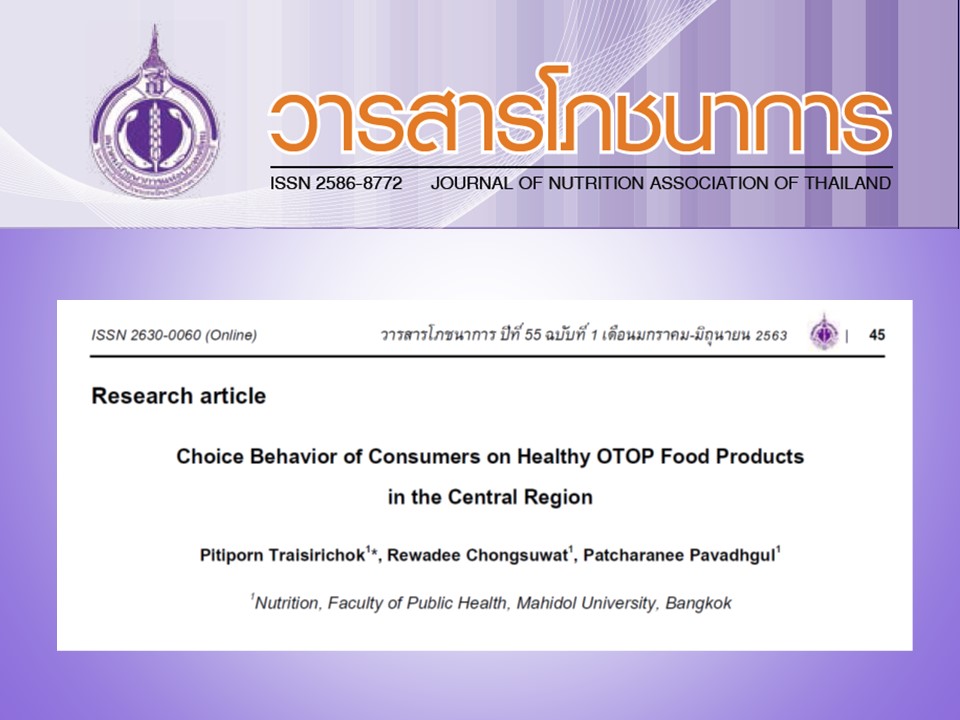
Choice Behavior of Consumers on Healthy OTOP Food Products in the Central Region
Keywords:
Behavior, OTOP food products, Health foodAbstract
OTOP stands for ‘One Tambon One Product’ has been the Thai government's strategic approach for the community to identify a product that signifies the uniqueness of the community. With the increasing trend of health awareness, communities have produced health-related OTOP products as an alternative for consumers. The objective of this study was to examine consumer’s knowledge, attitude, and personal factors in relation to the choice of OTOP healthy food products. A survey was conducted in five souvenir shops in central Thailand, and 381 persons were interviewed using a questionnaire. The results showed that the highest purchase was snacks, followed by processed foods and processed fruits. 92.7% of the consumers intended to buy healthy OTOP food products; among these, 22.6% used to buy OTOP healthy food products. The knowledge and attitude scores of the participants were moderate. There was no significant relationship between knowledge and behavior in choosing healthy OTOP food products (p = 0.549). All personal factors, namely, attitude, age, income, and occupation were significantly related to choosing healthy OTOP food products (p-values: 0.010, 0.014, 0.005, and 0.006, respectively. In conclusion, study participants who have a positive attitude towards OTOP products were more likely to purchase OTOP healthy food product(s). It showed that OTOP food products are accepted by consumers however the knowledge was not related to decision and frequency of choosing OTOP healthy food products. The frequency of healthy food choices was not related to the level of nutrition knowledge because they have no different levels of healthy food choices. The suggestion of this population indicated that healthy food products were not diverse, expensive, and difficult to access.
References
Institute for Population and Social Research, Mahidol University. Thai Health 2017: Non-communicable Diseases. Nonthaburi: Office of the National Health Commission; 2017.
Wantanee Kriengsinyos. Reduces sodium, prolongs life. Bangkok; 2012.
Hfocus news agency, The Phiwat Thai Public Health Foundation [homepage on the Internet]. Thai people eat very sweet, get too much sugar, risk disease [updated 2017 Aug 26; cited 2018 Mar 15]. Available from: https://www.hfocus.org/content/2017/08/14479.
Komin W, Subsing B. The situation of repeated frying oil usage in Thailand, the fact that you should know. Bangkok: Roadmap to dominate health consumers and Faculty of Pharmacy, Chulalongkorn University; 2011.
Thai Health Promotion Foundation (Thai Health) [homepage on the Internet]. Thai Health invites you to send happiness to the new year with OTOP for health [updated 2017 Nov 29; cited 2018 Feb 25]. Available from: http://www.thaihealth.or.th
Suriyachai N. Changes in healthy food consumption behavior among working people in Thailand and Malaysia. [Thesis]. Nakhon Pathom: Silpakorn University; 2015.
Hep S. Factor in deciding to purchase health foods in Nonthaburi province [Thesis]. Bangkok: Department of Economics, Siam University; 2014.
Chaitokkiey S. Factors affecting food consumption behaviors of adults in northeastern Thailand [Thesis]. Loei: Food and Nutrition Program, Faculty of Science and Technology, Loei Rajabhat University; 2015.
Nanthasin N. Factors affecting consumer’s consumption behavior and loyalty toward health Food in Bangkok metropolis. Bangkok: Journal of Cultural Approach; 2015.
Ruangkalapawongse A, Ruangkalapawongse S. Factors related to decision making to buy functional food products for senior citizens in the Bangkok metropolis. SDU Res J 2015; 11(2):77-94.
The Food and Drug Administration, a government agency responsible for food and drug safe. Factors that affect the behavior of consumers to change the health product consumption at present. Nonthaburi: Ministry of Public Health, 2015.
Saengthong P. Title service user’s attitude and behavior on transportation business and distribution of SUZUYO (Thailand) limited [Thesis]. Bangkok; Management, Srinakharinwirot University; 2008.
Downloads
Published
How to Cite
Issue
Section
License
Upon acceptance of an article, copyright is belonging to the Nutrition Association of Thailand.

