
การพัฒนารูปแบบการสนับสนุนการจัดการตนเองของผู้ป่วยความดันโลหิตสูง อำเภอแม่ลาน้อย จังหวัดแม่ฮ่องสอน
คำสำคัญ:
ความดันโลหิตสูง , การจัดการตนเอง , ความเท่าทันต่อโรค , การมีส่วนร่วมบทคัดย่อ
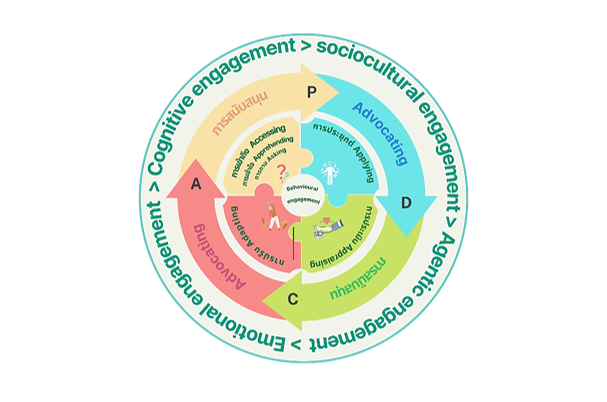
การวิจัยและพัฒนานี้มีวัตถุประสงค์เพื่อ 1) พัฒนารูปแบบการสนับสนุนการจัดการตนเองของผู้ป่วยโรคความดันโลหิตสูง โดยบูรณาการแนวคิดวงจรคุณภาพ PDCA แนวคิดความเท่าทันต่อโรค (7A’s) และมิติการมี
ส่วนร่วมของผู้ป่วย 5 ด้าน (5E) และ 2) ศึกษาผลของการใช้รูปแบบที่พัฒนาขึ้นต่อระดับการจัดการตนเองของผู้ป่วย การวิจัยแบ่งออกเป็น 2 ระยะ ได้แก่ ระยะที่ 1 การพัฒนารูปแบบ โดยการทบทวนวรรณกรรมแนวคิดการจัดการตนเองตามกรอบ PDCA ร่วมกับแนวคิดความเท่าทันต่อโรค (7A’s) และมิติการมีส่วนร่วมของผู้ป่วย (5E) และระยะ
ที่ 2 การทดลองใช้รูปแบบกับกลุ่มตัวอย่างผู้ป่วยโรคความดันโลหิตสูง จำนวน 60 คน ณ โรงพยาบาลส่งเสริมสุขภาพประจำตำบลในเขตพื้นที่อำเภอแม่ลาน้อย จังหวัดแม่ฮ่องสอน ระหว่างเดือนมกราคม – มีนาคม พ.ศ. 2568 แบ่งเป็นกลุ่มทดลองและกลุ่มเปรียบเทียบ กลุ่มละ 30 คน เก็บรวบรวมข้อมูลก่อนและหลังการทดลองใช้รูปแบบ วิเคราะห์ข้อมูลด้วยสถิติเชิงพรรณนาและการทดสอบค่าทีแบบอิสระ ผลการวิจัยพบว่า
1. รูปแบบการสนับสนุนการจัดการตนเองของผู้ป่วยโรคความดันโลหิตสูงที่พัฒนาขึ้นในครั้งนี้ มีชื่อว่า The PDCA-7A-5E Integrated Model for Hypertension Self-Management Support ผ่านการประเมินโดยผู้ทรงคุณวุฒิ และมีความถูกต้อง เหมาะสม สามารถนำไปใช้ได้จริงในบริบทชุมชนห่างไกล
2. ผลของการใช้รูปแบบการสนับสนุนการจัดการตนเองที่พัฒนาขึ้น พบว่า ผู้ป่วยกลุ่มทดลองมีคะแนนการจัดการตนเองโดยรวมหลังการใช้รูปแบบสูงกว่าก่อนการใช้อย่างมีนัยสำคัญทางสถิติที่ระดับ .01 (p-value < .001) และมีคะแนนการจัดการตนเองโดยรวมสูงกว่ากลุ่มเปรียบเทียบอย่างมีนัยสำคัญทางสถิติที่ระดับ .01 (p-value = .005) นอกจากนี้ผู้ป่วยกลุ่มทดลองมีค่าเฉลี่ยความดันโลหิตทั้งขณะหัวใจบีบตัวและขณะหัวใจคลายตัวลดลงอย่างมีนัยสำคัญทางสถิติที่ระดับ .05 (p-value < .05) เมื่อเปรียบเทียบกับทั้งก่อนการทดลองและกลุ่มเปรียบเทียบ
รูปแบบที่พัฒนาขึ้นสามารถส่งเสริมความสามารถในการจัดการตนเองของผู้ป่วยโรคความดันโลหิตสูงได้อย่างมีประสิทธิภาพ จึงควรนำไปประยุกต์ใช้เป็นหลักฐานเชิงประจักษ์ในการกำหนดนโยบายและแนวทาง
การจัดบริการสุขภาพเชิงรุก เพื่อส่งเสริมการดูแลตนเองอย่างต่อเนื่องและลดภาวะเสี่ยงของโรคในระยะยาว
เอกสารอ้างอิง
Aekplakorn, W., Chariyalertsak, S., Kessomboon, P., Assanangkornchai, S., Taneepanichskul, S., Goldstein, A., et al. (2024). Trends in hypertension prevalence, awareness, treatment, and control in the Thai population, 2004 to 2020. BMC Public Health, 24(3149). https://doi.org/10.1186/s12889-024-20643-1
Aungsuroch, Y., Polsook, R., Anuruang, S., Phongphibool, S., Gunawan, J., & Nazliansyah. (2022). How a self-management program affects blood pressure among Indonesians with hypertension: A quasi-experimental study. Iranian Journal of Nursing and Midwifery Research, 27(3), 229–235. https://doi.org/10.4103/ijnmr.IJNMR_244_20
Bartlett, J. E. (2022). Introduction to Power Analysis: A Guide to GPower, Jamovi, and Superpower* Version 1.4 (01/02/2022). Retrieved August 2, 2024, from https://osf.io/zqphw/DOI: 10.17605/OSF.IO/PCFVJzenodo+1
Cohen, J. (1988). Statistical Power Analysis for the Behavioral Sciences (2nd ed.). New Jersey: Lawrence Erlbaum Associates.
Deming, W. E. (1986). The New Economics for Industry, Government, Education (2nd ed.). Massachusetts: MIT Press.
Faul, F., Erdfelder, E., Buchner, A., & Lang, A.-G. (2009). Statistical power analyses using G*Power 3.1: Tests for correlation and regression analyses. Behavior Research Methods, 41, 1149-1160.
Grady, P. A., & Gough, L. L. (2014). Self-management: a comprehensive approach to management of chronic conditions. American Journal of Public Health, 104(8), e25–e31. https://doi.org/10.2105/AJPH.2014.302041
Han, X., & Ding, Y. (2024). Effectiveness of the PDCA cycle in chronic disease self-management: A systematic review. Alternative Therapies in Health and Medicine, 30(2), 45-56. http://www.alternative-therapies.com/oa/pdf/10491.pdf
Hany, A., Putra, K. R., Vatmasari, R. A., Nafis, A. N., Amalia, A. T., & Khamdani, E. (2024). Importance of self-management interventions in hypertension patients: A scoping review. Healthcare in Low-Resource Settings, 12(s1), 13434. https://doi.org/10.4081/hls.2024.13034
Health Data Center, Ministry of Public Health. (2023). Standard Reports – Hypertension & NCD Indicators (Province/District Level). Retrieved October 25, 2025, from https://hdc.moph.go.th (in Thai)
Inagaki, Y., Matsushita, K., Appel, L. J., Perry, H. B., & Neupane, D. (2024). Task-sharing with community health workers to treat hypertension: A scoping review. Journal of Hypertension, 42(1), 1-14. https://chwcentral.org/wp-content/uploads/task_sharing_with_community_health_workers_to.525.pdf
Kamdaeng, P., Kanonthawornchot, A., & Kannika, P. (2025). The relationship between health literacy and self-management among hypertensive patients in Mae La Noi District, Mae Hong Son Province. Journal of Nurses Association of Thailand Northern Office, 31(2), 1-17. https://www.tci-thaijo.org/articles/health01-280447 (in Thai)
Kongai, A., Kamdaeng, P., Lorka, T., Apiwongwan, P., Satsasakulrat, S., Nuanbunruang, P., et al. (2023). Disease literacy and self-management among older adults with hypertension in Mae Hong Son Province: A qualitative explanatory study. Journal of Nursing and Health Care, 41(4), e265940. https://www.tci-thaijo.org/articles/health01-265940 (in Thai)
Mae La Noi District Health Service Network. (2024). Operational and budget plan for fiscal year 2024. Mae Hong Son: Mae La Noi Hospital. Retrieved November 3, 2025, from https://www.maelanoihospital.go.th/web66/wp-content/uploads/2023/12/2_9.pdf (in Thai)
Non-Communicable Disease Division, Department of Disease Control, Ministry of Public Health. (2024). Mortality rate of 5 major NCDs in Thailand, 2019–2023. Retrieved October 25, 2025, from https://www.ddc.moph.go.th/dncd/news.php?news=39911 (in Thai)
Nyame, S., Boateng, D., Heeres, P., Gyamfi, J., Gafane-Matemane, L. F., Amoah, J., Iwelunmor, J., et al. (2024). Community-based strategies to improve health-related outcomes in people living with hypertension in low- and middle-income countries: A systematic review and meta-analysis. Global Heart, 19(1), 51. https://doi.org/10.5334/gh.1329
Peters, M. A., Alonge, O., Edward, A., Commodore-Mensah, Y., Kaur, J., Kumar, N., et al. (2022). Barriers to effective hypertension management in rural Bihar, India: A cross-sectional, linked supply- and demand-side study. PLOS Global Public Health, 2(10), e0000513. https://doi.org/10.1371/journal.pgph.0000513
Polsook, R., & Aungsuroch, Y. (2024). The effect of a self-management programme on blood pressure levels among people with hypertension: a randomised controlled trial. Journal of Research in Nursing, 29(6), 452-466. https://doi.org/10.1177/17449871241261668
World Health Organization. (2023). Global Report on Hypertension: The Race Against a Silent Killer. World Health Organization. Retrieved October 26, 2025, from https://www.who.int/publications/i/item/9789240081062
Zhou, J., Xu, H., Jiang, M., Cao, H., Jiang, L., Xu, T., et al. (2021). Effect of PDCA-based nursing management model on the quality of life and complications of patients with acute leukemia undergoing chemotherapy. American Journal of Translational Research, 13(4), 3246–3253. https://pmc.ncbi.nlm.nih.gov/articles/PMC8129232/
ดาวน์โหลด
เผยแพร่แล้ว
ฉบับ
ประเภทบทความ
สัญญาอนุญาต
ลิขสิทธิ์ (c) 2026 วารสารการพยาบาลและการศึกษา

อนุญาตภายใต้เงื่อนไข Creative Commons Attribution-NonCommercial-NoDerivatives 4.0 International License.


