
ความล้มเหลวของกระบวนการทางด้านความคิดกับการเกิดพฤติกรรมความไม่ปลอดภัยในการทำงาน
คำสำคัญ:
ความล้มเหลวในกระบวนการทางด้านความคิด , กลไกทางด้านความคิดของมนุษย์ , อุบัติเหตุจากการทำงาน, พฤติกรรมความไม่ปลอดภัยในการทำงานบทคัดย่อ
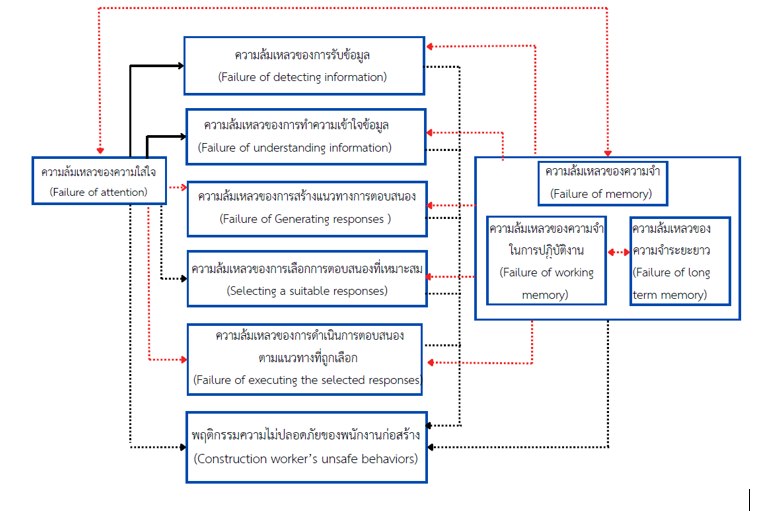
พฤติกรรมความไม่ปลอดภัยเป็นสาเหตุที่สำคัญโดยตรงที่นำไปสู่การเกิดอุบัติเหตุจากการทำงาน การแสดงออกถึงพฤติกรรมความไม่ปลอดภัยในการทำงานเป็นผลมาจากหลากหลายปัจจัยที่มีความสัมพันธ์กัน โดยเฉพาะปัจจัยที่เกี่ยวข้องกับกระบวนการทางด้านความคิดและการรับรู้ของมนุษย์ การศึกษาวิจัยเกี่ยวกับพฤติกรรมความไม่ปลอดภัยในการทำงานในประเทศไทยที่ผ่านมายังไม่มีการนำเอาทฤษฎีเกี่ยวกับความล้มเหลวในกระบวนการทางด้านความคิด มาใช้ในการอธิบายการเกิดพฤติกรรมความไม่ปลอดภัยในการทำงานมากนัก บทความนี้มีวัตถุประสงค์ เพื่ออธิบายกลไกการเกิดพฤติกรรมความไม่ปลอดภัยในการทำงานที่เป็นผลมาจากการเกิดความล้มเหลวในกระบวนการทางด้านความคิดของมนุษย์ ในบทความนี้ยังอธิบายถึงกลไกทางด้านความคิดของมนุษย์ ประเภทความล้มเหลวในกระบวนการทางด้านความคิดของมนุษย์ ทั้งหมด 7 ประเภท และยกตัวอย่างการศึกษาในต่างประเทศที่อธิบายถึงความเชื่อมโยงของกลไกการเกิดความล้มเหลวในกระบวนการทางด้านความคิด เพื่อนำไปใช้ในการอธิบายการเกิดพฤติกรรมความไม่ปลอดภัยในการทำงานและเป็นประโยชน์ต่อวงการศึกษาทางด้านความปลอดภัยในการทำงานของประเทศไทยต่อไป
เอกสารอ้างอิง
Ajzen, I. (1991). The Theory of Planned Behavior. Organizational Behavior and Human Decision Processes.
Aksorn, T., & Hadikusumo, B. H. (2008). Critical success factors influencing safety program performance in Thai construction projects. Safety Science, 46(4), 709-727.
Allahyari, T., Rangi, N. H., Khalkhali, H., & Khosravi, Y. (2014). Occupational cognitive failures and safety performance in the workplace. International Journal of Occupational Safety and Ergonomics, 20(1), 175-180.
Bandura, A. (1977). Social learning theory. Group & Organization Studies, 2(3), 384-385. Becker, M. H. (1974). The health belief model and personal health behavior. Health Education Monographs, 2, 324-473.
Brossoit, R. M., Crain, T. L., Leslie, J. J., Hammer, L. B., Truxillo, D. M., & Bodner, T. E. (2019). The effects of sleep on workplace cognitive failure and safety. Journal of Occupational Health Psychology, 24(4), 411–422.
Butmee, T., Jitjamnong, A., Sangaroon, P. (2024). Analyzing causes of accident at work by using HFACS: Human factors analysis and classification system. Primary Health Care Journal (Northeastern Edition), 39(3), 1-11. (in Thai).
Chang, Y. H. J., & Mosleh, A. (2007). Cognitive modeling and dynamic probabilistic simulation of operating crew response to complex system accidents: Part 1: Overview of the IDAC Model. Reliability Engineering & System Safety, 92(8), 997-1013.
Chen, J., Song, X., & Lin, Z. (2016). Revealing the “Invisible Gorilla” in construction: Estimating construction safety through mental workload assessment. Automation in Construction, 63, 173-183.
Choi, B., & Lee, S. (2018). An empirically based agent-based model of the sociocognitive process of construction workers’ safety behavior. Journal of Construction Engineering and Management, 144(2), 04017102.
Deng, S., Peng, R., & Pan, Y. (2022). A cognitive failure model of construction workers’ unsafe behavior. Advances in Civil Engineering, 2022(1), 2576600.
Fang, D., Jiang, Z., Zhang, M., & Wang, H. (2015). An experimental method to study the effect of fatigue on construction workers’ safety performance. Safety Science, 73, 80-91.
Fang, D., Zhao, C., & Zhang, M. (2016). A cognitive model of construction workers’ unsafe behaviors. Journal of Construction Engineering and Management, 142(9).
Fang, L., Zhang, Z., & Guo, H. (2018). Cognitive mechanism and intervention strategies of coal miners’ unsafe behaviors: Evidence from China. Revista De Cercetare Si Interventie Sociala, 61, 7-31.
Hasanzadeh, S., Dao, B., Esmaeili, B., & Dodd, M. D. (2019). Role of personality in construction safety: Investigating the relationships between personality, attentional failure, and hazard identification under fall-hazard conditions. Journal of Construction Engineering and Management, 145(9), 04019052.
Hassanzadeh-Rangi, N., Asghar Farshad, A., Khosravi, Y., Zare, G., & Mirkazemi, R. (2014). Occupational cognitive failure and its relationship with unsafe behaviors and accidents. International Journal of Occupational Safety And Ergonomics, 20(2), 265-271.
Heinrich, H. W. (1941). Industrial Accident Prevention. A Scientific Approach. Hollnagel, E. (1998). Cognitive Reliability and Error Analysis Method (CREAM). Elsevier.
Ke, J., Zhang, M., Luo, X., & Chen, J. (2021). Monitoring distraction of construction workers caused by noise using a wearable Electroencephalography (EEG) device. Automation in Construction, 125, 103598.
Li, J., Li, H., Wang, H., Umer, W., Fu, H., & Xing, X. (2019). Evaluating the impact of mental fatigue on construction equipment operators' ability to detect hazards using wearable eye-tracking technology. Automation in construction, 105, 102835.
Liao, P. C., Liu, B., Wang, Y., Wang, X., & Ganbat, T. (2017). Work paradigm as a moderator between cognitive factors and behaviors–A comparison of mechanical and rebar workers. KSCE Journal of Civil Engineering, 21, 2514-2525.
Liao, P. C., Liu, M., Su, Y. S., Shi, H., & Luo, X. (2018). Estimating the influence of improper workplace environment on human error: Posterior predictive analysis. Advances in Civil Engineering, 2018(1), 5078906.
Lifen, F. A. N. G., Zhang, Z., & Haihong, G. U. O. (2018). Cognitive mechanism and intervention strategies of coal miners’ unsafe behaviors: evidence from China. Revista DE Cercetare SI Interventie Sociala, 61, 7.
Ma, H., Wu, Z., & Chang, P. (2021). Social impacts on hazard perception of construction workers: a system dynamics model analysis. Safety Science, 138, 105240.
Namian, M., Albert, A., & Feng, J. (2018). Effect of distraction on hazard recognition and safety risk perception. Journal of construction engineering and management, 144(4), 04018008.
Petitta, L., Probst, T. M., Ghezzi, V., & Barbaranelli, C. (2019). Cognitive failures in response to emotional contagion: Their effects on workplace accidents. Accident Analysis & Prevention, 125, 165-173.
Rasmussen, J. (1987). Information Processing and Human-Machine Interaction. An approach to cognitive engineering. North-Holland. Reason J. (2008). The Human Contribution – Unsafe acts, accidents and heroic recoveries. UK: Ashgate Publishing Limited.
Shappell S. A. & Wiegmann D. A. (2001). Applying Reason: The Human Factors Analysis and Classification System (HFACS). Human Factors and Aerospace Safety. Retrieved March, 10, 2025 from https://www.researchgate.net/publication/247897525.
Wickens, C. D., Helton, W. S., Hollands, J. G., & Banbury, S. (2021). Engineering Psychology and Human Performance. Routledge.
Xiang, Q., Ye, G., Liu, Y., Goh, Y. M., Wang, D., & He, T. (2023). Cognitive mechanism of construction workers’ unsafe behavior: A systematic review. Safety Science, 159, 106037.
Xing, X., Zhong, B., Luo, H., Rose, T., Li, J., & Antwi-Afari, M. F. (2020). Effects of physical fatigue on the induction of mental fatigue of construction workers: A pilot study based on a neurophysiological approach. Automation in Construction, 120, 103381.
Ye, G., Yue, H., Yang, J., Li, H., Xiang, Q., Fu, Y., et al. (2020). Understanding the sociocognitive process of construction workers’ unsafe behaviors: An agent-based modeling approach. International Journal of Environmental Research And Public Health, 17(5), 1588.
Zhang, M., & Fang, D. (2013). A cognitive analysis of why Chinese scaffolders do not use safety harnesses in construction. Construction Management and Economics, 31(3), 207-222.
Zhang, P., Li, N., Jiang, Z., Fang, D., & Anumba, C. J. (2019). An agent-based modeling approach for understanding the effect of worker-management interactions on construction workers' safety-related behaviors. Automation in Construction, 97, 29-43.
ดาวน์โหลด
เผยแพร่แล้ว
ฉบับ
ประเภทบทความ
สัญญาอนุญาต
ลิขสิทธิ์ (c) 2025 วารสารการพยาบาลและการศึกษา

อนุญาตภายใต้เงื่อนไข Creative Commons Attribution-NonCommercial-NoDerivatives 4.0 International License.


