
ผลของการใช้โปรแกรมการสร้างเสริมความรอบรู้ด้านสุขภาพต่อความรู้ในการปฏิบัติตน การรับรู้ความสามารถในการดูแลตนเอง และพฤติกรรมการดูแลตนเองของหญิงตั้งครรภ์วัยรุ่นโรงพยาบาลหนองบัวแดง
คำสำคัญ:
ความรอบรู้ด้านสุขภาพ , ความรู้, พฤติกรรมการดูแลตนเอง , หญิงตั้งครรภ์วัยรุ่นบทคัดย่อ
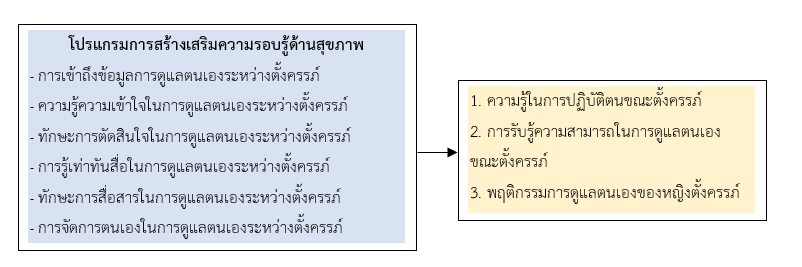
การวิจัยกึ่งทดลองแบบกลุ่มเดียววัดผลก่อนและหลังนี้ มีวัตถุประสงค์เพื่อศึกษาผลของโปรแกรมการสร้างเสริมความรอบรู้ด้านสุขภาพต่อความรู้ในการปฏิบัติตน การรับรู้ความสามารถในการดูแลตนเอง และพฤติกรรมการดูแลสุขภาพตนเองของหญิงตั้งครรภ์วัยรุ่น กลุ่มตัวอย่างคือหญิงตั้งครรภ์วัยรุ่นที่มารับบริการฝากครรภ์ที่แผนกฝากครรภ์ โรงพยาบาลหนองบัวแดง จังหวัดชัยภูมิ จำนวน 25 ราย คัดเลือกโดยวิธีการเลือกแบบเจาะจง ที่ใช้ในการวิจัยประกอบด้วย โปรแกรมการสร้างเสริมความรอบรู้ด้านสุขภาพหญิงตั้งครรภ์ และแบบสอบถาม 3 ฉบับ ได้แก่ แบบสอบถามความรู้เกี่ยวกับการดูแลตนเอง แบบสอบถามการรับรู้ความสามารถในการดูแลสุขภาพตนเองและแบบสอบถามพฤติกรรมการดูแลตนเอง ผ่านการตรวจสอบความตรงเชิงเนื้อหาโดยผู้ทรงคุณวุฒิ 3 ท่าน โดยมีค่าดัชนีความสอดคล้อง เท่ากับ 1.00, .67 และ .67 ตามลำดับ และมีค่าความเที่ยงของเครื่องมืออยู่ระหว่าง .79 – .92 วิเคราะห์ข้อมูลโดยใช้สถิติเชิงพรรณนาและสถิติทดสอบทีแบบจับคู่ ผลการวิจัยพบว่า
1. หลังการใช้โปรแกรมฯ กลุ่มตัวอย่างมีคะแนนเฉลี่ยความรู้ในการปฏิบัติตน สูงกว่าก่อนเข้าร่วมโปรแกรม อย่างมีนัยสำคัญทางสถิติ (t = 19.96, p-value < .001)
2. หลังการใช้โปรแกรมฯ กลุ่มตัวอย่างมีคะแนนเฉลี่ยการรับรู้ความสามารถในการดูแลตนเอง สูงกว่าก่อนเข้าร่วมโปรแกรม อย่างมีนัยสำคัญทางสถิติ (t = 11.81, p-value < .001)
3. หลังการใช้โปรแกรมฯ กลุ่มตัวอย่างมีคะแนนเฉลี่ยการรับรู้ความสามารถในการดูแลตนเองสูงกว่าก่อนเข้าร่วมโปรแกรม อย่างมีนัยสำคัญทางสถิติ (t = 24.12, p-value < .001)
ผลการศึกษานี้ชี้ให้เห็นว่า โปรแกรมการสร้างเสริมความรอบรู้ด้านสุขภาพสามารถช่วยส่งเสริมพฤติกรรมการดูแลตนเองของหญิงตั้งครรภ์วัยรุ่นได้อย่างมีประสิทธิภาพ เหมาะสำหรับนำไปใช้ในงานบริการฝากครรภ์เพื่อส่งเสริมสุขภาพมารดาและทารกอย่างยั่งยืน
เอกสารอ้างอิง
Albright, C. M., Ali, R. A., Lopes, V. M., & Rouse, D. J. (2020). Nutritional considerations in pregnancy. Nutrition Reviews, 78(6), 537–550.
American College of Obstetricians and Gynecologists. (2015). Nutrition During Pregnancy (FAQ001). Retrieved December 19, 2024, from https://www.acog.org/womens-health/faqs/nutrition-during-pregnancy
Apriani, W., & Fitri, Y. (2023). Effectiveness of animated videos as information media on adolescent reproductive health in disaster situations. Science Midwifery, 11(4), 715–720.
Bandura, A. (1997). Self-efficacy: The Exercise of Control. New York: W.H. Freeman.
Daniel, W. W., & Cross, C. L. (2013). Biostatistics: A Foundation for Analysis in The Health Sciences (10th ed.). Wiley.
Chamnansee, P., & Chomphupan, K. (2018). Predictive factors of health-promoting dietary behaviors among pregnant women. Journal of Nursing Science and Health, 41(4), 179–189. (in Thai)
Cunningham, F. G., Leveno, K. J., Bloom, S. L., Hauth, J. C., Rouse, D. J., & Spong, C. Y. (2005). Williams Obstetrics (22nd ed.). New York: McGraw-Hill.
Eastman, C. J., & Zimmermann, M. B. (2018). The Iodine Deficiency Disorders. In L. J. De Groot, G., Chrousos, K., Dungan, K. R., Feingold, A., Grossman, J. M., Hershman, C., et al. (Eds.), Endotext [Internet]. MDText.com, Inc. Retrieved December 5, 2024, from https://www.ncbi.nlm.nih.gov/books/NBK285556/
Field, A. (2009). Discovering Statistics Using SPSS (3rd ed.). London: Sage.
Gibbs, C. M., Wendt, A., Peters, S., & Hogue, C. J. (2012). The impact of early age at first childbirth on maternal and infant health. Paediatric and Perinatal Epidemiology, 26(s1), 259-284.
Gupta, N., Kiran, U., & Bhal, K. (2008). Teenage pregnancies: Obstetric characteristics and outcome. European Journal of Obstetrics & Gynecology and Reproductive Biology, 137(2), 165–171.
Jeano, M. (2012). The Effect of A Supportive Educative Program for Reduction of Anemia on Self-Care Behavior of Muslim Pregnant Women [Master’s thesis, Prince of Songkla University]. Prince of Songkla University.
Kingmala, C., Rawiworrakul, T., & Powwattana, A. (2015). Effect of a pregnancy prevention program for female adolescents. Boromarajonani College of Nursing, Bangkok Journal, 31(3), 25–34. (in Thai)
Kohan, S., Ghasemi, S., & Dodangeh, M. (2016). The effect of health education on knowledge and behavior toward prevention of unwanted pregnancy in adolescent girls. Iranian Journal of Nursing and Midwifery Research, 21(3), 267–271.
Kosasih, C. E., Solehati, T., & Maryati, I. (2024). Comparing the effect of LINE-based and WhatsApp-based educational interventions on reproductive health knowledge, attitudes, and behaviors among Triad adolescents: A quasi-experimental study. Belitung Nursing Journal, 10(1), 87–95.
Narkarat, P., Taneepanichskul, S., Kumar, R., & Somrongthong, R. (2021). Effects of mobile health education on sexual and reproductive health information among female school-going adolescents of rural Thailand. F1000Research, 10, 452.
Nintao, N., Manonai, J., Wattanayingcharoenchai, R., Wattanayingcharoenchai, C., Puttanapong, N., & Chaithongwongwatthana, S. (2023). Effects of an animated educational video on knowledge of cell-free DNA screening among Thai pregnant women: A randomized controlled trial. BMC Pregnancy and Childbirth, 23(1), 1-11
Nutbeam, D. (2008). The evolving concept of health literacy. Social Science & Medicine, 67(12), 2072–2078.
Piyathida, S., Nittaya, S., & Wannaa, P. (2013). The effects of a nutrition promotion program on pregnancy outcomes in adolescents. Kuekarun Journal, 20(2), 100-115.
Polit, D. F., & Beck, C. T. (2014). Essentials of Nursing Research: Appraising Evidence for Nursing Practice (8th ed.). Lippincott Williams & Wilkins.
Potharst, E. S., Schaeffer, M. A., Gunning, C., Cohen de Lara, M., Boekhorst, M. G. B. M., Hulsbosch, L. P., et al. (2022). Implementing "online communities" for pregnant women in times of COVID-19 for the promotion of maternal well-being and mother-to-infant bonding: A pretest–posttest study. BMC Pregnancy and Childbirth, 22(1), 1-12
Tachasuksri, T., Siriarunrat, S., Suppasri, P., Suppaseemanont, W., Boonnate, N., & Kwannate, C. (2017). Causal model for quality of life among pregnant women. Burapha University Journal of Nursing, 4(1), 28–46.
Tinker, S. C., Gilboa, S. M., Moore, C. A., Waller, D. K., Simeone, R. M., Kim, S. Y., et al. (2020). Specific birth defects in pregnancies of women with diabetes: National birth defects prevention study, 1997–2011. American Journal of Obstetrics and Gynecology, 222(2), 176.e1–176.e11.
Wang, H., Long, X., Luo, H., Wen, N., Peng, Z., & Ouyang, Y. (2020). Contraceptive and reproductive health education and service needs of unmarried adolescents in Chongqing, China: a cross-sectional study. BMC Pregnancy and Childbirth, 20(1), 1-10.
Willcox, J. C., van der Pligt, P., Ball, K., Wilkinson, S. A., Lappas, M., McCarthy, E. A., et al. (2019). eHealth interventions for pregnancy: A systematic review and meta-analysis. BJOG: An International Journal of Obstetrics & Gynaecology, 126(9), 1097–1106.
World Health Organization. (2020). Adolescent Pregnancy. Retrieved December 8, 2024, from https://www.who.int/news-room/fact-sheets/detail/adolescent-pregnancy
ดาวน์โหลด
เผยแพร่แล้ว
ฉบับ
ประเภทบทความ
สัญญาอนุญาต
ลิขสิทธิ์ (c) 2025 วารสารการพยาบาลและการศึกษา

อนุญาตภายใต้เงื่อนไข Creative Commons Attribution-NonCommercial-NoDerivatives 4.0 International License.


