
การพัฒนารูปแบบการป้องกันการเกิดโรคเบาหวานชนิดที่ 2 ในวัยรุ่นกลุ่มเสี่ยง
คำสำคัญ:
วัยรุ่นกลุ่มเสี่ยง รูปแบบการป้องกันการเกิดโรคเบาหวานชนิดที่ 2บทคัดย่อ
การวิจัยและพัฒนานี้มีวัตถุประสงค์เพื่อพัฒนารูปแบบการป้องกันโรคเบาหวานชนิดที่ 2 ในวัยรุ่นกลุ่มเสี่ยง แบ่งเป็น 2 ระยะ 1) การศึกษาสถานการณ์การรับรู้ความเสี่ยงของการเกิดโรคและความรอบรู้ด้านการป้องกันโรคเบาหวานชนิดที่ 2 ในวัยรุ่นกลุ่มเสี่ยงและผู้เกี่ยวข้อง จำนวน 10 คน เก็บข้อมูลด้วยแบบสัมภาษณ์แบบกึ่งโครงสร้าง วิเคราะห์ข้อมูลเชิงเนื้อหา 2) พัฒนารูปแบบการป้องกันโรคเบาหวานชนิดที่ 2 ในวัยรุ่นกลุ่มเสี่ยง โดยยกร่างรูปแบบจากข้อค้นพบในระยะที่ 1 และประยุกต์ใช้แนวคิดความรอบรู้ด้านสุขภาพ นำไปทดลองใช้จริงกับวัยรุ่นกลุ่มเสี่ยง จำนวน 33 คน คัดเลือกกลุ่มตัวอย่างแบบเฉพาะเจาะจง คำนวณขนาดกลุ่มตัวอย่างด้วยโปรแกรม G* Power Analysis เครื่องมือการวิจัยประกอบด้วย รูปแบบการป้องกันการเกิดโรคเบาหวานชนิดที่ 2 ในวัยรุ่น
กลุ่มเสี่ยง คู่มือบันทึกสุขภาพ I Can DO แบบสอบถามความรอบรู้ด้านสุขภาพและแบบสอบถามพฤติกรรมการป้องกันการเกิดโรคเบาหวานชนิดที่ 2 วิเคราะห์ข้อมูลด้วยสถิติเชิงพรรณนา และสถิติ Paired t-test ผลการวิจัยพบว่า
1. วัยรุ่นกลุ่มเสี่ยงยังไม่รับรู้ถึงความเสี่ยงต่อการเกิดโรคเบาหวานของตนเอง ไม่มีความรู้และแนวทางปฏิบัติตนที่เหมาะสม ประเมินความน่าเชื่อถือของข้อมูลไม่ได้ ไม่กล้าซักถามหรือหาข้อมูลจากหน่วยงานสาธารณสุข สำหรับผู้ที่เกี่ยวข้องมีการรับรู้ความเสี่ยงของการเกิดโรคเบาหวานในวัยรุ่น ผู้ปกครองไม่ทราบวิธีการกระตุ้นให้วัยรุ่นสนใจดูแลสุขภาพ แต่ยินดีสนับสนุนกิจกรรมควบคุมน้ำหนัก ครูพยาบาลและเจ้าหน้าที่มีนโยบายและแหล่งข้อมูลที่จะสนับสนุนเกี่ยวกับการป้องกันโรคเบาหวานในวัยรุ่นกลุ่มเสี่ยง
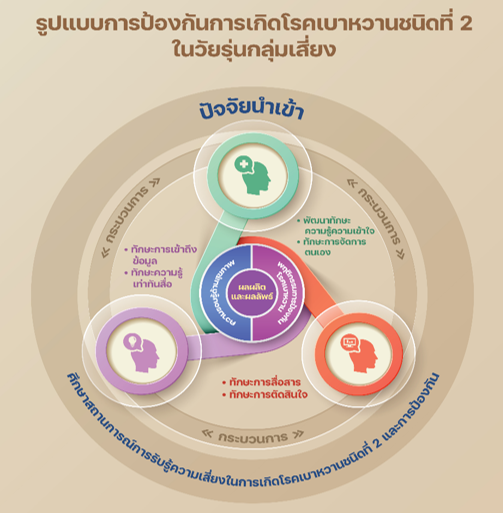
2. รูปแบบการป้องกันโรคเบาหวานชนิดที่ 2 ในวัยรุ่นกลุ่มเสี่ยง ประกอบด้วย 1) ทักษะความรู้ความเข้าใจและทักษะการจัดการตนเอง 2) ทักษะการเข้าถึงข้อมูลและทักษะการรู้เท่าทันสื่อ และ 3) ทักษะการสื่อสารและทักษะการตัดสินใจ เมื่อนำรูปแบบที่พัฒนาขึ้นไปทดลองใช้จริงพบว่า คะแนนเฉลี่ยความรอบรู้ด้านสุขภาพและพฤติกรรมการป้องกันการเกิดโรคเบาหวานชนิดที่ 2 หลังใช้รูปแบบสูงกว่าก่อนการใช้รูปแบบอย่างมีนัยสำคัญทางสถิติที่ระดับ .001 (t = 4.19, p-value < .001, t = 5.76, p-value < .001) ตามลำดับ
รูปแบบการป้องกันโรคเบาหวานชนิดที่ 2 ในวัยรุ่นกลุ่มเสี่ยงมีประโยชน์มากที่จะช่วยป้องกันวัยรุ่นกลุ่มเสี่ยงไม่ให้เป็นโรคเบาหวานในอนาคต ทำให้มีคุณภาพชีวิตที่ดี ลดค่าใช้จ่ายในระบบสาธารณสุข
เอกสารอ้างอิง
Aekplakorn, W. (2016). Thai National Health Examination Survey V--NHES V study group. Health System Research Institute. (in Thai)
Aekplakorn, W., Puckcharern, H, & Satheannoppakao, W. (2021). Thai National Health Examination Survey, NHES VI 2019-2020. Bangkok. Aksorn Graphic and Design Publishing House. (in Thai)
Bureelerd, O., Songserm, N., & Charoenbut, P. (2018). Behavior modification model for preventing type 2 diabetes in primary school students, Huachiew Chlermprakiet Science and Technology Journal, 4(2), 20-29. (in Thai)
Calabria, A. (2024). Diabetes Mellitus in Children and Adolescents. Retrieved June 25, 2024 from https://www.msdmanuals.com/ professional/pediatrics/endocrine-disorders-in-children/diabetes-mellitus-in-children-and-adolescents
Cohen, J. (1988). Statistical Power Analysis for the Behavioral Sciences (2nd ed.). Hillsdale, NJ: Lawrence Erlbaum Associates, Publishers.
Faul, F., Erdfelder, E., Lang, A. G., & Buchner, A. (2007). G*power 3: A flexible statistical power analysis program for the social, behavioral, and biomedical sciences. Behavior Research Methods, 39(2), 175-191.
Fleary, S. A., Joseph, P., & Pappagianopoulos, J. E. (2018). Adolescent health literacy and health behaviors: A systematic review. Journal of Adolescence, 62, 116–127.
Freeman, J. L., Caldwell, P. H. Y., & Scott, K. M. (2023). How adolescents trust health information on social media: a systematic review. Academic pediatrics, 23(4), 703–719.
Guba, E., & Lincoln, Y. (1989). Fourth Generation Evaluation. Newbury Park, CA: Sage. Health Information System Development Office. (2023). Health Data Center (HDC). Ministry of Public Health, Thailand. Retrieved July 15, 2024 from https://www.hiso.or.th/ thaihealthstat/ area/index. php?ma=3&pf=01848101&tm=2&tp=3302. (in Thai)
Hsieh, H. F., & Shannon, S. (2005). Three approaches to qualitative content analysis. Qualitative Health Research, 15(9), 1277-1288.
International Diabetes Federation. (2021). IDF Diabetes Atlas-10th Edition. Retrieved June 14, 2024 from www.diabetesatlas.org.
Jauhari, S., Agarwal, M., Pandit, P., Bajpai, P. K., Singh, A., & James, C. D. (2025). Effectiveness of educational interventions on adolescent knowledge and practices for preventing on communicable diseases in low- and middle-income countries: a systematic review and meta-analysis. The Journal of Adolescent Health: official Publication of the Society for Adolescent Medicine, 76(5), 767–780. doi.org/10.1016/j.jadohealth.2024.12.014
Jia Jia, I. L., Zampetti, S., Pozzilli, P., & Buzzetti, R. (2024). Type 2 diabetes in children and adolescents: Challenges for treatment and potential solutions. Diabetes Research and Clinical Practice, 205, 110846. doi.org/10.1016/j.diabres.2023.110846
Kaewboran, S., Samartkit, N., & Masingboon, K. (2019). Factors predicting diabetes prevention behaviors among adolescents at risk for type II diabetes in Samutprakan. Journal of Nursing and Health Care, 37(2), 218-227. (in Thai)
Mohd Rawi, S. B., Low, Y. F. Z., Muhammad Khairus, N. F. F., Annandan, S. K., Mohd Sani, N., Mat Termizi, M. H., Ahmad, N., & Ibrahim, R. (2023). Risk perception and its predictors towards type 2 diabetes mellitus among students in Universiti Kebangsaan Malaysia. Medicine, 102(43), e35520. doi.org/10.1097/MD.0000000000035520
No-in, K. (2017). Overweight and obesity among Thai school-aged children and adolescents. Journal of The Royal Thai Army Nurses, 18 (Supplement), 1-8. (in Thai)
Nutbeam, D. (2000). Health literacy as a public health goal: A challenge for contemporary health education and communication strategies into the 21st century. Health Promotion International, 15(3), 259–267.
Nutbeam, D. (2008). The evolving concept of health literacy. Social Science & Medicine, 67(12), 2072-2078. Paakkari, L., & Okan, O. (2020). COVID-19: health literacy is an underestimated problem. The Lancet Public Health, 5(5), e249–e250. doi.org/10.1016/S2468-2667(20)30086-4.
Pinhas-Hamiel, O., & Zeitler, P. (2023). Type 2 Diabetes in Children and Adolescents- A Focus on Diagnosis and Treatment. In K. R. Feingold (Eds.) et. al., Endotext. MDText.com, Inc.
Riiser, K., Helseth, S., Haraldstad, K., Torbjørnsen, A., & Richardsen, K. R. (2020). Adolescents' health literacy, health protective measures, and health-related quality of life during the Covid-19 pandemic. PLOS ONE, 15(8), e0238161. doi.org/10.1371/journal.pone.0238161.
Rubio, M., & Blay, C. (2023). Health literacy in children and adolescents: A review of the state of the art. Medical Research Archives, 11(6). doi:10.18103/mra.v11i6.3882
Saentecha, P., & Lamluk, P. (2020). The effectiveness of a program for health literacy development in the patients with type 2 diabetes. Thai Journal of Health Education, 43(2), 150-164. (in Thai)
Stufflebeam, D. L., & Shinkfield, A. J. (2007). Evaluation Theory, Models and Applications. San Francisco, CA: Jossey-Bass. The Royal College of Physicians of Thailand, Diabetes Association of Thailand under The Patronage of Her Royal Highness Princess Maha Chakri Sirindhorn, The Endocrine Society of Thailand, Department of Medical Services, National Health Security Office. (2023). DiaClinical Practice Guideline for Diabetes 2023, Bangkok. Sri Muang Printing Co.LTD. (in Thai)
Wijitraphan, T. (2020). Effectiveness of health literacy and health behavior promoting program in risk group of diabetes mellitus at Thung Siao Primary Care Cluster, Sanpatong District, Chiangmai Province. Journal of Health Science, 29(4), 618-624. (in Thai)
World Health Organization. (2016). Global Report on Diabetes. World Health Organization. Retrieved July 10, 2024 from http://www.who.int/iris/handle/10665/204871.
Xu, H., & Verre, M. C. (2018). Type 2 diabetes mellitus in children. American Family Physician, 98(9), 590-594.
Ya-in, B. (2021). The effects of health literacy enhancement program on self-care behaviors of patients with uncontrolled diabetes type II, chumsaeng Hospital in Nakhonsawan province.Sawanpracharak Medical Journal, 18(1), 35-48. (in Thai)
ดาวน์โหลด
เผยแพร่แล้ว
ฉบับ
ประเภทบทความ
สัญญาอนุญาต
ลิขสิทธิ์ (c) 2025 วารสารการพยาบาลและการศึกษา

อนุญาตภายใต้เงื่อนไข Creative Commons Attribution-NonCommercial-NoDerivatives 4.0 International License.


