
ผลของโปรแกรมส่งเสริมการจัดการตนเองโดยใช้แอปพลิเคชันไลน์ต่อความรู้ และพฤติกรรมการป้องกันโรคไตเรื้อรังของผู้ป่วยกลุ่มเสี่ยง
บทคัดย่อ
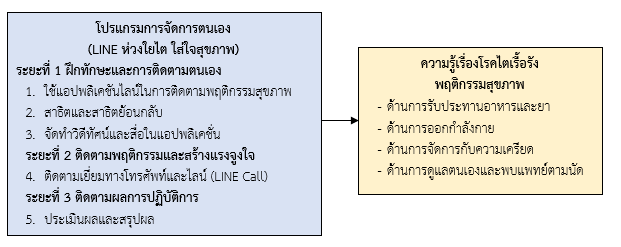
การวิจัยกึ่งทดลองแบบสองกลุ่มวัดผลก่อนและหลังนี้มีวัตถุประสงค์เพื่อศึกษาผลของโปรแกรมส่งเสริมการจัดการตนเองโดยใช้แอปพลิเคชันไลน์ต่อความรู้และพฤติกรรมการป้องกันโรคไตเรื้อรังของผู้ป่วยกลุ่มเสี่ยงในชุมชน กลุ่มตัวอย่างคือผู้ที่มีโรคประจำตัวที่เป็นสาเหตุของโรคไตเรื้อรัง ที่มีระยะเวลาเป็นโรคตั้งแต่ 1 ปีขึ้นไป จำนวน 64 คน คัดเลือกตัวอย่างแบบเฉพาะเจาะจงเป็นกลุ่มควบคุม ได้รับการพยาบาลตามปกติจำนวน 32 คน และกลุ่มทดลองได้รับการดูแลตามปกติร่วมกับโปรแกรมส่งเสริมการจัดการตนเองโดยใช้แอปพลิเคชันไลน์ เป็นเวลา 6 สัปดาห์ สื่อการสอน คือบัญชีทางการของไลน์ประกอบด้วยวิดีทัศน์และอินโฟกราฟฟิก 8 เรื่อง จำนวน 32 คน เครื่องมือที่ใช้ในการเก็บรวบรวมข้อมูล ได้แก่ แบบวัดความรู้ และแบบวัดระดับพฤติกรรมการป้องกันโรคไตเรื้อรัง วิเคราะห์ข้อมูลโดยใช้สถิติบรรยาย สถิติไคสแควร์ และสถิติที ผลการวิจัยพบว่า
1. หลังการทดลอง คะแนนเฉลี่ยความรู้และพฤติกรรมโรคไตเรื้อรังของผู้ป่วยกลุ่มทดลองสูงกว่าก่อนทดลองอย่างมีนัยสำคัญทางสถิติที่ระดับ .05, .01 และ .001 สำหรับกลุ่มควบคุมที่ได้รับการดูแลตามปกติระหว่างก่อนและหลังการทดลองไม่แตกต่าง
2. คะแนนเฉลี่ยพฤติกรรมด้านการรับประทานอาหารและยา ด้านการออกกำลังกาย และด้านการดูแลตนเองและพบแพทย์ตามนัดหลังการทดลอง ในกลุ่มทดลองสูงกว่ากลุ่มควบคุมอย่างมีนัยสําคัญทางสถิติ ที่ระดับ .001
ดังนั้นพยาบาลชุมชนสามารถนําโปรแกรมส่งเสริมการจัดการตนเองโดยใช้แอปพลิเคชันไลน์ด้านความรู้และพฤติกรรมการป้องกันโรคไตเรื้อรังของผู้ป่วยกลุ่มเสี่ยงในชุมชนที่พัฒนาขึ้นนี้ไปใช้เพื่อส่งเสริมความรู้และพฤติกรรมการป้องกันโรคไตเรื้อรังของผู้ป่วยกลุ่มเสี่ยงในชุมชนได้
เอกสารอ้างอิง
Aunsrimuang, K., Siriwattanametanon, J., & Bua-tee, S. (2013). Effects of self-management program on knowledge, self-management, and health indicators among patients with chronic kidney disease stage 3. Journal of Nurses’s association of Thailand, North-Eastern Division, 31(2), 91 – 99. (in Thai)
Bloom, B. S., Madaus, G. F., & Hastings, J. T. (1971). Handbook on Formative and Summative Evaluation of Student Learning. New York: McGraw-Hill.
GBD Chronic Kidney Disease Collaboration. (2020). Global, regional, and national burden of chronic kidney disease, 1990–2017: a systematic analysis for the Global Burden of Disease Study 2017. The Lancet, 395, 709 – 733.
Gerhardt, M. W. (2010). Individual Self-management Training in Management Education. Retrieved May 15, 2024 from https://www.researchgate.net/publication/268425764_Self-Management_Tutorials_Individual_Self-Management_Training_in_Management_Education
Hamalee, C., Piphatvanicha, N., & Paokanha, R. (2014). Effect of the perceived health belief promoting program on behavior delaying progression of chronic kidney disease among the elderly with type 2 diabetes mellitus at risk of chronic kidney disease. Songklanagarind Journal of Nursing, 34(2), 67 – 86. (in Thai)
Klatinpoo, B., Oba, N., & Neawbood, S. (2020). Effects of a behavioral modification program in complication control of diabetes patients with chronic kidney complication. Journal of Health and Nursing Education, 26(1), 58 – 70. (in Thai)
Kovesdy C. P. (2022). Epidemiology of Chronic Kidney Disease: An Update 2022. International Society of Nephrology. Published by Elsevier Inc.
Nephrology Society of Thailand. (2022). Guidelines for the Management of Chronic Kidney Disease before Dialysis Therapy: 2022. Retrieved July 26, 2024 from https://www.nephrothai.org/wp-content/uploads/2023/03/CKD-guideline-2565-revised-edition.pdf (in Thai)
Nonthaburi Provincial Public Health Office. (2023). Chronic Kidney Disease Patient Statistics in Nonthaburi Province. Health Data Center (HDC). Retrieved August 1, 2024 from https://hdcservice.moph.go.th/hdc/main/index.php (in Thai)
Office of Non-Communicable Diseases, Ministry of Public Health. (2022). Annual report 2022: Division of Non-communicable Diseases, Department of Disease Control. Retrieved August 1, 2024 from http://www.thaincd.com/2016/media-detail.php?id=14502&gid=1-015-005 (in Thai)
Paulauskas, S., & Paulauskas, A. (2008). The virtualics and strategic self-management as tools for sustainable development. Technological and Economic Development of Economy, 14(1), 76-88. (in Thai)
Pochai, S., Kingkeaw, J., & Yomsriken, N. (2022). Self–management behavior of chronic kidney disease patients without dialysis treatment level 1–4 in Pho, Nongkaew and Phonkhwo sub–district, Mueng district, Sisaket province. Journal of Sakon Nakhon Hospital, 25(3), 48 – 57. (in Thai)
Posaget, P. (2021). Enhancing desirable public health behaviors in working age 25 – 29 years of age of Wang Sam Mo district, Udon Thani province, Academic Journal of Mahamakut Buddhist University Roi Et Campus, 11(2), 199 – 210. (in Thai)
Pradubpoth, K., & Kanin, S. (2021). The effects of the 3 – self health behavior modification program on changing the level of blood sugar, blood pressure and waist circumference among diabetes mellitus and hypertension risk groups in phromkhiri district, Nakhon Si Thammarat Province. Journal of MCU Nakhondhat, 8(5), 148 – 161. (in Thai)
Sa-ngrattanapiman, K., Arsa, K., & Khiewchaum, R. (2023). The effects of a self-management program in chronic kidney disease stages 3A to 4 patients on knowledge, self-management behaviors, and glomerular filtration rate, Sakaeo Crown Prince hospital, Journal of Nursing and Public Health Research, 4(1), e262291. (in Thai)
Sattayasomboon, T., & Sattayasomboon, Y. (2020). Hypertension and type 2 diabetes mellitus patients: A systematic review on the chronic care model (CCM) and self-management support (SMS). The Southern College Network Journal of Nursing and Public Health, 7(2), 232 – 243. (in Thai)
ดาวน์โหลด
เผยแพร่แล้ว
ฉบับ
ประเภทบทความ
สัญญาอนุญาต
ลิขสิทธิ์ (c) 2025 วารสารการพยาบาลและการศึกษา

อนุญาตภายใต้เงื่อนไข Creative Commons Attribution-NonCommercial-NoDerivatives 4.0 International License.


