
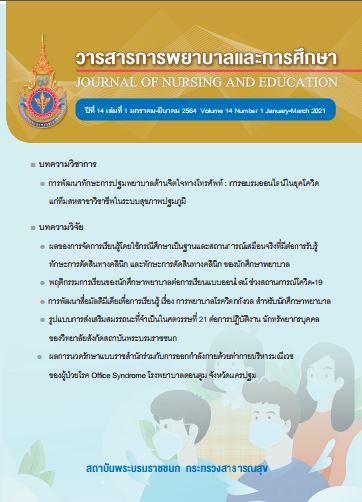
การพัฒนาทักษะการปฐมพยาบาลด้านจิตใจทางโทรศัพท์ : การอบรมออนไลน์ในยุดโควิดแก่ทีมสหสาขาวิชาชีพ ในระบบสุขภาพปฐมภูมิ
บทคัดย่อ
การระบาดของโควิด 19 ส่งผลกระทบต่อสุขภาพจิตของประชาชน กระทรวงสาธารณสุขกำหนดให้บุคลากรในระบบสุขภาพปฐมภูมิโดยทีมสหสาขาวิชาชีพในหน่วยบริการปฐมภูมิและเครือข่ายหน่วยบริการปฐมภูมิเป็นด่านหน้าในการช่วยเหลือประชาชน ซึ่งจำเป็นต้องใช้การปฐมพยาบาลด้านจิตใจเป็นเครื่องมือในการให้บริการ เพื่อให้เป็นไปตามมาตรการการเว้นระยะห่างในการป้องกันการแพร่ระบาดของเชื้อโรคโควิด การอบรมแบบออนไลน์เพื่อพัฒนาทีมสหสาขาวิชาชีพจึงได้ถูกพัฒนาขึ้น และปรับการให้การปฐมพยาบาลด้านจิตใจเป็นทางโทรศัพท์ บทความนี้มีวัตถุประสงค์เพื่อเสนอแนวทางการจัดอบรมแบบออนไลน์ในการพัฒนาทักษะการปฐมพยาบาลด้านจิตใจทางโทรศัพท์ โดยมีขอบเขตของบทความประกอบด้วย ผลกระทบของโควิด 19 ต่อสภาพจิตใจของประชาชน การปฏิบัติงานของทีมสหสาขาวิชาชีพในหน่วยบริการปฐมภูมิและเครือข่ายหน่วยบริการปฐมภูมิ แนวคิดการอบรมแบบออนไลน์และการปฐมพยาบาลด้านจิตใจทางโทรศัพท์ การพัฒนารูปแบบการอบรมแบบออนไลน์ และปัจจัยแห่งความสำเร็จของการอบรมแบบออนไลน์
การอบรมแบบออนไลน์ได้รับการพัฒนาขึ้นตามหลักการจัดสิ่งแวดล้อมเพื่อการศึกษา (Educational Environment Theory) และแนวคิดการเรียนรู้แบบผู้ใหญ่ (Adult Learning) ประกอบด้วย 5 ขั้นตอน ได้แก่ 1) การออกแบบเนื้อหาที่ท้าทายความรู้เดิมของผู้อบรม (Dissonance) การเตรียมการเพื่อการจัดอบรม ทั้งเนื้อหา หลักสูตร ระบบบริหารการสอน และช่องทางการสื่อสาร 2) การมอบหมายงานเพื่อขยายความรู้ใหม่ (Refinement) เน้นการกระตุ้นให้ฝึกปฏิบัติทักษะการปฐมพยาบาลด้านจิตใจทางโทรศัพท์ แสดงความเห็น และแลกเปลี่ยนเรียนรู้ 3) การจัดหรือสร้างองค์ความรู้ใหม่ (Organizational) โดยการบันทึกผลการเรียนรู้จากการอบรม 4) การแลกเปลี่ยนองค์ความรู้ใหม่ (Feedback) ทั้งในกลุ่มย่อยและกลุ่มใหญ่กับผู้เข้าอบรม และ 5) การสะท้อนกระบวนการเรียนรู้ และเรื่องที่ได้เรียนรู้ (Consolidation) ซึ่งเป็นการประเมินผลการเรียนรู้ด้วยตนเองในห้องเรียนออนไลน์
สรุป รูปแบบการอบรมแบบออนไลน์ที่พัฒนาขึ้น สามารถใช้พัฒนาทีมสหสาขาวิชาชีพให้มีความรู้ ทักษะการปฐมพยาบาลด้านจิตใจทางโทรศัพท์ ให้การช่วยเหลือประชาชนที่ได้รับผลกระทบด้านจิตใจจากการระบาดของโควิด 19 ได้อย่างมั่นใจ และมีมาตรฐานในแนวทางเดียวกัน
เอกสารอ้างอิง
2. Mekthon S, Mungchit P, Wetchapanbhesat S, Larbbenjakul S, Sriyakul D, Tassanee S, et al, Guideline of Primary Care Cluster Services. Bangkok: The Agricultural Cooperative Federation of Thailand Limited; 2015. (in Thai)
3. Caplan, G., Principles of Preventive Psychiatry. London: Tavistock; 1964.
4. Seymour-Walsh A. E., Bell A., Weber A., Smith T. Adapting to A New Reality: COVID-19 Coronavirus and Online Education in The Health Professions. Rural Remote Health. 2020 May;20(2) 6000. DOIi:10.22605/rrh6000. PMID: 32456441.
5. Roskvist, R., Eggleton K., & Smith G. F. Provision of E-Learning Programmes to Replace Undergraduate Medical Students’ Clinical General Practice Attachments During COVID-19 Stand-Down, Education for Primary Care, 2020; 31(4); 247-254. DOI: 10.1080/14739879.2020.1772123
6. Xiong J., Lipsitz O., Nasri F., Lui LMW., Gill H., Phan L., Chen-Li D., Iacobucci M., Ho R,. Majeed A., McIntyre R. S. Impact of COVID-19 Pandemic on Mental Health in The General Population: A Systematic Review. J Affect Disord. 2020 Aug 8;277:55-64. doi: 10.1016/j.jad.2020.08.001. Epub ahead of print. PMID: 32799105; PMCID: PMC7413844.
7. Brooks K. S., Webster K. R., Smith E. L., Woodland L., Wessely S., Greenberg N., & Rubin J. G., The Psychological Impact of Quarantine and How to Reduce It: Rapid Review of The Evidence. Lancet 2020; 395: 912–20. Doi: 10.1016/S0140-6736(20)30460-8
8. Ministry of Public Health. Guidelines for Public Health Practice to Manage COVID-19 Epidemic, Under the Requirements Issued in Section 9 of The Emergency Decree, B.E. 2548 (1st edition) (3 April 2020). Samut Prakan: T. S. Inter-print; 2020. (in Thai)
9. Department of Mental Health, Manual of Psychological First Aid for Care Team: People Affected by Corona Virus 2019 Pandemic. Nonthaburi: Department of Mental Health; 2020. (in Thai)
10. Downes, M. J., Mervin, M. C., Byrnes, J. M. et al. Telephone Consultations for General Practice: A Systematic Review. Systematic Reviews 2017. 6(1): 128. DOI:10.1186/s13643-017-0529-0
11. World health organization, Psychological First Aid: Guide for Field Workers. Geneva: World Health Organization. 2011.
12. The Royal Australian College of General Practitioners, Guide to Providing Telephone and Video Consultations in General Practice. East Melbourne, Victoria: The Royal Australian College of General Practitioners. 2020.
13. Pei, L., & Wu, H. Does Online Learning Work Better Than Offline Learning in Undergraduate Medical Education? A Systematic Review and Meta-Analysis. Medical Education Online, 2019; 24. DOI:10.1080/10872981.2019.1666538
14. Al-Shorbaji, N., Atun, R., Car, J., Majeed, A., & Wheeler, E. E-Learning for Undergraduate Health Professional Education: A Systematic Review Informing A Radical Transformation of Health Workforce Development. Geneva: WHO. 2015.
15. Smith, M. K., ‘David A. Kolb on Experiential Learning’, The encyclopedia of Pedagogy and Informal Education. 2010 [cited 2020/8/1]. Available from: https://infed.org/mobi/david-a-kolb-on-experiential-learning
16. Heiman H. L., Uchida T., Adams C., et al. E-Learning and Deliberate Practice for Oral Case Presentation Skills: A Randomized Trial. Med Teach. 2012; 34(12): e820-e826. DOI:10.3109/0142159X.2012.714879
ดาวน์โหลด
เผยแพร่แล้ว
ฉบับ
ประเภทบทความ
สัญญาอนุญาต

อนุญาตภายใต้เงื่อนไข Creative Commons Attribution-NonCommercial-NoDerivatives 4.0 International License.


