
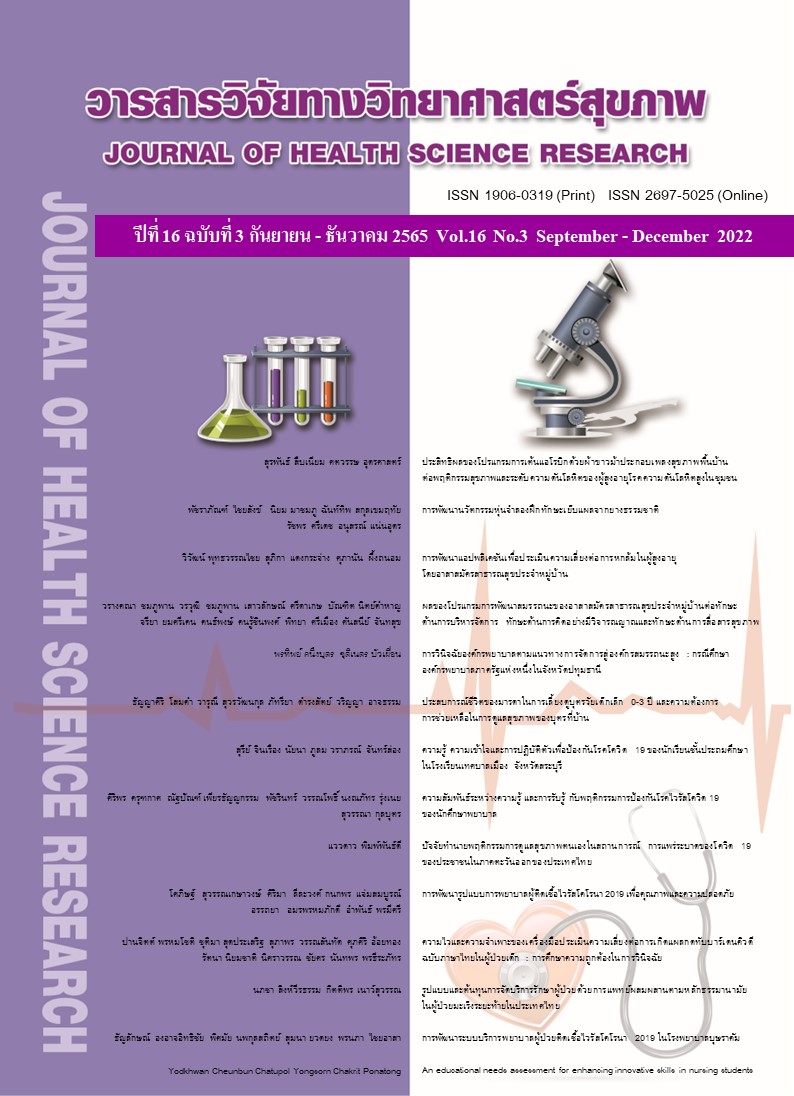
Knowledge, understanding and practices to prevent COVID-19 among primary school pupils in Municipal School, Muang, Saraburi Province
Article Sidebar
Main Article Content
Abstract
Background: The study of knowledge, understanding, and practices for self-protection from Covid-19 among primary school pupils are essential, because the findings can be baseline data for preventing and controlling the spreading of Covid-19.
Objectives: To describe the knowledge, understanding, and practices for self-protection of COVID-19 among primary school pupils.
Methods: In a descriptive study, 317 pupils from primary school grades 2-6 were selected by stratified random sampling technique. Data were collected by using a questionnaire including personal characteristics, the pupil’s understanding of COVID-19 questionnaire and the pupil’s preventing practices to COVID-19 questionnaire. The reliability of the two questionnaires were .74 and .71 respectively. The data were analyzed using descriptive statistics.
Results: The mean age of the sample was 11 years, with almost all residing in a house with 2-8 persons (76.00%). Around 30.50% did not understand about symptoms of the COVID 19 and prevention practices. They had risk activities, including going to crowded places (91.10%), touch their face, nose eye and mouth by hand (89.50%), played the sport team (84.60%) and had a meal together in their house and did not keep distance (75.20%).
Conclusions: The results of the study showed most samples lacking of knowledge in understanding about the symptoms of Covid-19 and that most of them had incorrect preventing practice. This reflects the risk in Covid-19 both in their household and school settings. Therefore, symptoms of the COVID-19 disease and prevention should be promoted in accordance with the developmental stage of children.
Downloads
Article Details

This work is licensed under a Creative Commons Attribution-NonCommercial-NoDerivatives 4.0 International License.
บทความที่ได้รับการตีพิมพ์เป็นลิขสิทธิ์ของวิทยาลัยพยาบาลบรมราชชนนี จังหวัดนนทบุรี
ข้อความที่ปรากฏในบทความแต่ละเรื่องในวารสารวิชาการเล่มนี้เป็นความคิดเห็นส่วนตัวของผู้เขียนแต่ละท่านไม่เกี่ยวข้องกับวิทยาลัยพยาบาลบรมราชชนนี จังหวัดนนทบุรี และคณาจารย์ท่านอื่น ในวิทยาลัยฯ แต่อย่างใด ความรับผิดชอบองค์ประกอบทั้งหมดของบทความแต่ละเรื่องเป็นของผู้เขียนแต่ละท่าน หากมีความผิดพลาดใด ๆ ผู้เขียนแต่ละท่านจะรับผิดชอบบทความของตนเองแต่ผู้เดียว
References
Reference
Center of Rapid Response for Emerging Challenges, Division of Non Communicable disease, Ministry of Public Health. COVID-19 Situation Report, No. 363 [Internet]. 2021 [cited 2020 Nov 10]; Available from: https://ddc.moph.go.th/viralpneumonia/ file/situation/situation-no 363-311263.pdf.
Office of Public Health, Saraburi Province, COVID-19 situation report 2021 [Internet]. 2021 [cited 2020 Dec 10]; Available from: https://sssaraburi.moph.go.th/covid19/view- slide-php. (in Thai).
Dong Y, Mo X, Hu Y, Qi X, Jiang F, et al. Epidemiology of COVID-19 among children in China. Prediatrics. 2020;145(6):e20200702. doi: 10.1542/peds.2020-0702.
Bi Q, Wu Y, Mei S, et al. Epidemiology and transmission of COVID-19 in Shenzhen China: Analysis of 391 cases and 1,286 of their close contacts. Lancet Infect Dis. 2020;20(8):911-9. doi: 10.1101/2020.03.03. 20028423.
Zhang R, Li Y, Zhang AL, Wang Y, Molinae MJ. Identifying airborne transmission as the dominant route for the spread of COVID-19. Proc Natl Acad Sci USA. 2020;117(26):14857-63. doi: 10.1073/pnas. 2009637117.
Zhang H, Kang Z, Gong H, Xu D, Wang J, Li Z, et al. Digestive system is apotential route of COVID-19: an analysis of single-cell co-expression pattern of key proteins in viral entry process. BMJ Gut 2020;69(6): 1010–18. doi. 10.1136/gutjnl-2020-320953.
Tian Y, Rong L, Nian W, He Y. Review article: gastrointestinal features in Covid-19 and the possibility of fecal transmission. Aliment Pharmaco Ther. 2020;51(9):843-51. doi.10.1111/apt.15731.
Mehraeen E, Salehi MA, Behnezhed F, Moghaddam HR, SeyedAlinaghi S. Transmission modes of Covid-19: a systematic review. Infect Disord Drug Targets. 2021;21(6):e170721187995. doi: 10.2174/1871526520666201116095934.
Lu X, Zhang L, Du H, et al. SARS-CoV-2 infection in children. N Engl J Med. 2020; 382(17):1663-5. doi. 10.1056/NEJMc2005073.
Zimmermann P, Curtis N. Coronavirus Infections in children including Covid-19: An Overview of the epidemiology, clinical feature, diagnosis, treatment, and prevention options in children. Pediatr Infect Dis J. 2020;39(5):355–68. doi: 10.1097/INF.00 0000000000002660.
Li F, Li YY, Liu MJ, Fang LQ, Dean NE, Wong GWK, et al. Household transmission of SARS-CoV-2 and risks factors for susceptibility and infectivity in Wuhan: a retrospective observational study. Lancet Infect Dis. 2021;21(5):617-28. doi: 10.10 16/S1473-3099(20)30981-6.
Du W, Yu J, Wang H, Zhang X, Zhang S, et al. Clinical characteristics of COVID-19 in children compared with adults in Shandong Province, China. Infection 2020;48(3): 445-52. doi: 101007/s15010-020-01427-2.
Babakr ZH, Mohamedamin P, Kakamad K. Piaget’s cognitive developmental theory: critical review. In: education quarterly reviews. 2020;2(3):517-24. doi: 10.310 14/aior.1933.02.03.84.
Office of Education, Saraburi Town Municipality, Educational Statistics, 2020. (Unpublished manuscript). (in Thai).
Krejcie RV, Morgan DW. Determining sample size for research activities. Educ Psychol Meas. 1970;30(3):607-10.
Department of Health, Ministry of Public Health. Educational manual for school to prevent the pandemic of COVID 19. 2020. p 80-81 [Internet]. 2020 [Cited 2020 Nov 15]; Available from https://multimedia. anamai.moph.go.th/associates/educational-manual-covid19. (in Thai).
Lei H, Xu X, Xiao S, Wu X, Shu Y. Household transmission of COVID 19 -a systematic review and meta-analysis. J Infect. 2020;81(6):979-97. doi: 10.1016/ j.jinf.2020.08.033.
Madewell ZJ, Yang Y, Longini IM Jr, Halloran ME, Dean NE. Factor associated with household transmission of SARS-CoV-2: an update systematic review and meta-analysis. JAMA Netw Open. 2021;4(8).e2122240. doi: 10.1001/jama networkopen.2021.22240.
Paul LA, et al. Characteristic associated with household transmission of severe acute respiratory syndrome coronavirus 2
(SAR-CoV-2) in Ontario Canada: A cohort study. Clin Infect Dis. 2021;73(10):1840-48. doi: 10.1093/cid/ciab186.
Wei WE, Li Z, Chiew CJ, Yong SE, Toh MP, Lee VJ. Presymptomatic transmission of SARS-CoV-2—Singapore, January 23-March 16, 2020. MMWR Morb Mortal Wkly Rep. 2020;69(14):411-5. doi: 10. 15585/mmwr. mm6914e1.
Calvani M, Cantiello G, Cavani M, Larcote E, Mariani B, Panetta V, et al. Reason for SAR CoV-2 infection in children and their role in the transmission of infection according to age: a case control study. Ital J Pediatr. 2021;47(1):193. doi. 10.1 186/s13052-021-01141-1.
Devecchio E, Orgiles M, Morales A, et al. Covid-19: Psychological symptoms and coping strategies in preschoolers, schoolchildren, and adolescents. J Appl Dev Psychol. 2022;79:101390. doi. 10.1016/j.appdev. 2022.10139.
Albarracin D. Wang W. Li H. Noguchi K. Structure of attitudes, judgments, memory, and implications for change. In: Attitudes and attitude change. Taylor and Francis; 2011. p19-40. doi: 10.4324/9780203838068.
