
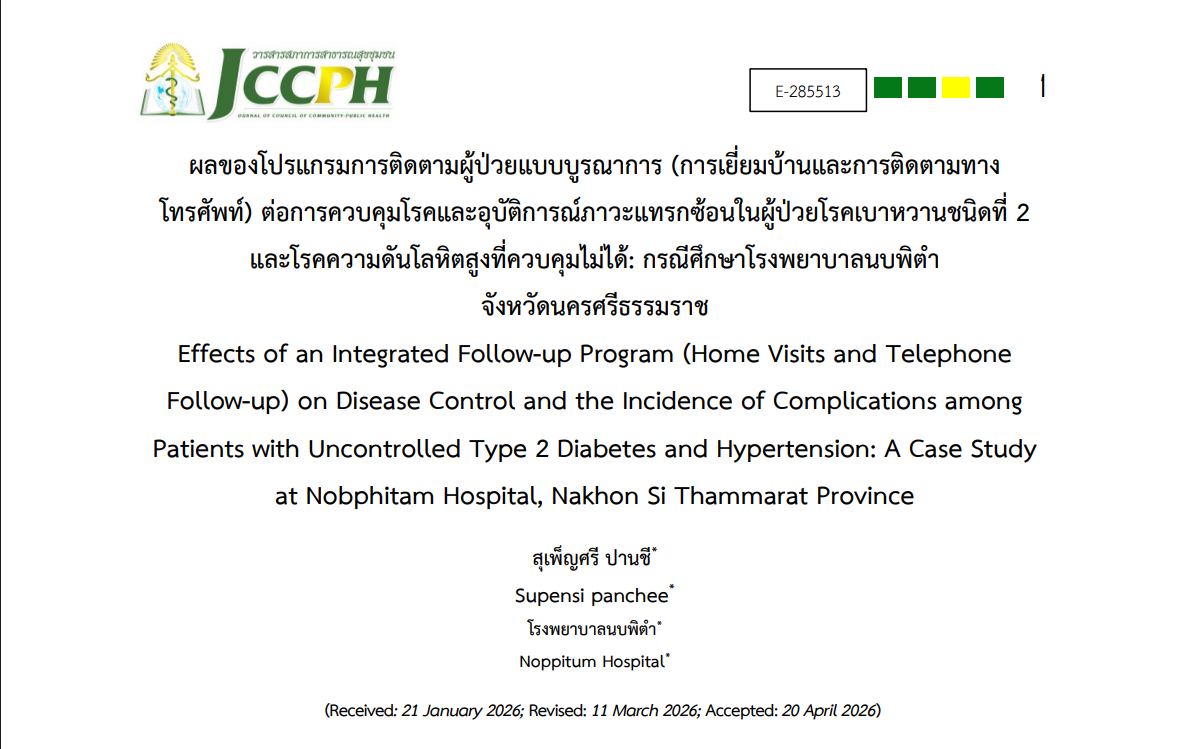
ผลของโปรแกรมการติดตามผู้ป่วยแบบบูรณาการ (การเยี่ยมบ้านและการติดตามทางโทรศัพท์) ต่อการควบคุมโรคและอุบัติการณ์ภาวะแทรกซ้อนในผู้ป่วยโรคเบาหวานชนิดที่ 2 และโรคความดันโลหิตสูงที่ควบคุมไม่ได้: กรณีศึกษาโรงพยาบาลนบพิตำ จังหวัดนครศรีธรรมราช
คำสำคัญ:
การติดตามแบบบูรณาการ, การเยี่ยมบ้าน, การติดตามทางโทรศัพท์, โรคเบาหวานและความดันโลหิตสูง, ภาวะแทรกซ้อนบทคัดย่อ
การวิจัยกึ่งทดลองนี้มีวัตถุประสงค์เพื่อศึกษาผลของโปรแกรมการติดตามผู้ป่วยแบบบูรณาการ
(การเยี่ยมบ้านและการติดตามทางโทรศัพท์) ต่อระดับน้ำตาลสะสม (HbA1c) ระดับความดันโลหิต และอุบัติการณ์ภาวะแทรกซ้อน ในผู้ป่วยโรคเบาหวานชนิดที่ 2 และโรคความดันโลหิตสูงที่ควบคุมไม่ได้ กลุ่มตัวอย่างจำนวน 152 ราย แบ่งเป็นกลุ่มทดลองและกลุ่มควบคุม กลุ่มละ 76 ราย กลุ่มทดลองได้รับโปรแกรมการเยี่ยมบ้าน โดยทีมสหวิชาชีพทุก 2 เดือนร่วมกับการติดตามทางโทรศัพท์รายเดือนเป็นเวลา 5 เดือน ส่วนกลุ่มควบคุมได้รับการดูแลตามมาตรฐานปกติ เครื่องมือวิจัยประกอบด้วยแบบบันทึกข้อมูลทางคลินิกและแนวสัมภาษณ์เชิงลึก วิเคราะห์ข้อมูลด้วยสถิติ t-test, Chi - square และการวิเคราะห์เนื้อหา โดยผลการวิจัยพบว่า หลังสิ้นสุดโปรแกรม 5 เดือน กลุ่มทดลองมีค่าเฉลี่ย HbA1c และระดับความดันโลหิตลดลงอย่างมีนัยสำคัญทางสถิติ (P-value < 0.05) และดีกว่ากลุ่มควบคุมอย่างมีนัยสำคัญ ด้านอุบัติการณ์ภาวะแทรกซ้อนรวม พบว่ากลุ่มทดลองเกิดภาวะแทรกซ้อนทางหลอดเลือดหัวใจ สมอง และไต ต่ำกว่ากลุ่มควบคุมอย่างชัดเจน (ร้อยละ 9.20 เทียบกับร้อยละ 27.60, P-value <0.05) ผลการศึกษาเชิงคุณภาพพบว่าปัจจัยสำคัญที่ส่งผลต่อการควบคุมโรคคือการที่ผู้ป่วยสัมผัสถึงความใส่ใจและการเสริมพลังผ่านการตั้งเป้าหมายสุขภาพร่วมกันที่สอดคล้องกับวิถีชีวิตจริง ข้อเสนอแนะจากการวิจัยคือ โรงพยาบาลชุมชนควรนำรูปแบบการติดตามแบบบูรณาการผ่านการเยี่ยมบ้านและการติดตามทางโทรศัพท์ไปใช้เป็นบริการประจำสำหรับผู้ป่วยกลุ่มเสี่ยงสูงเพื่อป้องกันการเกิดภาวะแทรกซ้อนรุนแรงอย่างเป็นรูปธรรม
เอกสารอ้างอิง
กองตรวจราชการ กระทรวงสาธารณสุข. (2567). บทสรุปผู้บริหาร (Executive Summary) ประเด็นที่ 4: เรื่องลดแออัด ลดรอคอย ลดป่วย ลดตาย เขตสุขภาพที่ 11 ปีงบประมาณ พ.ศ. 2567 รอบที่ 2. กระทรวงสาธารณสุข.
โรงพยาบาลนบพิตำ. (2566). รายงานสถิติผู้ป่วยโรคเบาหวานและความดันโลหิตสูง โรงพยาบาลนบพิตำ ประจำปีงบประมาณ 2566 [เอกสารภายในหน่วยงาน].
Alhasani, R., Ghosh, A., & Banerjee, D. (2023). Sample size considerations in quasi- experimental health research. Journal of Clinical Research Methods, 45(2), 115–123.
Anderson, R. M., & Funnell, M. M. (2010). Patient empowerment: Myths and misconceptions. Patient Education and Counseling, 79(3), 277-282.
Anowar, S., & Kumar, A. (2021). Effectiveness of home-based follow-up on renal outcomes among hypertension patients: A quasi-experimental study. International Journal of Hypertension Care, 12(3), 88–96.
Brownlee, M. (2001). Biochemistry and molecular cell biology of diabetic complications. Nature, 414(6865), 813-820.
Carman, K. L., Dardess, P., Maurer, M., Sofaer, S., Adams, K., Bechtel, C., & Sweeney, J. (2013). Patient and family engagement: A framework for understanding the elements and developing interventions and policies. Health Affairs, 32(2), 223-231.
Haggerty, J. L., Reid, R. J., Freeman, G. K., Starfield, B. H., Adair, C. E., & McKendry, R. (2003). Continuity of care: A multidisciplinary review. BMJ, 327(7425), 1219-1221.
Harrison, D. G., Griendling, K. K., Landmesser, U., Hornig, B., & Drexler, H. (2003). Role of oxidative stress in atherosclerosis. The American Journal of Cardiology, 91(3), 7-11.
Heisler, M., Smith, D., & Reeves, S. (2020). Improving medication adherence through structured follow-up and counseling: Evidence from chronic disease programs. Chronic Care Management Review, 18(4), 210–218.
International Diabetes Federation. (2024). IDF Diabetes Atlas (11th ed.).
Kim, J. (2016). Statistical power analysis in health science research. Springer.
Lorig, K. R., & Holman, H. R. (2003). Self-management education: History, definition, outcomes, and mechanisms. Annals of Behavioral Medicine, 26(1), 1-7.
National Health Examination Survey Office. (2021). The Sixth Thai National Health Examination Survey (NHES VI: 2019–2020). Ministry of Public Health.
Nunnally, J. C., & Bernstein, I. H. (1994). Psychometric theory (3rd ed.). McGraw-Hill.
Osterberg, L., & Blaschke, T. (2005).
Adherence to medication. New England Journal of Medicine, 353(5), 487-497.
Pimkhae, S., Kongsomboon, K., & Prasertsuk, P. (2022). Proactive follow-up program to improve glycemic control among type 2 diabetes patients in community hospitals. Journal of Public Health Nursing, 36(1), 55–66.
Wang, Y., Li, T., & Zhou, J. (2019). Telephone-based support for improving antihypertensive medication adherence: A randomized controlled trial. BMC Cardiovascular Disorders, 19(1), 245–253.
World Health Organization. (2003). Adherence to long-term therapies: Evidence for action. Geneva: World Health Organization.
World Health Organization. (2021). Hypertension: Key facts. https://www.who.int/news-room/fact-sheets/detail/hypertension
World Health Organization. (2022). Global report on diabetes and hypertension: Trends, prevention, and burden. WHO Press.
World Health Organization. (2023). Global report on hypertension: The race against a silent killer. WHO Press.
ดาวน์โหลด
เผยแพร่แล้ว
ฉบับ
ประเภทบทความ
สัญญาอนุญาต
ลิขสิทธิ์ (c) 2026 วารสารสภาการสาธารณสุขชุมชน

อนุญาตภายใต้เงื่อนไข Creative Commons Attribution-NonCommercial-NoDerivatives 4.0 International License.
- บทความหรือข้อคิดเห็นใด ๆ ที่ปรากฏในวารสารสภาการสาธารณสุขชุมชน ที่เป็นวรรณกรรมของผู้เขียน บรรณาธิการ ไม่จำเป็นต้องเห็นด้วย
- บทความที่ได้รับการตีพิมพ์ถือเป็นลิขสิทธิ์ของ วารสารสภาการสาธารณสุขชุมชน


