
พฤติกรรมการป้องกันโรคจากไวรัสโคโรนา 2019 ของนักศึกษา มหาวิทยาลัยราชภัฏสงขลา
คำสำคัญ:
คำสำคัญ: โรคไวรัสโคโรนา 2019, พฤติกรรมการป้องกันจากไวรัสโคโรนา 2019, ทัศนคติที่มีต่อการป้องกันโรคไวรัสโคโรนา 2019, ความรู้เกี่ยวกับโรคไวรัสโคโรนา 2019บทคัดย่อ
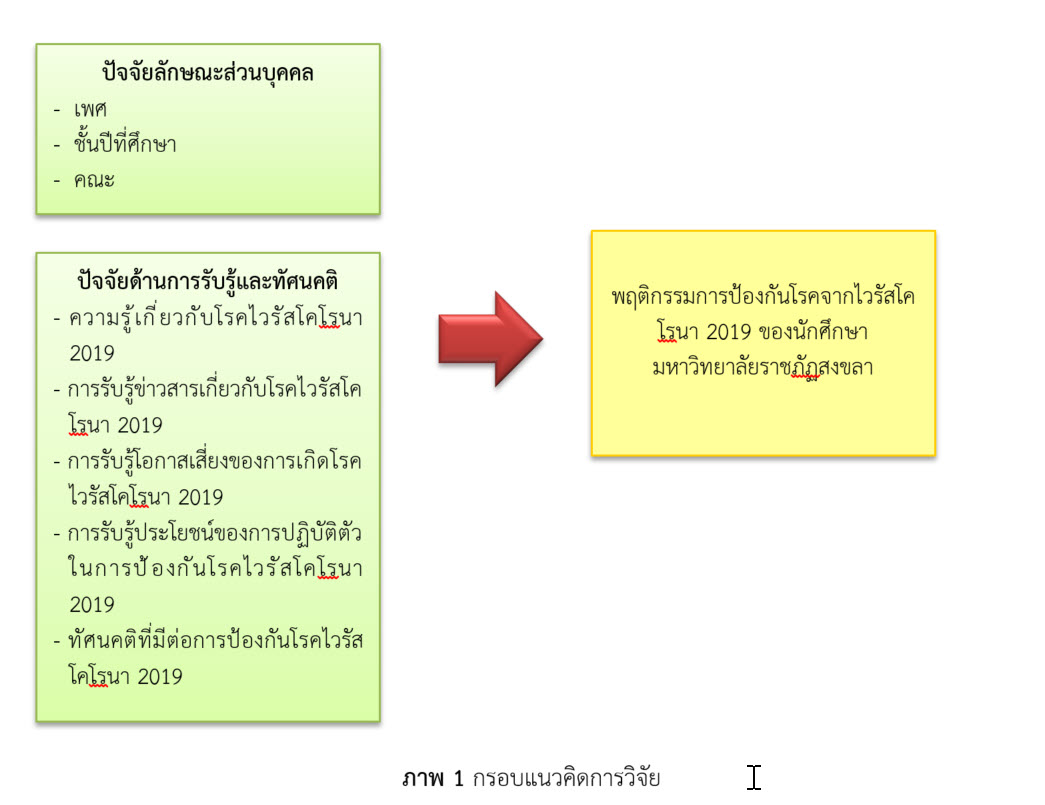
การวิจัยนี้เป็นวิจัยเชิงความสัมพันธ์ มีวัตถุประสงค์เพื่อศึกษาพฤติกรรมการป้องกันโรคไวรัสโคโรนา 2019 ของนักศึกษาในมหาวิทยาลัยราชภัฏสงขลา และหาความสัมพันธ์ระหว่างปัจจัยส่วนบุคคล ความรู้เกี่ยวกับโรค การรับรู้ข่าวสารเกี่ยวกับโรค การรับรู้โอกาสเสี่ยงของการเกิดโรค การรับรู้ประโยชน์ของการปฏิบัติตัวในการป้องกันโรค ทัศนคติที่มีต่อการป้องกันโรคไวรัสโคโรนา 2019 ต่อพฤติกรรมการป้องกันโรคจากไวรัสโคโรนา 2019 กลุ่มตัวอย่างจำนวน 370 คน เครื่องมือที่ใช้ในการวิจัยเป็นแบบสอบถามความรู้ การรับรู้โอกาสเสี่ยง การรับรู้ประโยชน์ในการปฏิบัติตัว และทัศนคติเกี่ยวกับการป้องกันโรคไวรัสโคโรนา 2019 มีค่าความเชื่อมั่นของแบบสอบถามเท่ากับ .881 วิเคราะห์ข้อมูลโดยใช้สถิติพรรณนา ผลการวิจัยพบว่า
- นักศึกษามากกว่าร้อยละ 80 มีความรู้เกี่ยวกับโรคไวรัสโคโรนา 2019 ในระดับที่ดี ร้อยละ 61.62 มีการรับรู้โอกาสเสี่ยงอยู่ในระดับสูง (M=4.56, SD=.682) มีการรับรู้ประโยชน์ของการปฏิบัติอยู่ในระดับสูง (M=4.67, SD=.627) มีทัศนคติอยู่ในระดับสูง (M=4.18, SD=.747) และมีพฤติกรรมการป้องกันโรคไวรัสโคโรนา 2019 อยู่ในระดับสูง (M=4.59, SD=.821)
- ความรู้เกี่ยวกับโรคไวรัสโคโรนา 2019 การรับรู้โอกาสเสี่ยงของการเกิดโรคไวรัสโคโรนา 2019 ทัศนคติในการป้องกันตัวเองจากโรคไวรัสโคโรนา 2019 มีความสัมพันธ์กับพฤติกรรมการป้องกันโรคไวรัสโคโรนา 2019 ของนักศึกษามหาวิทยาลัยราชภัฎสงขลาในระดับที่ต่ำ เป็นไปในทิศทางเดียวกัน อย่างมีนัยสำคัญทางสถิติที่ระดับ 0.05 (r=-.361, r=.496 และ r=.325 ตามลำดับ) และการรับรู้ประโยชน์ของการปฏิบัติตัวในการป้องกันโรคไวรัสโคโรนา 2019 มีความสัมพันธ์กับกับพฤติกรรมการป้องกันโรคไวรัสโคโรนา 2019 ของนักศึกษามหาวิทยาลัยราชภัฎสงขลาในระดับปานกลาง เป็นไปในทิศทางเดียวกัน อย่างมีนัยสำคัญทางสถิติที่ระดับ 0.05 (r=.546) และในทุกปัจจัยของของนักศึกษามหาวิทยาลัยราชภัฎสงขลา เป็นไปในทิศทางเดียวกัน ยกเว้น การรับรู้ด้านความรู้เกี่ยวกับโรคไวรัสโคโรนา 2019 อยู่ในระดับต่ำ มีความสัมพันธ์เป็นไปในทิศทางตรงข้าม
พฤติกรรมการป้องกันโรคจากไวรัสโคโรนา 2019 จะมีประสิทธิภาพได้นั้น จำเป็นต้องมีการชี้แจงเพื่อให้ทราบถึงสถานการณ์ รวมทั้งภาครัฐ เอกชน มหาวิทยาลัย เข้ามามีส่วนร่วมเป็นแกนนำในการขับเคลื่อน โดยการปฏิบัติอย่างจริงจังและต่อเนื่อง จึงจะสามารถขับเคลื่อน และขยายผลต่อไปได้อย่างยั่งยืน
เอกสารอ้างอิง
กชกร สมมัง. (2557). ปัจจัยที่มีความสัมพันธ์ตอพฤติกรรมการป้องกันโรคไข้หวัดใหญ่ของผู้รับบริการงานผู้ป่วยนอก โรงพยาบาลพระนารายณ์มหาราช. เล่มที่ 126 วารสารสุขศึกษา. กรมควบคุมโรค. (2563). รายงานสถานการณ์ โควิด-19. สืบค้นเมื่อ 20 พฤษภาคม 2563 จาก https://covid19.ddc.moph.go.th.
กรมสุขภาพจิต. (2563). ความเสี่ยง และผลกระทบต่อผู้สูงอายุในช่วง Covid-19 สืบค้นเมื่อ 20 พฤษภาคม 2563 จาก https://www.dmh.go.th/news-dmh/view.asp?id=30794.
บุญใจ ศรีสถิตย์นรากูร. (2550). ระเบียบวิธีการวิจัยทางพยาบาลศาสตร์. (พิมพ์ครั้งที่ 4). กรุงเทพฯ: ยูแอนด์ไอ อินเตอร์มีเดีย.
แพทยสภา. (2563). เรื่องน่ารู้เกี่ยวกับโรคติดเชื้อ COVID-19 จากเชื้อไวรัส SARS-CoV-2. สืบค้นเมื่อ 20 พฤษภาคม 2563 จาก https://tmc.or.th/covid19/download/pdf/tmc-covid19-19.pdf?fbclid=IwAR1FgAywRopZD XGnUrQawhG2jGfAyMWNliFHYfys5q8zxyOaTFF0Qi7X3SA.
มหาวิทยาลัยราชภัฏสงขลา. (2563). ประวัติมหาวิทยาลัย (Online). สืบค้นเมื่อ 22 กรกฎาคม 2563. https://www.skru.ac.th/th/about/history.
มหาวิทยาลัยราชภัฏสงขลา. (2563). สถิตินักศึกษาประจำปีการศึกษา 2563 สืบค้นเมื่อ 22 กรกฎาคม 2563 จากhttp://regis.skru.ac.th/RegisWeb/webpage/information_std.php.
มหาวิทยาลัยราชภัฏสงขลา. (2563). หน่วยงาน. สืบค้นเมื่อ 22 กรกฎาคม 2563 จาก https://sci.skru.ac.th/science/index.php.
รัฐบาลไทย. (2563). ศูนย์บริหารสถานการณ์โควิด-19. สืบค้นเมื่อ 20 พฤษภาคม 2563 จาก https://www.thaigov.go.th.
สัญญา สุปัญญาบุตร. (2554). ปัจจัยที่มีผลต่อการปฏิบัติตนเพื่อป้องกันโรคไข้หวัดใหญ่ ชนิด A (2009 H1N1) ของประชาชนอำเภอนามน จังหวัดกาฬสินธุ์. สำนักงานป้องกันควบคุมโรคที่ 6 ขอนแก่น.
สุพิดา เย็นโพคา. (2553). ปัจจัยที่ส่งผลต่อพฤติกรรมการป้องกันโรคไข้หวัดใหญ่สายพันธุ์ใหม่ 2009 ของนักเรียนช่วงชั้นที่ 3 สังกัดกรุงเทพมหานคร กลุ่มเขตกรุงเทพตะวันออก. ปริญญานิพนธ์การศึกษามหาบัณฑิต (การวิจัยและสถิติทางการศึกษา). มหาวิทยาลัยศรีนครินทรวิโรฒ.
Becker, M. H. (1974). Thehealthbelief Model Andsickrole Behavior. InM. H. Becker (Ed.), The Health Belief Model and Personal Health Behavior (pp. 82-92). Thorofare, NJ: Charles B.Slack.
ดาวน์โหลด
เผยแพร่แล้ว
ฉบับ
ประเภทบทความ
สัญญาอนุญาต
- บทความหรือข้อคิดเห็นใด ๆ ที่ปรากฏในวารสารสภาการสาธารณสุขชุมชน ที่เป็นวรรณกรรมของผู้เขียน บรรณาธิการ ไม่จำเป็นต้องเห็นด้วย
- บทความที่ได้รับการตีพิมพ์ถือเป็นลิขสิทธิ์ของ วารสารสภาการสาธารณสุขชุมชน


