
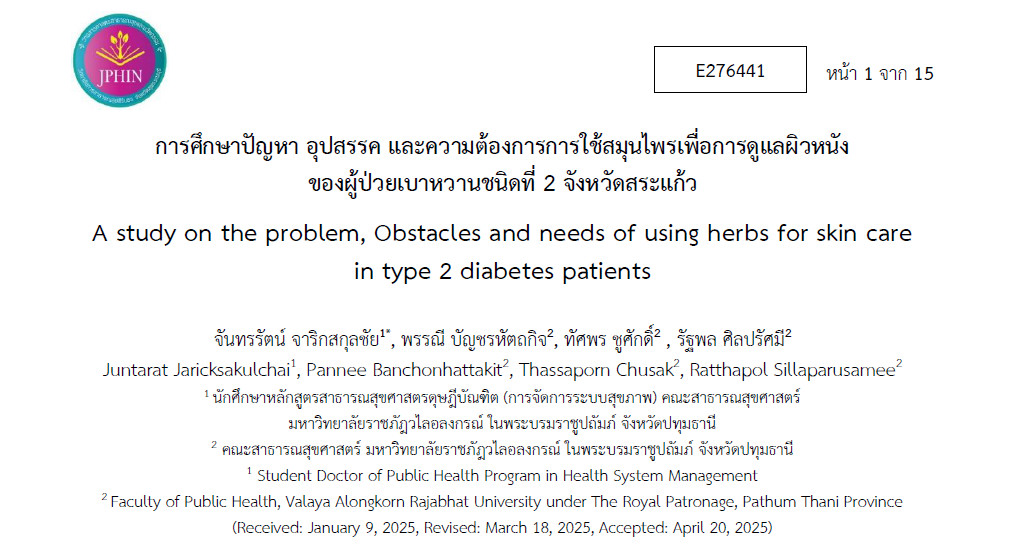
A study on the problem, Obstacles and needs of using herbs for skin care in type 2 diabetes patients
Keywords:
Using herbs, Skin health care, Type 2 diabetic patientsAbstract
This qualitative research aims to 1) study the problems, obstacles and needs of using herbs for skin care in type 2 diabetes patients and 2) Study the use of herbs that are on the primary health care list of local wisdom scholar and Thai traditional medicine personnel. The sample groups for data collection consisted of 8 patients, 8 caregivers, 4 Thai traditional medicine personnel, and 4 local wisdom scholars. The tool used was an in-depth interview and data were analyzed using content analysis.
The results of the research found that 1) The problems with using herbs in skin care are lack of knowledge about diseases that affect the skin's protective system and most patients have problems with inflamed, dry and itchy skin. 2) An obstacle in using current health products is that current products are not suitable for patients' skin problems in terms of efficiency and strengthening of the skin. 3) The need for using herbs in skin care is that patients desire to use products containing Thai herbal ingredients but are limited by the usage format and convenience of use, including the properties of herbs. 4) The use of herbs by local wisdom scholars and traditional Thai medicine personnel found that most herbs used to treat skin inflammation include Centella asiatica, Turmeric, Andrographis paniculata, Clinacanthus nutans, and Piper betle leaves.
The results of this study provide basic information for developing skin care guidelines of type 2 diabetes patients with dermatitis and can develop herbal innovations that have biological effects on the skin to meet health product standards.
References
คณะเภสัชศาสตร์ มหาวิทยาลัยศิลปากร. (2560). บัวบก. สืบค้นจากhttps://thaicam.dtam.moph.go.th/ wp-content/uploads/2021/-2564.pdf
ณัฐวรรณ วรรณมณี, ภัทรดรา สิริวัฒนาวรกุล, สุกัญญา มูณี, อนงค์นาถ มณีโชติ, วิทวัส หมาดอี และ กุสุมาลย์ น้อยผา. (2564). การศึกษาสารพฤกษเคมีเบื้องต้น ปริมาณฟีนอลิกและฤทธิ์ต้านอนุมูลอิสระของสารสกัดสมุนไพรเพื่อพัฒนาเป็นเซรั่มสมุนไพรบํารุงมือ. วารสารหมอยาไทยวิจัย, 7(2), 31-44.
นทพร ชัยพิชิต. (2560). การบริบาลทางเภสัชกรรมในโรคผิวหนังอักเสบ. เชียงรายวารสาร, 9(2), 157-169.
ปัทมา แคสันเทียะ และทิพาพร กาญจนราช. (2563). ปัญหาและข้อเสนอแนะในการทดแทนยาแผนปัจจุบันด้วยยาสมุนไพรในโรงพยาบาลของรัฐ: การศึกษานำร่องจากมุมมองของบุคลากรทางการแพทย์ของโรงพยาบาลชุมชนในภาคตะวันออกเฉียงเหนือ. วารสารเภสัชกรรมไทย, 13(4), 836-847.
ผมหอม เชิดโกทา. (2563). สภาพปัญหาการอนุรักษ์พืชสมุนไพรพื้นบ้านของชุมชนตำบลหนองสังข์ อำเภออรัญประเทศ จังหวัดสระแก้ว. วารสารบัณฑิตศึกษา มหาวิทยาลัยราชภัฏวไลยอลงกรณ์ ในพระบรมราชูปถัมภ์, 14(3), 106-114.
วิชัย เอกพลากร; ลัดดา เหมาะสุวรรณ; นิชรา เรืองดารกานนท์; วราภรณ์ เสถียรนพเก้า; หทัยชนก พรรคเจริญ. (2561), สถาบันวิจัยระบบสาธารณสุข (สวรส.). นนทบุรี.
สามารถ ใจเตี้ย. (2560). ปัจจัยทำนายการใช้วัฒนธรรมสุขภาพเพื่อการเสริมสร้างสุขภาพของประชาชนลุ่มน้ำลี้ จังหวัดลำพูน. วารสารมหาวิทยาลัยคริสเตียน, 22(2), 150-158.
สายฝน ม่วงคุ้ม, พรพรรณ ศรีโสภา, วัลภา คุณทรงเกียรติ, ปณิชา พลพินิจ, วิภา วิเสโส, ชุติมา ฉันทมิตรโอภาส และชัยชาญ ดีโรจนวงศ์. (2563). ปัจจัยที่มีอิทธิพลต่อการเกิดภาวะแทรกซ้อนของหลอดเลือดแดงขนาดเล็กในผู้ที่เป็นเบาหวานชนิดที่ 2. วารสารคณะพยาบาลศาสตร์ มหาวิทยาลัยบูรพา, 28(2), 74-84.
เสาวลักษณ์ เจริญสุข, ศิรินุช ศรีเจริญเวช, ภัสรา ลานเหลือ, อภิชญา นิยมจันทร์, ศนิ ใบไม้, กนกพร แผลงฤทธิ์ และศศิภา เพียรราลึก. (2566). ผลกระทบของภาวะน้าตาลในเลือดสูงต่อโครงสร้างของผิวหนังชั้นหนังแท้ในหนูที่ถูกเหนี่ยวนาให้เป็นเบาหวาน. วารสารวิทยาศาสตร์และเทคโนโลยี, 12(3), 80-91.
อรมณี ประจวบจินดา, อินทัช ศักดิ์ภักดีเจริญ, ผกากรอง ทองดียิ่ง และสุมาลี ปานทอง. (2563). สมุนไพรในงานสาธารณสุขมูลฐานที่ช่วยรักษาอาการแพ้อักเสบของผิวหนังจากแมลงสัตว์กัดต่อย. วารสารการแพทย์แผนไทยและการแพทย์ทางเลือก, 18(3), 604-615.
International Diabetes Federation [IDF] Atlas.(2019). IDF Diabetes atlas (9th ed.). Retrieved October 5, 2024, from: http://www.diabetesatlas.org/resources/2024.
Quondamatteo F. Skin and diabetes mellitus: what do we know? Cell Tissue Res. 2014;355:1–21.
Walsh JW, Hoffstad OJ, Sullivan MO, Margolis DJ. Association of diabetic foot ulcer and death in a population-based cohort from the United Kingdom. Diabet Med., 33(11), 1493-8.
World Health Organization. (2021). World Health Statistics report 2021 monitoring health for the SDGs, sustainable development goals. https://apps.who.int/iris/handle /10665/342703
Downloads
Published
How to Cite
Issue
Section
License
Copyright (c) 2025 Sirindhorn College of Public Health, Suphanburi

This work is licensed under a Creative Commons Attribution-NonCommercial-NoDerivatives 4.0 International License.
1. บทความหรือข้อคิดเห็นใด ๆ ที่ปรากฏในวารสารศาสตร์สาธารณสุขและนวัตกรรม ที่เป็นวรรณกรรมของผู้เขียน บรรณาธิการ ไม่จำเป็นต้องเห็นด้วย
2. บทความที่ได้รับการตีพิมพ์ถือเป็นลิขสิทธิ์ของ วารสารศาสตร์สาธารณสุขและนวัตกรรม



