
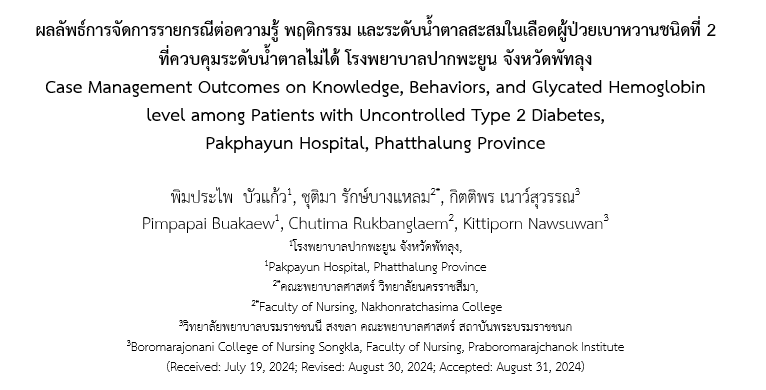
ผลลัพธ์การจัดการรายกรณีต่อความรู้ พฤติกรรม และระดับน้ำตาลสะสมในเลือดผู้ป่วยเบาหวานชนิดที่ 2 ที่ควบคุมระดับน้ำตาลไม่ได้ โรงพยาบาลปากพะยูน จังหวัดพัทลุง
คำสำคัญ:
การจัดการรายกรณี, ความรู้, พฤติกรรม, ระดับน้ำตาลสะสมในเลือด, ผู้ป่วยเบาหวานชนิดที่ 2บทคัดย่อ
การวิจัยกึ่งทดลองแบบหนึ่งกลุ่มวัดผลก่อนและหลังการทดลองนี้เพื่อศึกษาผลลัพธ์การจัดการรายกรณีต่อความรู้ พฤติกรรมสุขภาพ และระดับน้ำตาลสะสมในเลือดผู้ป่วยเบาหวานชนิดที่ 2 ที่ควบคุมระดับน้ำตาลไม่ได้ โดยเปรียบเทียบ ความรู้ พฤติกรรมสุขภาพ และระดับน้ำตาลสะสมในเลือด ระหว่างก่อนและหลังให้การดูแลตามโปรแกรมการจัดการรายกรณี ในผู้ป่วยโรคเบาหวานชนิดที่ 2 ที่ควบคุมระดับน้ำตาลในเลือดไม่ได้ ที่มารับบริการที่คลินิกเบาหวาน โรงพยาบาลปากพะยูน จำนวน 27 คน เลือกกลุ่มตัวอย่างแบบเจาะจง เครื่องมือที่ใช้ในการวิจัยคือ คู่มือโปรแกรมการจัดการรายกรณี แบบสอบถามข้อมูลส่วนบุคคล แบบประเมินความรู้เรื่องโรคเบาหวาน และแบบสอบถามพฤติกรรมสุขภาพ ได้ค่าความสอดคล้องระหว่างข้อคำถามกับวัตถุประสงค์ระหว่าง .67 -1.00 ได้ค่าความเชื่อมั่นสัมประสิทธิ์แอลฟาของครอนบาค และ ค่า KR 20 เท่ากับ .71 และ .70 ตามลำดับ วิเคราะห์ข้อมูลโดยใช้สถิติเชิงพรรณนา สถิติ Wilcoxon Signed Rank test และสถิติ Dependent t-test ผลการวิจัยพบว่า หลังใช้โปรแกรมการจัดการรายกรณี ผู้ป่วยเบาหวานชนิดที่2 ที่ควบคุมระดับน้ำตาลในเลือดไม่ได้ มีค่าเฉลี่ยคะแนนความรู้เกี่ยวกับโรคเบาหวาน (M =97.62, SD=3.45) และค่าเฉลี่ยคะแนนพฤติกรรมการดูแลตนเองเพิ่มขึ้น (M =4.24, SD=0.25) และค่าเฉลี่ยระดับน้ำตาลสะสมในเลือดลดลง (M =6.98, SD=0.93) อย่างมีนัยสำคัญทางสถิติที่ระดับ .001 ดังนั้นจากผลการวิจัยแสดงให้เห็นว่าการจัดการรายกรณีส่งผลต่อผลลัพธ์ที่ดีในการดูแลผู้ป่วยเบาหวาน เพราะส่งผลให้ผู้ป่วยควบคุมโรคได้ดี สามารถลดภาวะแทรกซ้อนต่างๆได้ในระยะยาว ซึ่งจากผลลัพธ์ที่ดีดังกล่าว สามารถนำมาปรับใช้เพื่อเป็นแนวทางในการดูแลผู้ป่วยเบาหวานและโรคเรื้อรังอื่น ๆ ต่อไป
เอกสารอ้างอิง
คณะทำงานพัฒนาแนวทางการรักษาผู้ป่วยโรคเบาหวานชนิดที่ 2 รายใหม่ ให้เข้าสู่ระยะสงบของโรคด้วยการปรับเปลี่ยนพฤติกรรมร่วมกับการตรวจระดับน้ำตาลในเลือดด้วยตนเอง. (2565). แนวทางการดูแลผู้ป่วย เบาหวาน ชนิดที่ 2 ให้เข้าสู่โรคเบาหวานระยะสงบด้วยการ ปรับเปลี่ยนพฤติกรรม อย่างเข้มงวดสำหรับ บุคลากรทางการแพทย์และสาธารณสุข. กรุงเทพฯ : ราชวิทยาลัยแพทยเวชศาสตรครอบครัวแห่งประเทศไทย.
ตวงรัตน์ อินทรแสน. (2564). ผลของการจัดการรายกรณีต่อพฤติกรรมการดูแลตนเองและระดับน้ำตาลในเลือดของผู้ป่วยโรคเบาหวานชนิดที่ 2 ที่รับบริการแผนกผู้ป่วยนอกโรงพยาบาลบ้านโป่ง. วารสารวิชาการและการพยาบาล วิทยาลัยพยาบาลบรมราชชนนี จักรีรัช. 1(1), 64 -75.
ปราณี จุลกศิลป์อภิชาต. (2566). ผลของการจัดการรายกรณีต่อผลลัพธ์ด้านผู้ป่วยของผู้ป่วยเบาหวานชนิดที่ 2ที่ ใช้อินซูลินโรงพยาบาลสุไหงโก-ลก จังหวัดนราธิวาส. วารสารมหาวิทยาลัยนราธิวาสราชนครินทร์.15(2), 49-64.
ละอองดาว ขุราศี. (2564). ผลการใชการพัฒนาโปรแกรมผู้จัดการรายกรณี สําหรับผูปวยเบาหวาน ที่รักษาระดับน้ำตาลไม่ได้ ในคลินิกเบาหวาน โรงพยาบาลเมืองสรวง. วารสารวิจัยและพัฒนานวัตกรรมทางสุขภาพ.2(2), 17-28.
ศิริอร สินธุ, พิเชต วงรอต. (2556). การจัดการรายกรณีผู้ป่วยโรคเบาหวานและความดันโลหิตสูง.
สถาบันวิจัยประชากรและสังคม มหาวิทยาลัยมหิดล. (2567). เบาหวานไม่เบาใจ NCDs ในคนไทยใกล้ตัวแค่ไหน?. สืบค้นเมื่อ 27 สิงหาคม 2567 จากhttps://www.thaihealthreport.com/th/articles_detail. php?id=228
สมาคมโรคเบาหวานแห่งประเทศไทยในพระราชูปถัมภ์สมเด็จพระเทพรัตนราชสุดาฯ สยามบรมราชกุมารี. (2562). แนวทางเวชปฏิบัติสำหรับโรคเบาหวาน. (พิมพ์ครั้งที่ 3). ปทุมธานี: บริษัท ร่มเย็นมีเดีย จำกัด
สำนักงานสาธารณสุขจังหวัด พัทลุง. (2566). กลุ่มรายงานมาตรฐาน การป่วยด้วยโรคไม่ติดต่อที่สำคัญ อัตราการป่วยด้วยโรคเบาหวาน. [อินเทอร์เนต]. พัทลุง: [เข้าถึงเมื่อ 10 ตุลาคม 2566].เข้าถึงได้จาก https://plg.hdc.moph.go.th/hdc/reports/report.php?&cat_id=6
อรรถเกียรติ กาญจนพิบูลวงศ์, ภานุวัฒน์ คำวังสง่า, สุธิดา แก้วทา. (2562). รายงานสถานการณ์ NCDs เบาหวาน ความดันโลหิตสูง และปัจจัยที่เกี่ยวข้อง. กรุงเทพ ฯ. อักษรกราฟฟิคแอนด์ดีไซน.
อรุณี ไชยฤทธิ์.(2564). โปรแกรมการจัดการรายกรณีต่อระดับน้ำตาลในเลือดของผู้ป่วยเบาหวานประเภท 2. วิทยาลัยพยาบาลบรมราชชนนี พระพุทธบาท สระบุรี ประเทศไทย. วารสารพยาบาลทหารบก. 21(2),213 – 221.
Cohen, J. (1988). Statistical power analysis for the behavioral sciences. (2nd). Hillsdale, NJ: Lawrence Erlbaum Associates, Publishers.
Faul, F., Erdfelder, E., Lang, A. G., & Buchner, A. (2007). G*Power 3: A flexible statistical power analysis program for the social, behavioral, and biomedical sciences. Behavior Research Methods, 39(2), 175-191.
ดาวน์โหลด
เผยแพร่แล้ว
รูปแบบการอ้างอิง
ฉบับ
ประเภทบทความ
สัญญาอนุญาต
ลิขสิทธิ์ (c) 2024 วิทยาลัยการสาธารณสุขสิรินธร จังหวัดสุพรรณบุรี

อนุญาตภายใต้เงื่อนไข Creative Commons Attribution-NonCommercial-NoDerivatives 4.0 International License.
1. บทความหรือข้อคิดเห็นใด ๆ ที่ปรากฏในวารสารศาสตร์สาธารณสุขและนวัตกรรม ที่เป็นวรรณกรรมของผู้เขียน บรรณาธิการ ไม่จำเป็นต้องเห็นด้วย
2. บทความที่ได้รับการตีพิมพ์ถือเป็นลิขสิทธิ์ของ วารสารศาสตร์สาธารณสุขและนวัตกรรม



