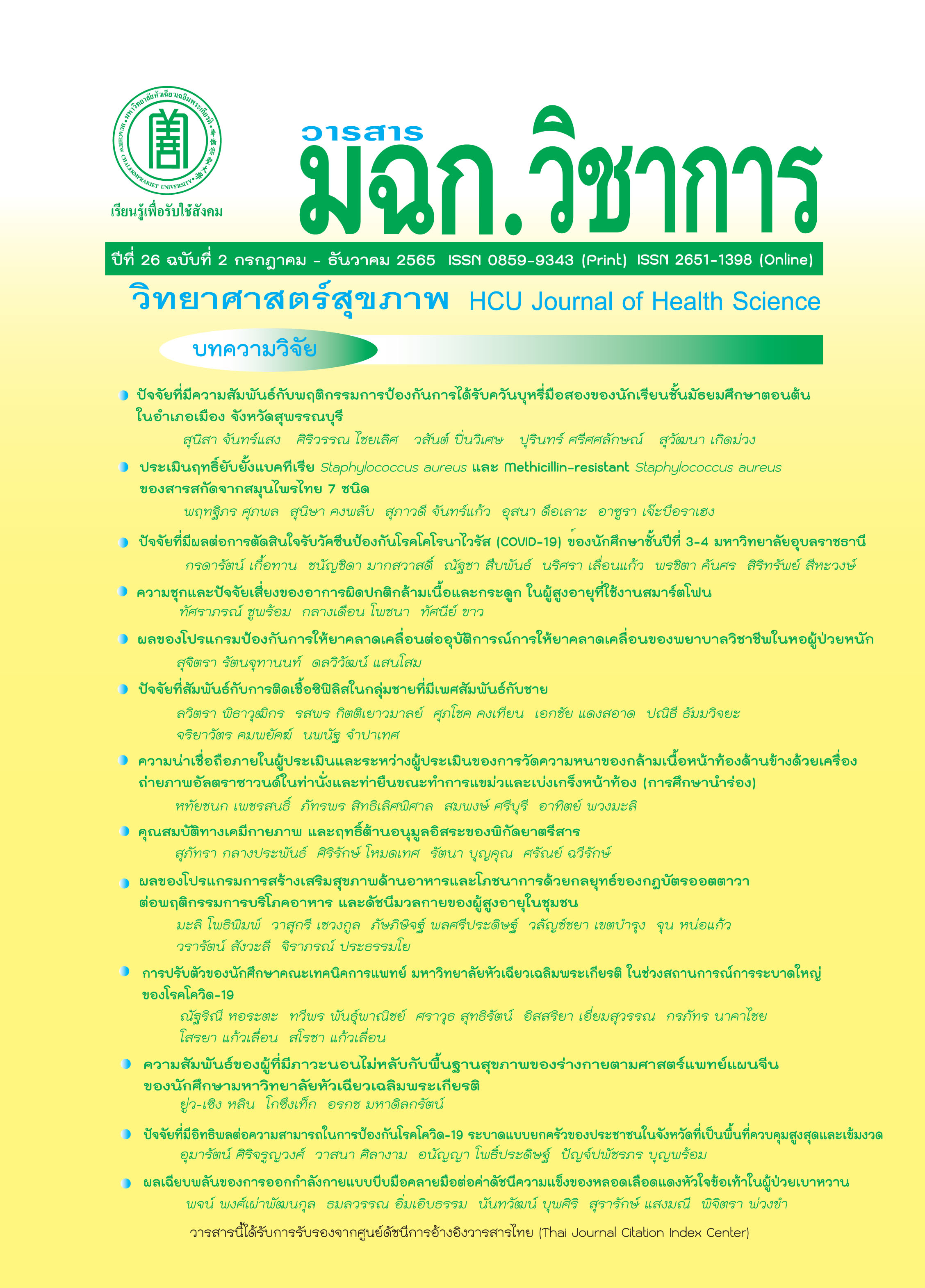
ผลเฉียบพลันของการออกกำลังกายแบบบีบมือคลายมือต่อค่าดัชนีความแข็งของหลอดเลือดแดงหัวใจข้อเท้าในผู้ป่วยเบาหวาน
คำสำคัญ:
ภาวะหลอดเลือดแดงแข็ง, ค่าดัชนีความแข็งของหลอดเลือดแดงหัวใจข้อเท้า , เบาหวาน, การออกกำลังกายบีบมือคลายมือบทคัดย่อ
การเพิ่มขึ้นของความแข็งของหลอดเลือดแดงมีความสัมพันธ์กับความเสี่ยงที่เพิ่มขึ้นของโรคหลอดเลือดหัวใจและหลอดเลือดสมอง ตัวแปรทางคลินิกดังกล่าวสามารถตรวจวัดได้โดยค่าดัชนีความแข็งของหลอดเลือดแดงหัวใจข้อเท้า (CAVI) ซึ่งผลการประยุกต์ใช้การออกกำลังกายแบบแอโรบิคและการออกกำลังกายด้วยการบีบมือเกร็งค้าง เพื่อเพิ่มการทำงานของหลอดเลือดแดงในกลุ่มผู้ป่วยโรคหลอดเลือด แสดงถึงการเพิ่มขึ้นของความแข็งตัวของหลอดเลือดแดงโดยเป็นการตอบสนองในระยะเฉียบพลัน อย่างไรก็ตาม ผลการศึกษาการออกกำลังกายแบบบีบมือคลายมือ (DHE) ในผู้ป่วยเบาหวานในประเด็นดังกล่าวยังมีอยู่อย่างจำกัด การศึกษานี้จึงมีวัตถุประสงค์เพื่อศึกษาการตอบสนองแบบเฉียบพลันของค่า CAVI ต่อการออกกำลังแบบบีบมือคลายมือ (DHE) ในผู้ป่วยเบาหวาน 14 คน และอาสาสมัครสุขภาพดี 14 คน เข้ารับการตรวจวัดค่าระบบไหลเวียนเลือดและค่า CAVI ในขณะพักและภายหลัง DHE ด้วยเวลา 3 นาที ผลการศึกษาแสดงถึง ในขณะพักผู้ป่วยเบาหวานมีค่า CAVI ฝั่งขวาและฝั่งซ้ายมากกว่าอาสาสมัครสุขภาพดี โดย DHE สามารถเพิ่มอัตราการเต้นของหัวใจ ความดันซิสโทลิก และ CAVI ของผู้ป่วยเบาหวานได้ และพบสัดส่วนการเพิ่มขึ้นที่มากกว่า ของค่า CAVI ฝั่งขวา (control vs. DM: 0.39 ± 0.48 vs. 0.78 ± 0.72, P = 0.102) และ CAVI ฝั่งซ้าย (control vs. DM: 0.24 ± 0.50 vs. 0.78 ± 0.68, P = 0.025) เมื่อเทียบกับอาสาสมัครสุขภาพดี โดยสรุป ผลแบบเฉียบพลันของ DHE ทำให้ CAVI ของผู้ป่วยเบาหวานเพิ่มสูงขึ้นในสัดส่วนที่มากกว่าคนปกติ
Downloads
เอกสารอ้างอิง
Vatner SF, Zhang J, Vyzas C, Mishra K, Graham RM, Vatner DE. Vascular stiffness in aging and disease. Front Physiol 2021;12:762437.
Miyoshi T, Ito H, Shirai K, Horinaka S, Higaki J, Yamamura S, et al. Predictive Value of the Cardio-Ankle Vascular Index for Cardiovascular Events in Patients at Cardiovascular Risk. J Am Heart Assoc 2021;10(16):e020103.
Namba T, Masaki N, Takase B, Adachi T. Arterial stiffness assessed by cardio-ankle vascular index. Int J Mol Sci 2019;20(15):3664.
Kollet DP, Marenco AB, Bellé NL, Barbosa E, Boll L, Eibel B, et al. Aerobic exercise, but not isometric handgrip exercise, improves endothelial function and arterial stiffness in patients with myocardial infarction undergoing coronary intervention: a randomized pilot study. BMC Cardiovasc Disord 2021;21(1):101.
Correia MA, Oliveira PL, Farah BQ, Vianna LC, Wolosker N, Puech‐Leao P, et al. Effects of isometric handgrip training in patients with peripheral artery disease: a randomized controlled trial. J Am Heart Assoc 2020;9(4):e013596.
Moon S-H, Moon J-C, Heo D-H, Lim Y-H, Choi J-H, Kim S-Y, et al. Increased pulse wave velocity and augmentation index after isometric handgrip exercise in patients with coronary artery disease. Clin Hypertens 2015;21(1):5.
Hartog R, Bolignano D, Sijbrands E, Pucci G, Mattace-Raso F. Short-term vascular hemodynamic responses to isometric exercise in young adults and in the elderly. Clin Interv Aging 2018;13:509-14.
Cooke AB, Dasgupta K, Spronck B, Sharman JE, Daskalopoulou SS. Adults with type 2 diabetes mellitus exhibit a greater exercise-induced increase in arterial stiffness and vessel hemodynamics. Hypertension 2020;75(6):1565-73.
Pongpaopattanakul P, Imerbtham T, Kitimala J, Phatthanawayu S, Kaewkong P. Effects of a dynamic handgrip exercise on left ventricular diastolic functions in diabetes mellitus patients: A preliminary clinical data. Chula Med J 2022;66(3):283-91.
Samuel TJ, Beaudry R, Haykowsky MJ, Sarma S, Nelson MD. Diastolic stress testing: similarities and differences between isometric handgrip and cycle echocardiography. J Appl Physiol (1985) 2018;125(2):529-35.
Garg R, Malhotra V, Kumar A, Dhar U, Tripathi Y. Effect of isometric handgrip exercise training on resting blood pressure in normal healthy adults. J Clin Diagn Res 2014;8(9):Bc08-10.
Stock JM, Chouramanis NV, Chirinos JA, Edwards DG. Dynamic and isometric handgrip exercise increases wave reflection in healthy young adults. J Appl Physiol 2020;129(4):709-17.
Chirinos JA, Segers P, Raina A, Saif H, Swillens A, Gupta AK, et al. Arterial pulsatile hemodynamic load induced by isometric exercise strongly predicts left ventricular mass in hypertension. Am J Physiol Heart Circ Physiol 2010;298(2):H320-H30.
Schultz MG, Davies JE, Roberts-Thomson P, Black JA, Hughes AD, Sharman JE. Exercise central (aortic) blood pressure is predominantly driven by forward traveling waves, not wave reflection. Hypertension 2013;62(1):175-82.
Li Y, Gu H, Fok H, Alastruey J, Chowienczyk P. Forward and backward pressure waveform morphology in hypertension. Hypertension 2017;69(2):375-81.
Roberto S, Crisafulli A. Consequences of type 1 and 2 diabetes mellitus on the cardiovascular regulation during exercise: a brief review. Curr Diabetes Rev 2017;13(6):560-5.
Staessen JA, van der Heijden-Spek JJ, Safar ME, Den Hond E, Gasowski J, Fagard RH, et al. Menopause and the characteristics of the large arteries in a population study. J Hum Hypertens 2001;15(8):511-8.
ดาวน์โหลด
เผยแพร่แล้ว
รูปแบบการอ้างอิง
ฉบับ
ประเภทบทความ
สัญญาอนุญาต
ลิขสิทธิ์ (c) 2022 วารสาร มฉก.วิชาการ

อนุญาตภายใต้เงื่อนไข Creative Commons Attribution-NonCommercial-NoDerivatives 4.0 International License.
บทความที่ได้รับการตีพิมพ์เป็นลิขสิทธิ์ของวารสารวิทยาศาสตร์สุขภาพและสุขภาวะ
ข้อความที่ปรากฏในบทความแต่ละเรื่องในวารสารวิชาการเล่มนี้เป็นความคิดเห็นส่วนตัวของผู้เขียนแต่ละท่านไม่เกี่ยวข้องกับมหาวิทยาลัยหัวเฉียวเฉลิมพระเกียรติ และคณาจารย์ท่านอื่นๆในมหาวิทยาลัยฯ แต่อย่างใด ความรับผิดชอบองค์ประกอบทั้งหมดของบทความแต่ละเรื่องเป็นของผู้เขียนแต่ละท่าน หากมีความผิดพลาดใดๆ ผู้เขียนแต่ละท่านจะรับผิดชอบบทความของตนเองแต่ผู้เดียว


