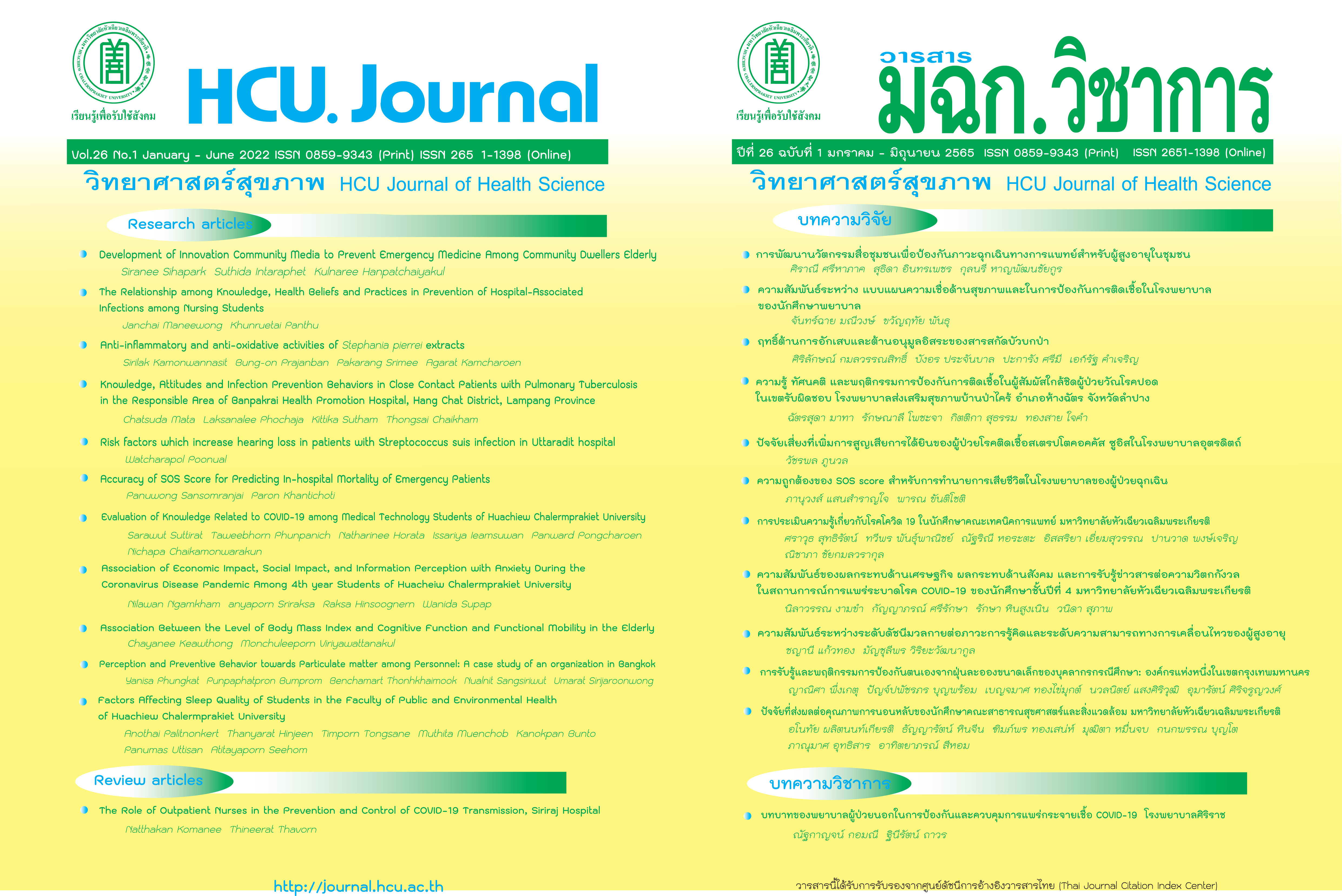
ปัจจัยเสี่ยงที่เพิ่มการสูญเสียการได้ยินของผู้ป่วยโรคติดเชื้อสเตรปโตคอคคัส ซูอิสในโรงพยาบาลอุตรดิตถ์
คำสำคัญ:
เชื้อสเตรปโตคอคคัส ซูอิส, การสูญเสียการได้ยิน, ปัจจัยเสี่ยงบทคัดย่อ
การวิจัยครั้งนี้มีวัตถุประสงค์เพื่อศึกษาปัจจัยเสี่ยงที่ทำให้เกิดการสูญเสียการได้ยินในผู้ป่วยที่ติดเชื้อสเตรปโตคอคคัส ซูอิส ในโรงพยาบาลอุตรดิตถ์ โรคติดเชื้อสเตรปโตคอคคัส ซูอิส มีแนวโน้มเพิ่มขึ้นอย่างต่อเนื่อง ซึ่งทางจังหวัดอุตรดิตถ์ มีจำนวนผู้ติดเชื้อสูงเป็นอันดับสองของจำนวนผู้ป่วยที่ติดเชื้อสเตรปโตคอคคัส ซูอิสในประเทศไทย ผู้ป่วยเหล่านี้ต้องเผชิญกับโอกาสการสูญเสียการได้ยิน รูปแบบการศึกษาเป็นการศึกษาแบบ Retrospective case-control study ข้อมูลศึกษาจากผู้ป่วยที่เข้ารับการรักษาในโรงพยาบาลอุตรดิตถ์ ช่วงระหว่างวันที่ 1 มกราคม 2552 ถึง 31 ตุลาคม 2562 ซึ่งได้รับการวินิจฉัยว่าติดเชื้อสเตรปโตคอคคัส ซูอิส เป็นครั้งแรกและมีการตรวจประเมินการได้ยินซึ่งเลือกผู้ป่วยจำนวน 92 ราย โดยแบ่งออกเป็นกลุ่มศึกษาและกลุ่มควบคุม กลุ่มศึกษาประกอบด้วยผู้ป่วยจำนวน 38 ราย ซึ่งเป็นผู้ป่วยประเภท Sensorineural hearing loss หรือประเภท Mixed hearing loss และกลุ่มควบคุมประกอบด้วยผู้ป่วยจำนวน 54 ราย ที่ไม่มีการสูญเสียการได้ยิน หรือเป็นผู้ป่วยประเภท Conductive hearing loss สถิติที่ใช้ในการศึกษา คือสถิติเชิงพรรณนาอธิบายด้วย จำนวน ร้อยละ chi-square test และ Fisher’s exact test สถิติเชิงวิเคราะห์อธิบายด้วย Odds ratio, 95% Cl
ผลการวิจัยพบว่า ภาวะไขมันในเลือดผิดปกติและโรคเยื่อหุ้มสมองอักเสบ จะเพิ่มโอกาสการสูญเสียการได้ยินอย่างมีนัยสำคัญ เพิ่มขึ้นเป็น 28.7 (95%CI=1.20-685.18, p=0.038) และ 8.2 (95%CI=1.99-14.19, p =0.004) เท่าตามลำดับ สำหรับกลุ่มผู้ป่วยที่มีโรคความดันโลหิตสูง เพศชาย และโรคไต มีโอกาสเพิ่มขึ้นเพียง 2.1 ( (95%CI=0.59-7.80, p=0.250), 1.8 (95%CI=0.38-8.68, p=0.457) และ 1.4 (95%CI=0.30-6.21, p=0.684 ) )เท่าตามลำดับ สรุป: ผู้ป่วยที่ติดเชื้อสเตรปโตคอคคัส ซูอิส ที่มีภาวะไขมันในเลือดสูง และ/หรือ โรคเยื่อหุ้มสมองอักเสบ มีความเสี่ยงที่จะสูญเสียการได้ยินเพิ่มขึ้น ดังนั้นจึงแนะนำให้เฝ้าระวังผู้ป่วยเหล่านี้เพื่อลดโอกาสการสูญเสียการได้ยิน
Downloads
เอกสารอ้างอิง
Goyette-Desjardins G, Auger J-P, Xu J, Segura M, Gottschalk M. Streptococcus suis, an important pig pathogen and emerging zoonotic agent-an update on the worldwide distribution based on serotyping and sequence typing. E M I. 2014;3(6): e45. Doi: 10.1038/emi.2014.45. Epub 2014 Jun 18.
Kidchana A, Meekhanon N, Hatrongjit R, Gottschalk M, Kerdsin A. Application of random amplified polymorphism DNA and 16S-23S rDNA intergenic spacer polymerase chain reaction-restriction fragment length polymorphism to predict major Streptococcus suis clonal complexes isolated from humans and pigs. Annual Review of Biomedical Engineering. 2019;43:34–9. doi:10.1016/j.mcp.2018.12.002
Dutkiewicz J, Sroka J, Zaj V, Wasinski B, Cisak E, Sawczyn A. Streptococcus suis: a re-emerging pathogen associated with occupational exposure to pigs or pork products. Part I–Epidemiology. Annals of Agricultural and Environmental Medicine 2017; 24(4): 683-695.
Huong V TL, Ha N, Huy N T, Horby P, Nghia H D T, Thiem V D, et al. Epidemiology, clinical manifestations, and outcomes of Streptococcus suis infection in humans. E I D. 2014;20(7):1105–14. doi:10.3201/eid2007.131594.
Rayanakorn A, Goh B-H, Lee L-H, Khan T M, Saokaew S. Risk factors for Streptococcus suis infection: A systematic review and meta-analysis. Scientific Reports. 2018;8(1):13358. doi: 10.1038/s41598-018-31598-w.
Seele J, Tauber S C, Bunkowski S, Baums C G, Valentin-Weigand P, de Buhr N, et al. The inflammatory response and neuronal injury in Streptococcus suis meningitis. BMC Infectious Diseases, 2018;18(1):297. doi:org/10.1186/s12879-018-3206-6.
Samkar A van, Brouwer M C, Schultsz C, Ende A van der, Beek D van de. Streptococcus suis Meningitis: A Systematic Review and Meta-analysis. Public Library of Science. PLOS Neglected Tropical Diseases 2015;9(10):e0004191. doi: 10.1371/journal.pmed1000097
Frisina RD, Ding B, Zhu X, Walton JP. Age-related hearing loss: Prevention of threshold declines, cell loss and apoptosis in spiral ganglion neurons. Aging (Albany NY) 2016;8(9):2081–99. doi:10.18632/aging.101045
Im GJ, Ahn JH, Lee JH, do Han K, Lee SH, Kim J-S, et al. Prevalence of severe-profound hearing loss in South Korea: A nationwide population-based study to analyse a 10-year trend (2006–2015). Scientific Reports 2018;8(1):9940. doi:10.1038/s41598-018-28279-z.
Zhang X, Weng Y, Xu Y, Xiong H, Liang M, Zheng Y, Ou Y. Selected blood inflammatory and metabolic parameters predicted successive bilateral sudden sensorineural hearing loss. Hindawi. Disease Markers 2019:e7165257. doi:org/10.1155/2019/7165257.
Meena RS, Aseri Y, Singh BK, Verma PC. Hearing loss in patients of chronic renal failure: A study of 100 cases. IJOHNS: Official Publication of the Association of Otolaryngology. 2012;64(4):356–9. doi: 10.1007/s12070-011-0405-5.
Mohammed SH, Shab-Bidar S, Abuzerr S, Habtewold TD, Alizadeh S, Djafarian K. Association of anemia with sensorineural hearing loss: A systematic review and meta-analysis. BMC 2019;12(1):283. doi: org/10.1186/s13104-019-4323-z.
Koohi N, Vickers DA, Utoomprurkporn N, Werring DJ, Bamiou D-E. A hearing screening protocol for stroke patients: an exploratory study. Frontiers in Neurology [Internet]. 2021 [cited 2021 July 1];10:1-8. Available from https://www.frontiersin.org/articles/10.3389/fneur.2019.00842/full
Dawes P, Cruickshanks KJ, Moore DR, Edmondson-Jones M, McCormack A, Fortnum H, et al. Cigarette smoking, passive smoking, alcohol consumption, and hearing loss. JARO. 2014;15(4): 663–74. doi: 10.1007/s10162-014-0461-0.
Dutkiewicz J, Sroka J, Zajac V, Wasinski B, Cisak E, Sawczyn A, et al. Streptococcus suis: A re-emerging pathogen associated with occupational exposure to pigs or pork products. Part I - Epidemiology. AAEM 2017;24(4):683–95. doi: 10.26444/aaem/79813.
Rayanakorn A, Katip W, Lee LH, Oberdorfer P. Endophthalmitis with bilateral deafness from disseminated Streptococcus suis infection. BMJ Case Reports 2019;12(2):e228501. doi: 10.1136/bcr-2018-228501.
Lin L, Xu L, Lv W, Han li, Xiang Y-Z, Fu L,et al. An NLRP3 inflammasome-triggered cytokine storm contributes to Streptococcal toxic shock-like syndrome (STSLS). PLoS pathogens 2019;15:e1007795. doi: 10.1371/journal.ppat.1007795.
Oetthong P, Anukul R, Tanburawong N, Samerchea S, Areeratana P, Lekhalula P, et al. Impact of a food safety campaign on streptococcus suis infection in humans in Thailand. The American Journal of Tropical Medicine and Hygiene 2017;96(6):1370-7. doi:10.4269/ajtmh.16-0456.
Nakamura M, Aoki N, Nakashima T, Hoshino T, Yokoyama T, Morioka S, et al. Smoking, alcohol, sleep and risk of idiopathic sudden deafness: a case-control study using pooled controls. J of Epi 2001;11(2):81–6. doi:0.2188/jea.11.81.
Huh HJ, Park K-J, Jang J-H, Lee M, Lee JH, Ahn YH, et al. Streptococcus suis meningitis with bilateral sensorineural hearing loss. The Korean Journal of Laboratory Medicine 2016;31(3):205–11. doi: 10.3343/kjlm.2011.31.3.205.
Opartpunyasarn P, Suwanpimolkul G. Bacterial meningitis: etiologies, drug susceptibilities and mortality rate at a university hospital in Thailand. Southeast Asian J Trop Med Public Health 2019;50(1):155-60.
ดาวน์โหลด
เผยแพร่แล้ว
รูปแบบการอ้างอิง
ฉบับ
ประเภทบทความ
สัญญาอนุญาต
ลิขสิทธิ์ (c) 2022 วารสาร มฉก.วิชาการ

อนุญาตภายใต้เงื่อนไข Creative Commons Attribution-NonCommercial-NoDerivatives 4.0 International License.
บทความที่ได้รับการตีพิมพ์เป็นลิขสิทธิ์ของวารสารวิทยาศาสตร์สุขภาพและสุขภาวะ
ข้อความที่ปรากฏในบทความแต่ละเรื่องในวารสารวิชาการเล่มนี้เป็นความคิดเห็นส่วนตัวของผู้เขียนแต่ละท่านไม่เกี่ยวข้องกับมหาวิทยาลัยหัวเฉียวเฉลิมพระเกียรติ และคณาจารย์ท่านอื่นๆในมหาวิทยาลัยฯ แต่อย่างใด ความรับผิดชอบองค์ประกอบทั้งหมดของบทความแต่ละเรื่องเป็นของผู้เขียนแต่ละท่าน หากมีความผิดพลาดใดๆ ผู้เขียนแต่ละท่านจะรับผิดชอบบทความของตนเองแต่ผู้เดียว


