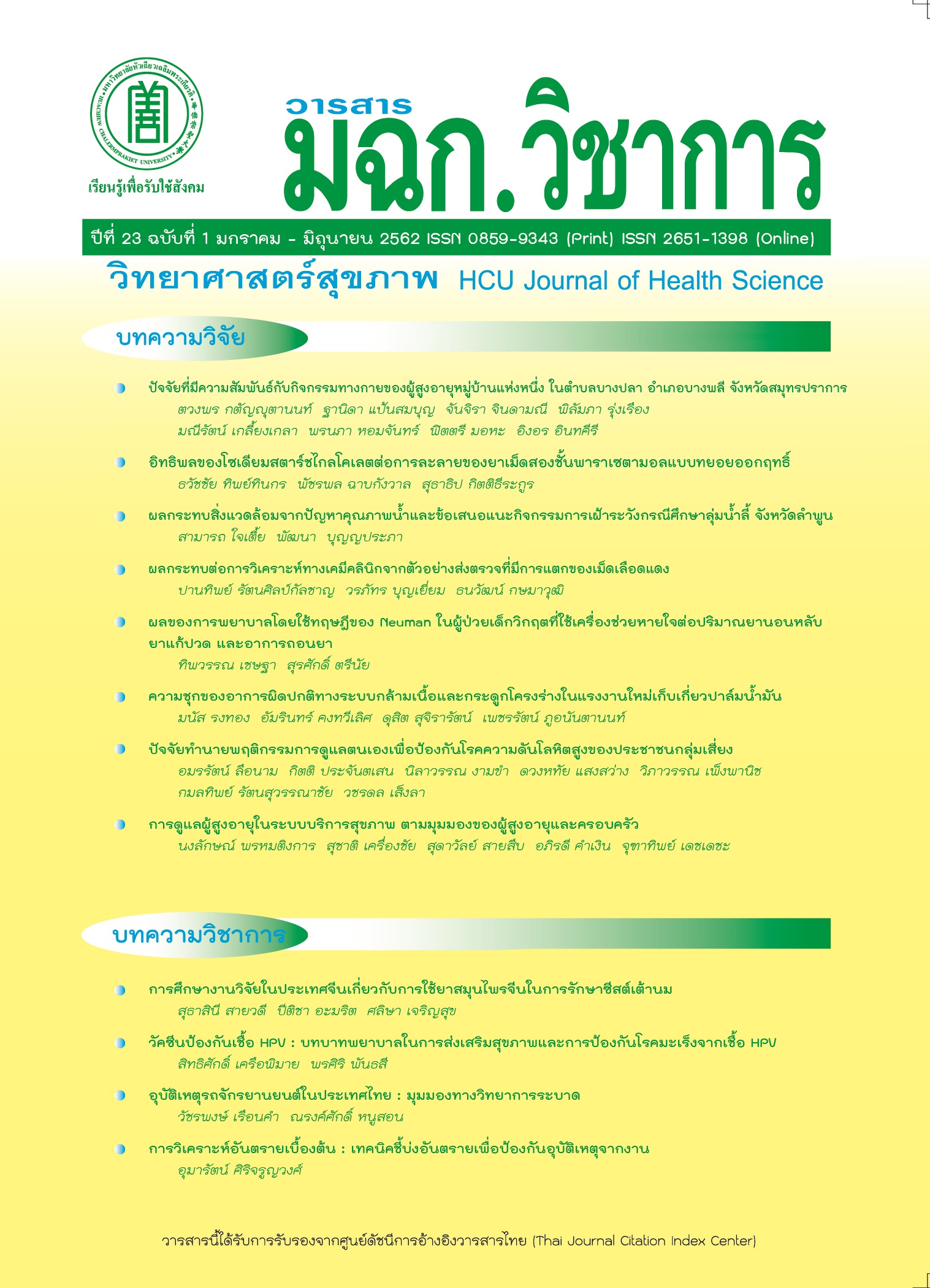
ผลของการพยาบาลโดยใช้ทฤษฎีของ Neumanในผู้ป่วยเด็กวิกฤตที่ใช้เครื่องช่วยหายใจ ต่อปริมาณยานอนหลับ ยาแก้ปวด และอาการถอนยา
คำสำคัญ:
ทฤษฎีของ Neuman, ผู้ป่วยเด็กวิกฤตที่มีภาวะหายใจล้มเหลวที่ใช้เครื่องช่วยหายใจ, ยานอนหลับ, ยาแก้ปวด, อาการถอนยาบทคัดย่อ
การวิจัยกึ่งทดลองทดลองนี้มีวัตถุประสงค์เพื่อเปรียบเทียบปริมาณยานอนหลับ ยาแก้ปวด และ อาการถอนยาระหว่างผู้ป่วยเด็กวิกฤตที่มีภาวะหายใจล้มเหลวที่ใช้เครื่องช่วยหายใจได้รับการพยาบาลโดยใช้ทฤษฎีของ Neuman กับกลุ่มที่ได้รับการพยาบาลตามปกติ คัดเลือกกลุ่มตัวอย่างตามเกณฑ์ที่กำหนดไว้ รวมทั้งสิ้น 30 คน และสุ่มเข้ากลุ่มทดลองและกลุ่มควบคุม โดยการสุ่มอย่างง่าย กลุ่มละ 15 คน เครื่องมือการวิจัยประกอบด้วย 1 ) โปรแกรมทางการพยาบาลโดยใช้ทฤษฎีของ Neuman เป็นกรอบแนวคิดเพื่อเชื่อมโยงกิจกรรมพยาบาลเพื่อป้องกันและลดการเกิดอาการถอนยา ที่ประกอบด้วย การบริหารยานอนหลับและยาแก้ปวด การสนับสนุนแบบแผนการนอนหลับ และการสัมผัสเพื่อความสุขสบาย 2) เครื่องมือที่ใช้ในการเก็บรวบรวมข้อมูล คือ แบบประเมินอาการถอนยาโดยใช้ Sophia Observation Withdrawal Scale 3) เครื่องมือกำกับการทดลอง ได้แก่ 3.1) แบบบันทึกการปฏิบัติกิจกรรมการพยาบาลในการบริหารยานอนหลับและยาแก้ปวด 3.2) แบบบันทึกการปฺฏิบัติกิจกรรมพยาบาลการสอน สาธิต และการสาธิตย้อนกลับการสัมผัสเพื่อความสุขสบาย 3.3) แบบบันทึกปฏิบัติกิจกรรมการพยาบาลในการสนับสนุนแบบแผนการนอนหลับ ซึ่งเครื่องมือทั้ง 3 ส่วนนี้ได้ผ่านการตรวจสอบความตรงตามเนื้อหา จากผู้ทรงคุณวุฒิจำนวน 5 คน เก็บรวบรวมข้อมูลปริมาณยานอนหลับ ยาแก้ปวด โดยผู้วิจัย และอาการถอนยาโดยผู้ช่วยผู้วิจัย ทุก 8 ชั่วโมง วิเคราะห์ข้อมูลโดยใช้สถิติเชิงบรรยาย การทดสอบ Mann- whitney U test และความแปรปรวนแบบวัดซ้ำ
ผลการวิจัยพบว่า ผู้ป่วยเด็กวิกฤตที่มีภาวะหายใจล้มเหลวที่ใช้เครื่องช่วยหายใจกลุ่มที่ได้รับการพยาบาลโดยใช้ทฤษฎีของ Neuman มีปริมาณยานอนหลับ ยาแก้ปวดไม่แตกต่างกันกับกลุ่มที่ได้รับการพยาบาลตามปกติ และผู้ป่วยเด็กวิกฤตที่มีภาวะหายใจล้มเหลวที่ใช้เครื่องช่วยหายใจกลุ่มที่ได้รับการพยาบาลโดยใช้ทฤษฎีของ Neuman มีคะแนนอาการถอนยาน้อยกว่ากลุ่มที่ได้รับการพยาบาลตามปกติ อย่างมีนัยสำคัญทางสถิติที่ระดับ .05
Downloads
เอกสารอ้างอิง
2. Anand KJ, Willson DF, Berger J, Harrison R, Meert KL, Zimmerman J, et al. Tolerance and withdrawal from prolonged opioid use in critically ill children. Pediatrics. 2010;125(5):e1208-e25.
3. Kudchadkar SR, Yaster M, Punjabi NM. Sedation, sleep promotion, and delirium screening practices in the care of mechanically ventilated children: a wake-up call for the pediatric critical care community. Crit Care Med. 2014;42(7):1592.
4. Rowe K, Fletcher S. Sedation in the intensive care unit. CONTINUING EDUCATION IN ANAESTHESIA, CRITICAL CARE & PAIN. 2008;8(2):50-5.
5. Macfarlane F. Paediatric anatomy and physiology and the basics of paediatric anaesthesia. London: association of anaesthesias; 2005.
6. Kress JP, Pohlman AS, O'Connor MF, Hall JB. Daily interruption of sedative infusions in critically ill patients undergoing mechanical ventilation. N Eng J Med. 2000;342(20):1471-7.
7. ณัฐวุธ สิบหมู่ ยุพิน สังวรินทะ. เภสัชวิทยา: เนื้อหาสำคัญและแบบฝึกหัด. กรุงเทพมหานคร: โฮลิสติกพับลิชชิ่ง; 2555
8. Ista E, te Beest H, van Rosmalen J, de Hoog M, Tibboel D, van Beusekom B, et al. Sophia Observation withdrawal symptoms-paediatric delirium scale: A tool for early screening of delirium in the PICU. Aust Crit Care. 2017;31(5)266-273.
9. Randolph AG, Wypij D, Venkataraman ST, Hanson JH, Gedeit RG, Meert KL, et al. Effect of mechanical ventilator weaning protocols on respiratory outcomes in infants and children: A randomized controlled trial. JAMA. 2002;288(20):2561-8.
10. Ista E, de Hoog M, Tibboel D, Duivenvoorden HJ, van Dijk M. Psychometric evaluation of the Sophia observation withdrawal symptoms scale in critically ill children. Pedr Crit Care Med. 2013;14(8):761-9.
11. Biswas AK, Feldman BL, Davis DH, Zintz EA. Myocardial ischemia as a result of severe benzodiazepine and opioid withdrawal. Clin Toxicol. 2005;43(3):207-9.
12. Sorce LR. Adverse responses: sedation, analgesia and neuromuscular blocking agents in critically ill children. Crit Care Nurs Clin North Am. 2005;17(4):441-50.
13. Neuman B, Fawcett J. The Neuman systems model. 4th ed. Upper Saddle River, NJ: Prentice Hall; 2002.
14. Poh YN, Poh PF, Buang SNH, Lee JH. Sedation guidelines, protocols, and algorithms in PICUs: a systematic review. Pediatr Crit Care Med. 2014;15(9):885-92.
15. Fuhrman BP, Zimmerman JJ, Clark RSB, Relvas M, T.Rotta A, Thompson AE, et al. Pediatric Critical Care. 5th ed. China: Elsevier,Inc; 2017.
16. Gleeson M, Timmins F. A review of the use and clinical effectiveness of touch as a nursing intervention. Clin Eff Nurs. 2005;9(1):69-77.
17. Henricson M, Berglund AL, Määttä S, Ekman R, Segesten K. The outcome of tactile touch on oxytocin in intensive care patients: a randomised controlled trial. J Clin Nurse. 2008;17(19):2624-33.
18. McCormack GL, Holsinger L. The significance of comforting touch to children with autism: Sensory processing Implications for occupational therapy. OJOT. 2016;4(2):4.
19. Burns N, Grove SK. The Practice of nursing research: Appraisal, synthesis, and generation of evidence. St. Louis, Mo: Saunders/Elsevier; 2009.
20. Ista E, van Dijk M, de Hoog M, Tibboel D, Duivenvoorden HJ. Construction of the Sophia Observation withdrawal symptoms-scale (SOS) for critically ill children. Intensive Care Med. 2009;35(6):1075-81.
21. Koo TK, Li MY. A Guideline of selecting and reporting intraclass correlation coefficients for reliability research. J Chiropr Med. 2016;15(2):155-63.
22. Jong Gt. Pediatric Development: Physiology. enzymes, drug metabolism, pharmacokinetics and pharmacodynamics. In: Bar-Shalom D, Rose K, editors. Pediatric Formulations: A roadmap. New York, NY: Springer New York. 2014;9-23.
23. Papaioannou V, Mebazaa A, Plaud B, Legrand M. ‘Chronomics’ in ICU: Circadian aspects of immune response and therapeutic perspectives in the critically ill. Intensive Car Med Exp. 2014;2(1):1.
24. Hu R-f, Jiang X-y, Zeng Y-m, Chen X-y, Zhang Y-h. Effects of earplugs and eye masks on nocturnal sleep, melatonin and cortisol in a simulated intensive care unit environment. Crit Care. 2010;14(2):1.
25. Le Guen M, Nicolas-Robin A, Lebard C, Arnulf I, Langeron O. Earplugs and eye masks vs routine care prevent sleep impairment in post-anaesthesia care unit: a randomized study. Bri J Anaesthesia. 2014;112(1):89-9.
ดาวน์โหลด
เผยแพร่แล้ว
รูปแบบการอ้างอิง
ฉบับ
ประเภทบทความ
สัญญาอนุญาต
บทความที่ได้รับการตีพิมพ์เป็นลิขสิทธิ์ของวารสารวิทยาศาสตร์สุขภาพและสุขภาวะ
ข้อความที่ปรากฏในบทความแต่ละเรื่องในวารสารวิชาการเล่มนี้เป็นความคิดเห็นส่วนตัวของผู้เขียนแต่ละท่านไม่เกี่ยวข้องกับมหาวิทยาลัยหัวเฉียวเฉลิมพระเกียรติ และคณาจารย์ท่านอื่นๆในมหาวิทยาลัยฯ แต่อย่างใด ความรับผิดชอบองค์ประกอบทั้งหมดของบทความแต่ละเรื่องเป็นของผู้เขียนแต่ละท่าน หากมีความผิดพลาดใดๆ ผู้เขียนแต่ละท่านจะรับผิดชอบบทความของตนเองแต่ผู้เดียว


