ผลลัพธ์การจัดการผู้ป่วยที่มีภาวะติดเชื้อและช็อกจากการติดเชื้อในกระแสเลือด หน่วยงานอุบัติเหตุฉุกเฉินและนิติเวช โรงพยาบาลสว่างวีระวงศ์ : การศึกษาย้อนหลัง 12 เดือน
คำสำคัญ:
ภาวะติดเชื้อในกระแสเลือด, ภาวะช็อกจากการติดเชื้อ, ผลลัพธ์การจัดการผู้ป่วยบทคัดย่อ
การวิจัยครั้งนี้เป็นการศึกษาย้อนหลัง มีวัตถุประสงค์เพื่อศึกษาผลลัพธ์การจัดการผู้ป่วยที่มีภาวะติดเชื้อและภาวะช็อกจากการติดเชื้อในกระแสเลือดที่เข้ารับการรักษาหน่วยงานอุบัติเหตุฉุกเฉินและนิติเวช โรงพยาบาลสว่างวีระวงศ์ ตัวอย่าง คือ ผู้ป่วยที่มีภาวะติดเชื้อและช็อกจากการติดเชื้อที่เข้ามารับบริการในหน่วยงานอุบัติเหตุฉุกเฉินและนิติเวช จำนวน 40 คน เลือกตัวอย่างแบบเจาะจง เครื่องมือวิจัย คือ แบบบันทึกข้อมูล ประกอบด้วย ข้อมูลส่วนบุคคลและการรักษาที่ได้รับ ผลลัพธ์ด้านกระบวนการและผลลัพธ์ด้านการรักษา วิเคราะห์ข้อมูลด้วยสถิติบรรยาย สถิติ One-sample t-test และ Wilcoxon Signed Rank test
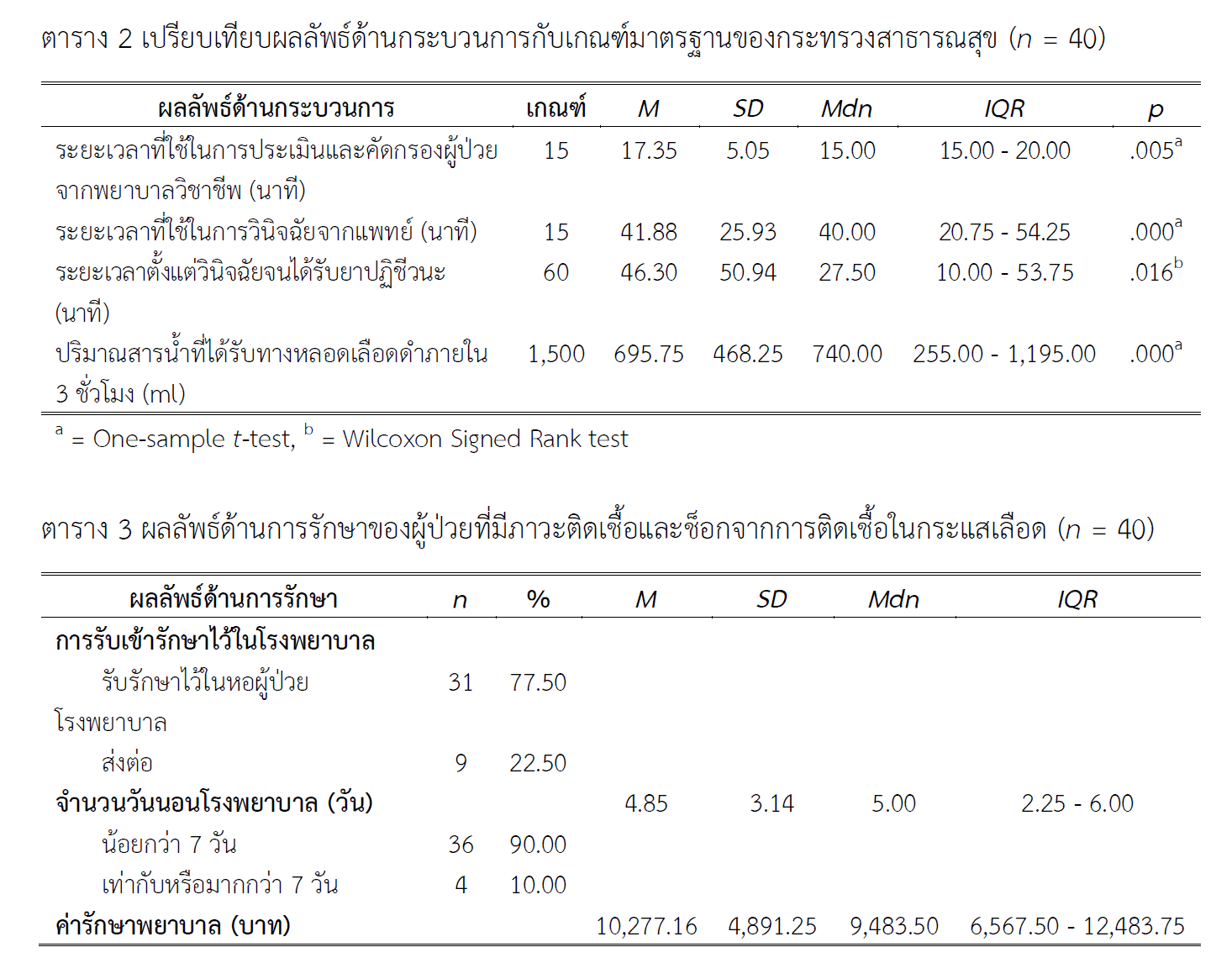
ผลการวิจัย พบว่า 1) ผลลัพธ์ด้านกระบวนการ พบว่า ระยะเวลาที่ใช้ในการประเมินและคัดกรองผู้ป่วยจากพยาบาลวิชาชีพ มีค่าเฉลี่ยเท่ากับ 17.35 นาที (SD = 5.05) และระยะเวลาที่ใช้ในการวินิจฉัยจากแพทย์ มีค่าเฉลี่ยเท่ากับ 41.88 นาที (SD = 25.93) ซึ่งใช้เวลาสูงกว่าเกณฑ์มาตรฐานของกระทรวงสาธารณสุขที่กำหนดไว้ (15 นาที) อย่างมีนัยสำคัญทางสถิติที่ระดับ .05 (p = .005 และ p = .000 ตามลำดับ) ระยะเวลาตั้งแต่วินิจฉัยจนได้รับยาปฏิชีวนะ มีค่ามัธยฐานเท่ากับ 27.50 นาที (IQR = 10.00 - 53.75) ซึ่งใช้เวลาต่ำกว่าเกณฑ์มาตรฐานของกระทรวงสาธารณสุขที่กำหนดไว้ (60 นาที) อย่างมีนัยสำคัญทางสถิติที่ระดับ .05 (p = .016) ขณะที่ปริมาณสารน้ำที่ได้รับทางหลอดเลือดดำภายใน 3 ชั่วโมง โดยที่ผู้ป่วยไม่มีข้อห้าม มีค่าเฉลี่ยเท่ากับ 695.75 มิลลิลิตร (SD = 468.25) ซึ่งใช้ปริมาณต่ำกว่าเกณฑ์มาตรฐานของกระทรวงสาธารณสุขที่กำหนดไว้ (1,500 มิลลิลิตร) อย่างมีนัยสำคัญทางสถิติที่ระดับ .05 (p = .000) และ 2) ผลลัพธ์ด้านการรักษา พบว่า ผู้ป่วยได้รับการรักษาตัวในหอผู้ป่วยใน (ร้อยละ 77.50) มีจำนวนวันนอนเฉลี่ยเท่ากับ 4.85 (SD = 3.14) วัน และมีค่ารักษาพยาบาลเฉลี่ยเท่ากับ 10,277.16 (SD = 4,891.25)
Downloads
เอกสารอ้างอิง
Arefian, H., Heublein, S., Scherag, A., Brunkhorst, F. M., Younis, M. Z., Moerer, O., . . . Hartmann, M. (2017). Hospital-related cost of sepsis: A systematic review. The Journal of Infection, 74(2), 107–117. https://doi.org/10.1016/j.jinf.2016.11.006
Donabedian, A. (2003). An introduction to quality assurance in health care. New York, NY: Oxford University Press.
Evans, L., Rhodes, A., Alhazzani, W., Antonelli, M., Coopersmith, C. M., French, C., . . . Levy, M. (2021). Surviving sepsis campaign: International guidelines for management of sepsis and septic shock 2021. Intensive Care Medicine, 47(11), 1181-1247. https://doi.org/10.1097/CCM.0000000000005337
Gavelli, F., Castello, L. M., & Avanzi, G. C. (2021). Management of sepsis and septic shock in the emergency department. Internal and Emergency Medicine, 16(6), 1649-1661. https://doi.org/10.1007/s11739-021-02735-7
Guarino, M., Perna, B., Cesaro, A. E., Maritati, M., Spampinato, M. D., Contini, C., & De Giorgio, R. (2023). 2023 Update on sepsis and septic shock in adult patients: Management in the emergency department. Journal of Clinical Medicine, 12(9), 3188. https://doi.org/10.3390/jcm12093188
Klamthuk, D., Chintapanyakun, T., & Thuankwan, K. (2025). The Outcome of management in sepsis and septic shock who admitted in an emergency department at Jainad Narendra hospital: 6-months retrospective observational cohort study. Nursing Journal of the Ministry of Public Health, 35(2), 150-161.
Kuntorn, N., Wangsrikhun, S., & Yothayai, C. (2024). Development of a multidisciplinary sepsis management model in an emergency department. Nursing Journal CMU, 51(3), 68–83.
La Via, L., Sangiorgio, G., Stefani, S., Marino, A., Nunnari, G., Cocuzza, S., . . . Maniaci, A. (2024). The global burden of sepsis and septic shock. Epidemiologia, 5(3), 456-478. https://doi.org/10.3390/epidemiologia5030032
Lamwanna, Y., Chintapanyakun, T., Charoenjunyakul, A., Sakulpipat, P., & Sompiea, D. (2024). The development of rapid response system of management in patients with sepsis and septic shock. Journal of the Police Nurses and Health Science, 16(2), 459–473.
Nonmaha, Y. (2024). The effect of the guideline for the care of patients with sepsis at emergency accidents and forensic medicine department in TaoNgoi hospital, Sakon Nakhon Province. Science and Technology to Community, 2(6), 30-47.
Public Health Strategies of the Ministry of Public Health. (2023). Public health statistics A.D. 2022. Nonthaburi: Ministry of Public Health.
Rudd, K. E., Johnson, S. C., Agesa, K. M., Shackelford, K. A., Tsoi, D., Kievlan, D. R., . . . Naghavi, M. (2020). Global, regional, and national sepsis incidence and mortality, 1990-2017: Analysis for the global burden of disease study. Lancet, 395(10219), 200–211. https://doi.org/10.1016/S0140-6736(19)32989-7
Samphaongern, N., Chenchob, P., & Ekthamasut, N. (2024). The effective of using clinical nursing practice guideline for sepsis patients in emergency department, Kongkrailat hospital, Sukhothai Province. Journal of Health and Nursing Research, 40(2), 201–212.
Sangkittipiboon, N., Sa-nganate, A., & Tabudda, P. (2024). Study on the quality of care management for patients with bloodstream infection symptoms at the inpatient nursing unit, Lopburi Cancer Hospital. Journal of Environmental and Community Health, 9(4), 196–204.
Srithumma, P. (2024). Outcome of using the nursing practice guideline for sepsis patients to prevent severity of disease progression at medical ward, Wanonniwat hospital, Sakon Nakhon province. Journal of Environmental and Community Health, 9(6), 551-561.
Wimansak, S., & Butdee, S. (2025). Effects of using nursing practice guidelines for sepsis on clinical outcome among patients with sepsis in Sop Prap hospital, Lampang province. Journal of Health Sciences Scholarship, 12(1), e274708.
ดาวน์โหลด
เผยแพร่แล้ว
รูปแบบการอ้างอิง
ฉบับ
ประเภทบทความ
สัญญาอนุญาต
ลิขสิทธิ์ (c) 2025 วารสารพยาบาลตำรวจและวิทยาศาสตร์สุขภาพ

อนุญาตภายใต้เงื่อนไข Creative Commons Attribution-NonCommercial-NoDerivatives 4.0 International License.
ผลงานที่ได้ตีพิมพ์แล้วจะเป็นลิขสิทธิ์ของวารสารพยาบาลตำรวจ