วิกฤตลมหายใจจากฝุ่น PM2.5 : การรับรู้ผลกระทบทางสุขภาพและ ประสบการณ์เผชิญปัญหาของผู้สูงอายุที่อาศัยในชุมชนชายขอบแม่น้ำโขง
คำสำคัญ:
ผู้สูงอายุ, ฝุ่น PM2.5, ผลกระทบทางสุขภาพบทคัดย่อ
การศึกษาครั้งนี้เป็นการวิจัยเชิงคุณภาพ มีวัตถุประสงค์เพื่อศึกษาการรับรู้ผลกระทบทางสุขภาพ และประสบการณ์การเผชิญปัญหาฝุ่น PM2.5 ของผู้สูงอายุที่อาศัยในชุมชนชายขอบแม่น้ำโขง คัดเลือกผู้ให้ข้อมูลแบบเฉพาะเจาะจง คือ ผู้ที่มีอายุมากกว่า 60 ปี อาศัยอยู่ในเขตเทศบาลเมืองนครพนมมากกว่า 1 ปีขึ้นไป สามารถพูด สื่อสารภาษาไทยได้เข้าใจ จำนวน 28 คน เก็บรวบรวมข้อมูลจากการสัมภาษณ์เชิงลึกโดยใช้แบบสัมภาษณ์กึ่งโครงสร้าง วิเคราะห์ข้อมูลด้วยวิธีวิเคราะห์แก่นสาระ
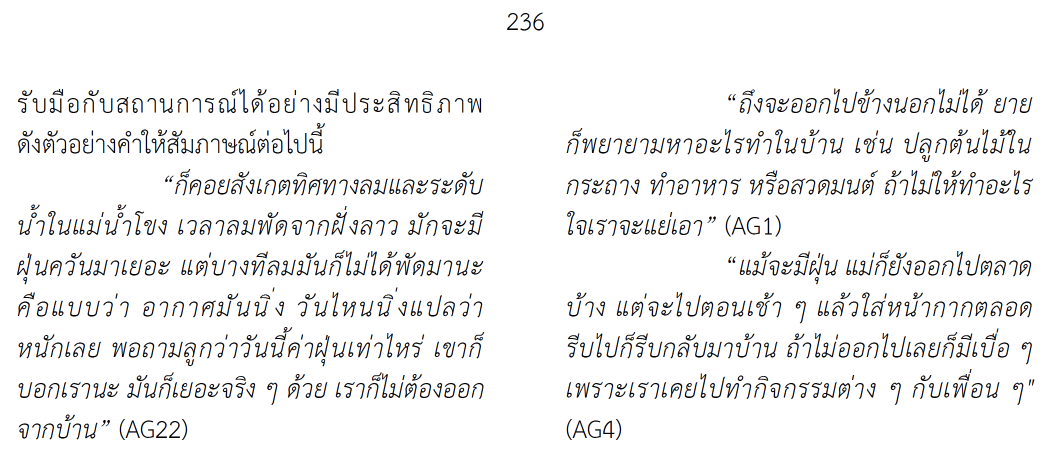
ผลการศึกษาพบว่า การรับรู้ผลกระทบทางสุขภาพจากฝุ่น PM2.5 ของผู้สูงอายุ ประกอบด้วย 3 ประเด็นหลัก ดังนี้ 1) ความรอบรู้ด้านสุขภาพขั้นพื้นฐานเป็นการรับรู้และเข้าใจภัยจากฝุ่น PM2.5 ผ่านประสบการณ์ตรง 2) ความรอบรู้ด้านสุขภาพขั้นปฏิสัมพันธ์เป็นการจัดการตนเองและการสื่อสารท่ามกลางความไม่แน่นอน และ 3) ความรอบรู้ด้านสุขภาพขั้นวิจารณญาณเป็นความสามารถในการคิดวิเคราะห์ แต่พบช่องว่างของการสนับสนุนสำหรับประสบการณ์การเผชิญปัญหา ซึ่งผู้สูงอายุมีกลยุทธ์ในการจัดการ 2 กลยุทธ์หลัก คือ 1) การปรับตัวเชิงรุกเพื่อต่อสู้กับภัยฝุ่นพิษ และ 2) การสร้างสมดุลชีวิตผ่านพลังเครือข่าย
ผลการศึกษาครั้งนี้เป็นข้อมูลพื้นฐานสำหรับการพัฒนานโยบายการจัดการมลพิษทางอากาศที่คำนึงถึงบริบทเฉพาะของชุมชนชายขอบ โดยเฉพาะพื้นที่ริมแม่น้ำโขงที่เผชิญกับมลพิษข้ามแดน
Downloads
เอกสารอ้างอิง
Chansuebsri, S., Kraisitnitikul, P., Wiriya, W., & Chantara, S. (2022). Fresh and aged PM2.5 and their ion composition in rural and urban atmospheres of Northern Thailand in relation to source identification. Chemosphere, 286, 131803. https://doi.org/10.1016/j.chemosphere.2021.131803
Diekelmann, N. L. (1992). Learning-as-testing: a Heideggerian hermeneutical analysis of the lived experiences of students and teachers in nursing. Advances in Nursing Science, 14(3), 72–83. https://doi.org/10.1097/00012272-199203000-00010
Guba, E. G., & Lincoln, Y. S. (1989). Fourth generation evaluation. Newbury Park, CA: Sage.
Heidegger, M. (1996). Being and time, translated by Joan Stambaugh. New York, NY: State University of New York Press.
Intarakamhang, U., & Health Impact Assessment Division (2020). Creating the situations report of environmental health literacy on preventing the health impacts from dust particulate matter of less than 2.5 micrometers (PM2.5) of village health volunteers in ecological industrial urban areas. Health Impact Assessment Division, Department of Health, Ministry of Public Health.
Junhasavasdikul, B., Wanikiat, P., Krobthong, A., & Chaiyasit K. (2020). Health effects of ambient air PM2.5, pathogenesis and alternative medicine treatment. Journal of Thai Traditional and Alternative Medicine, 18(1), 190-195.
Liu, L., Yan, Y., Nazhalati, N., Kuerban, A., Li, J., & Huang, L. (2020). The effect of PM2.5 exposure and risk perception on the mental stress of Nanjing citizens in China. Chemosphere, 254, 126797. https://doi.org/10.1016/j.chemosphere.2020.126797
Liu, X., Tu, R., Qiao, D., Niu, M., Li, R., Mao, Z., Huo, W., Chen, G., Xiang, H., Guo, Y., Li, S., & Wang, C. (2020). Association between long-term exposure to ambient air pollution and obesity in a Chinese rural population: The Henan rural cohort Study. Environmental Pollution, 260, 114077. https://doi.org/10.1016/j.envpol.2020.114077
Matthews, J. C., Chompoobut, C., Navasumrit, P., Khan, M. A. H., Wright, M. D., Ruchirawat, M., & Shallcross, D. E. (2023). Particle number concentration measurements on public transport in Bangkok, Thailand. International Journal of Environmental research and Public Health, 20(7), 5316. https://doi.org/10.3390/ijerph20075316
Muanhour, C., Kaewkerd, O., Amatayabundit, T., & Yodprong. S. (2024). Environmental health knowledge in preventing health impacts from PM2.5 dust particles of not more than 2.5 microns (PM2.5) of village health volunteers in Nakhon Phanom Province. Journal of Health and Environmental Studies, 9(1), 597-599.
Nguantad, S. (2025). The crisis of particulate matter 2.5 (PM2.5) affects the health of patients with acute exacerbation of chronic obstructive pulmonary disease: Role of nurses. Siriraj Medical Bulletin, 18(1), 30-40.
Nutbeam, D. (2008). The evolving concept of health literacy. Social Science & Medicine, 67(12), 2072–2078. https://doi.org/10.1016/j.socscimed.2008.09.050
Pollution Control Department. (2022). Situation and management of air and noise pollution problems. Retrieved from https://www.pcd.go.th/publication/30447/
Soontornmon, K., Wacharasint, S., Nasa, P., Charoenkun, K., & Chottanapund, S. (2025). Evaluation of the PM2.5 surveillance system in Nakhon Phanom Province, Thailand: A pilot case study. Journal of Health Systems Research, 19(1), 77-97.
Srikuankaew, A., Jiawiwatkul, A., & Thayansin, S. (2018). The relationship between happiness, health literacy and quality of life of elderly: A case study in Wiang Elderly School, Fang District, Chiang Mai Province. MFU Connexion: Journal of Humanities and Social Sciences, 7(2), 76-95.
Thai Meteorological Department. (2024). Current weather from the automatic weather station, Nakhon Phanom. Retrieved from https://www.tmd.go.th/weather/province/nakhon-phanom
Tipmalai, W., & Thammaapipon, S. (2019). Behavior and perception of the elderly rights through social networks. Journal of Management and Development Ubon Ratchathani Rajabhat University, 6(2), 247-264.
Wangsom, A., Udomkankaset, W., & Rueanrudipirom, K. (2025). Factors influencing self-protective behaviors from particulate matter 2.5 among older persons, Pathum Thani Province. Journal of Prachomklao College of Nursing, Phetchaburi Province, 8(1), 1-17.
Wirichai, R. (Ed). (2022). Guidelines/measures for health surveillance and risk communication to build literacy related to particulate matter smaller than 2.5 micrometers (PM2.5). Retrieved from https://ddc.moph.go.th/uploads/publish/1287120220815094919.pdf
World Health Organization. (2019). Health consequences of air pollution. Retrieved from https://www.who.int/news/item/25-06-2024-what-are-health-consequences-of-air-pollution-on-populations
Wu, Z., Chen, X., Li, G., Tian, L., Wang, Z., Xiong, X., . . . Pan, X. (2020). Attributable risk and economic cost of hospital admissions for mental disorders due to PM2.5 in Beijing. The Science of the Total Environment, 718, 137274. https://doi.org/10.1016/j.scitotenv.2020.137274
Yang, L., Zhang, Y., Qi, W., Zhao, T., Zhang, L., Zhou, L., Ye, L. (2021). Adverse effects of PM2.5 on cardiovascular diseases. Reviews on Environmental Health, 37(1), 71–80. https://doi.org/10.1515/reveh-2020-0155
ดาวน์โหลด
เผยแพร่แล้ว
รูปแบบการอ้างอิง
ฉบับ
ประเภทบทความ
สัญญาอนุญาต
ลิขสิทธิ์ (c) 2025 วารสารพยาบาลตำรวจและวิทยาศาสตร์สุขภาพ

อนุญาตภายใต้เงื่อนไข Creative Commons Attribution-NonCommercial-NoDerivatives 4.0 International License.
ผลงานที่ได้ตีพิมพ์แล้วจะเป็นลิขสิทธิ์ของวารสารพยาบาลตำรวจ