EFFECTS OF A PAIN MANAGEMENT AND BOWEL MOTILITY ENHANCEMENT PROTOCOL IN PATIENTS FOLLOWING URGENT ABDOMINAL SURGERY
Keywords:
nursing practice guideline, pain management, bowel motility, urgent abdominal surgery, postoperative recoveryAbstract
This quasi-experimental study aimed to compare pain scores, bowel motility, length of hospital stay, and medical expenses between two groups of patients after urgent abdominal surgery: one receiving a developed pain management and bowel motility enhancement protocol, and the other receiving standard postoperative care. The sample consisted of 56 male patients admitted to Male Surgical Ward 1 at King Narai Hospital in Lopburi Province, evenly divided into experimental and control groups (28 each). The control group received routine postoperative care, while the experimental group received an intervention protocol involving pain medication with deep breathing exercises, gum chewing, and mobilization at 24-, 48-, and 72-hour post-surgery. Data collection tools included personal data forms, pain score records, bowel motility assessments, hospital length of stay, and treatment cost records. Data were analyzed using descriptive statistics and non-parametric tests including the Mann-Whitney U test, Chi-square test, Friedman test, and Spearman’s rank correlation coefficient.
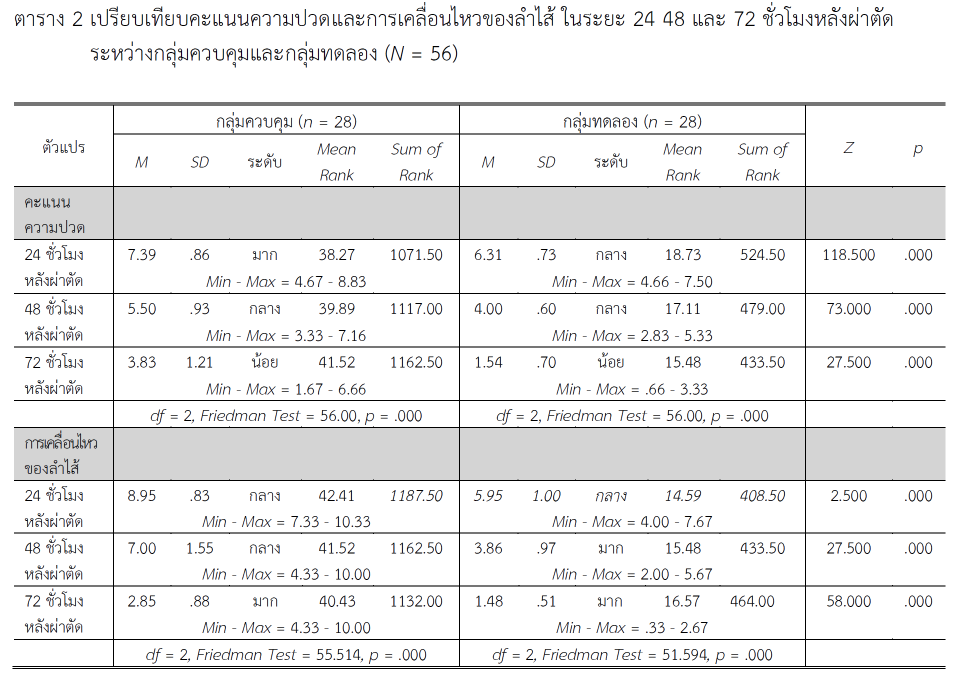
The results showed that the experimental group’s median pain scores at 24-, 48-, and 72-hour post-surgery were 6.33 (moderate), 4.00 (moderate), and 1.33 (mild), respectively, significantly lower than those in the control group (Z = 118.50, 73.00 and 27.00; p < .05). Median bowel motility scores in the experimental group were 5.83 (moderate), 3.66 (high), and 1.33 (high), which showed a significant improvement over those of the control group (Z = 2.50, 27.50 and 58.00; p < .05). However, there were no statistically significant differences between the two groups in terms of hospital stay duration or treatment costs (p > .05).
The findings of this study support that the developed practice guidelines can be appropriately applied to this patient group, particularly in clinical settings aiming to reduce postoperative pain and accelerate bowel function recovery.
Downloads
References
Anekar, A. A., & Cascella, M. (2021). WHO analgesic ladder. In StatPearls. StatPearls Publishing.
Aydemir, M., & Asgarpour, H. (2020). Effects of mechanical bowel preparation on physiological parameters of patients undergoing elective colorectal surgery: A quasi-experimental hospital-based study. International Journal of Caring Sciences, 13(1), 73-80.
Campbell, T. S., Johnson, J. A., & Zernicke, K. A. (2020). Gate control theory of pain. In Encyclopedia of behavioral medicine. Springer International Publishing, 914-916.
Dias, K. J., & Ferreira, G. (2022). Anatomy of the cardiovascular and pulmonary systems. Essentials of cardiopulmonary physical therapy (pp. 1-28) (5th ed.). St. Louis, Missouri: Elsevier.
El-Shewy, A. H., Abdalla, W. M., & Baghdadi, M. A. (2020). Enhanced recovery after surgery protocol in colorectal surgery. The Egyptian Journal of Surgery, 39(1), 94-101.
Gangamma, K., Manoj, P., & Shashikumar, H. B. (2022). Post-operative complications rates in patients undergoing emergency laparotomy in tertiary care hospital. Asian Journal of Medical Sciences, 13(4), 177-181.
Harnsberger, C. R., Maykel, J. A., & Alavi, K. (2019). Post operative ileus. Clinics in Colon and Rectal Surgery, 32(3), 166-170.
Hendriksen, B. S., Keeney, L., Morrell, D., Candela, X., Oh, J., Hollenbeak, C. S., & Amponsah-Manu, F. (2020). Epidemiology and perioperative mortality of exploratory laparotomy in rural Ghana. Annals of Global Health, 86(1), 1-7.
Jafari, H., Courtois, I., Van den Bergh, O., Vlaeyen, J. W., & Van Diest, I. (2017). Pain and respiration: A systematic review. Pain, 158(6), 995-1006.
Jaywant, S. S., & Pai, A. V. (2003). A comparative study of pain measurement scales in acute burn patients. The Indian Journal of Occupational Therapy, 35(3), 13-17.
Joseph, A. E., Moman, R. N., Barman, R. A., Kleppel, D. J., Eberhart, N. D., Gerberi, D. J., & Hooten, W. M. (2022). Effects of slow deep breathing on acute clinical pain in adults: A systematic review and meta-analysis of randomized controlled trials. Journal of Evidence-Based Integrative Medicine, 27(1), 1-10. https://www.doi.org/10.1177/2515690X221078006
Karabulut, İ., Yılmaz, A. H., & Yılmazel, F. (2020). The efficacy of chewing gum in postoperative ileus management after robot assisted laparoscopic radical prostatectomy: A prospective randomized study. Journal of Contemporary Medicine, 10(1), 96-101.
Khoyun, S., Poothawee, W., & Srisoy, A. (2019). Effect of post-operative recovery program with the use of easy walk equipment to prevent complications in abdominal surgery patients. Srinagarind Medical Journal, 34(4), 386-392.
Koesanthia, S., Wongkongkam, K., Danaidutsadeekul, S., & Thawitsri, T. (2022). Impact of early mobility programme on open abdominal surgery patients’ post-operative bowel function recovery during the first 72 hours. Journal of Thailand Nursing and Midwifery Council, 37(2), 61-80.
Mendell, L. M. (1966). Physiological properties of unmyelinated fiber projection to the spinal cord. Experimental Neurology, 16(3), 316-332.
Office of Strategy and Planning, Office of the Permanent Secretary, Ministry of Public Health. (2023). Summary of sick report. Gastrointestinal Disease Statistics 2021-2023. Retrieved from https://spd.moph.go.th/illness-report/
Oumer, K. E., Ahmed, S. A., Tawuye, H. Y., & Ferede, Y. A. (2021). Outcomes and associated factors among patients undergone emergency laparotomy: A retrospective study. International Journal of Surgery Open, 36(1), 1-10.
Patil, J. D., & Sefen, J. A. N. (2022). A mini review: Exploring non-pharmacological methods for pre-operative pain management. Frontiers in Surgery, 9(1), 1-5.
Poulton, T., Murray, D., & National Emergency Laparotomy Audit (NELA) Project Team. (2019). Pre-optimisation of patients undergoing emergency laparotomy: A review of best practice. Anaesthesia, 74(1), 100-107.
Roslan, F., Kushairi, A., Cappuyns, L., Daliya, P., & Adiamah, A. (2020). The impact of sham feeding with chewing gum on postoperative ileus following colorectal surgery: A meta-analysis of randomised controlled trials. Journal of Gastrointestinal Surgery, 24(11), 2643-2653.
Rosowicz, A., Brody, J. S., Lazar, D. J., Bangla, V. G., Panahi, A., Nobel, T. B., & Divino, C. M. (2022). Early ambulation is associated with improved outcomes following colorectal surgery. The American Surgeon, 89(12), 5225-5233.
Ruttanapun, T., Chinnawong, T., & Naka, K. (2021). Development and evaluation of clinical nursing practice guideline for promoting recovery in elderly patients after abdominal surgery. Journal of Research in Nursing-Midwifery and Health Sciences, 41(4), 60-73.
Sauro, K. M., Smith, C., Ibadin, S., Thomas, A., Ganshorn, H., Bakunda, L., & Nelson, G. (2024). Enhanced recovery after surgery guidelines and hospital length of stay, readmission, complications, and mortality: A meta-analysis of randomized clinical trials. JAMA Network Open,7(6), 1-16.
Shapter, S. L., Paul, M. J., & White, S. M. (2012). Incidence and estimated annual cost of emergency laparotomy in England: is there a major funding shortfall? Anaesthesia, 67(5), 474-478.
Sharma, J., Kumar, N., Huda, F., & Payal, Y. S. (2021). Enhanced recovery after surgery protocol in emergency laparotomy: A randomized control study. The Surgery Journal, 7(2), 92-99.
Shida, D., Tagawa, K., Inada, K., Nasu, K., Seyama, Y., Maeshiro, T., & Umekita, N. (2017). Modified enhanced recovery after surgery (ERAS) protocols for patients with obstructive colorectal cancer. BMC Surgery, 17(1), 1-6.
Simpson, J. C., Bao, X., & Agarwala, A. (2019). Pain management in enhanced recovery after surgery (ERAS) protocols. Clinics in Colon and Rectal Surgery, 32(2), 121-128.
Stethen, T. W., Ghazi, Y. A., Heidel, R. E., Daley, B. J., Barnes, L., Patterson, D., & McLoughlin, J. M. (2018). Walking to recovery: The effects of missed ambulation events on postsurgical recovery after bowel resection. Journal of Gastrointestinal Oncology, 9(5), 953-961.
Syed, W. H., Ahmed, R., Qureshi, U., Khan, J. S., Shafique, S., Azhar, F., & Farooqi, S. A. (2020). Exploratory laparotomies in the emergency room: Increasing burden and implications in Pakistan. Rawal Medical Journal, 45(4), 798-801.
The Joanna Briggs Institute. (2019). Joanna Briggs Institute reviewer manual 2019. Retrieved from https://wiki.joannabriggs.org/display/MANUAL/JBI+Reviewer%27s+Manual
The Royal College of Anesthesiologists of Thailand and Thai Association for the Study of Pain. (2019). Clinical guidance for acute postoperative pain management. Bangkok: The Royal College of Anesthesiologists of Thailand.
Tra, A., Tintin, S., & Ilya, K. (2020). A review on reducing the incidence of postoperative ileus by chewing gum, consuming coffee or warm water post abdominal surgery. Jurnal Medisains/Jurnal Ilmiah Kesehatan, 18(1), 24-34.
Weindelmayer, J., Mengardo, V., & Carlini, M. (2021). ERAS protocols for gastrectomy. Gastric Cancer: the 25-year R-Evolution, 245-251.
Whittemore, R., & Knafl, K. (2005). The integrative review: Updated methodology. Journal of Advanced Nursing, 52(5), 546-553.
Wongruang, W., Vuttanon, N., & Udomkhamsuk, W. (2020). Effect of gum chewing on bowel function recovery in post abdominal surgery patients. Nursing Journal, 47(3), 157-167.
Yang, P., Long, W. J., & Li, W. (2018). Chewing xylitol gum could accelerate bowel motility recovery after elective open proctectomy for rectal cancer. Revista de Investigacion Clinica, 70(1), 53-58.
Downloads
Published
How to Cite
Issue
Section
License
Copyright (c) 2025 JOURNAL OF THE POLICE NURSES AND HEALTH SCIENCE

This work is licensed under a Creative Commons Attribution-NonCommercial-NoDerivatives 4.0 International License.
ผลงานที่ได้ตีพิมพ์แล้วจะเป็นลิขสิทธิ์ของวารสารพยาบาลตำรวจ