ประสิทธิผลของโปรแกรมการสร้างเสริมความรอบรู้ทางสุขภาพต่อความตระหนักรู้และพฤติกรรมในการป้องกันปัจจัยเสี่ยงของโรคไข้เลือดออกของประชากรคนเมืองวัยผู้ใหญ่ เขตดุสิต กรุงเทพมหานคร
คำสำคัญ:
ความรอบรู้ทางสุขภาพ, พฤติกรรมการป้องกัน, โรคไข้เลือดออกบทคัดย่อ
การวิจัยกึ่งทดลองแบบสองกลุ่มวัดผลก่อนและหลังการทดลองครั้งนี้ มีวัตถุประสงค์เพื่อศึกษาผลของโปรแกรมการสร้างเสริมความรอบรู้ทางสุขภาพต่อความตระหนักรู้และพฤติกรรมในการป้องกันปัจจัยเสี่ยงของโรคไข้เลือดออกของประชากรคนเมืองวัยผู้ใหญ่ในเขตดุสิต กรุงเทพมหานคร ตัวอย่าง คือ วัยผู้ใหญ่ที่อาศัยในเขตดุสิต คัดเลือกแบบเฉพาะเจาะจงตามเกณฑ์การคัดเข้า จำนวน 76 คน แบ่งเป็นกลุ่มทดลองและกลุ่มเปรียบเทียบ กลุ่มละ 38 คน กลุ่มทดลองได้รับโปรแกรมการสร้างเสริมความรอบรู้ทางสุขภาพในการป้องกันปัจจัยเสี่ยงของโรคไข้เลือดออกเป็นเวลา 12 สัปดาห์ เครื่องมือที่ใช้ดำเนินการวิจัยประกอบด้วย โปรแกรมการสร้างเสริมความรอบรู้ทางสุขภาพในการป้องกันปัจจัยเสี่ยงของโรคไข้เลือดออก แบบสอบถามความตระหนักรู้ (CVI = .82) และแบบสอบถามพฤติกรรมในการป้องกันปัจจัยเสี่ยงของโรคไข้เลือดออก (CVI = .85) แบบสอบถามทั้ง 2 ฉบับ มีค่าความเที่ยงเท่ากับ .86 และ .92 ตามลำดับ ดำเนินการเก็บรวบรวมข้อมูลก่อนการทดลอง หลังการทดลอง และระยะติดตามผล วิเคราะห์ข้อมูลด้วยสถิติเชิงพรรณนา การทดสอบที และการวิเคราะห์ความแปรปรวนแบบวัดซ้ำ
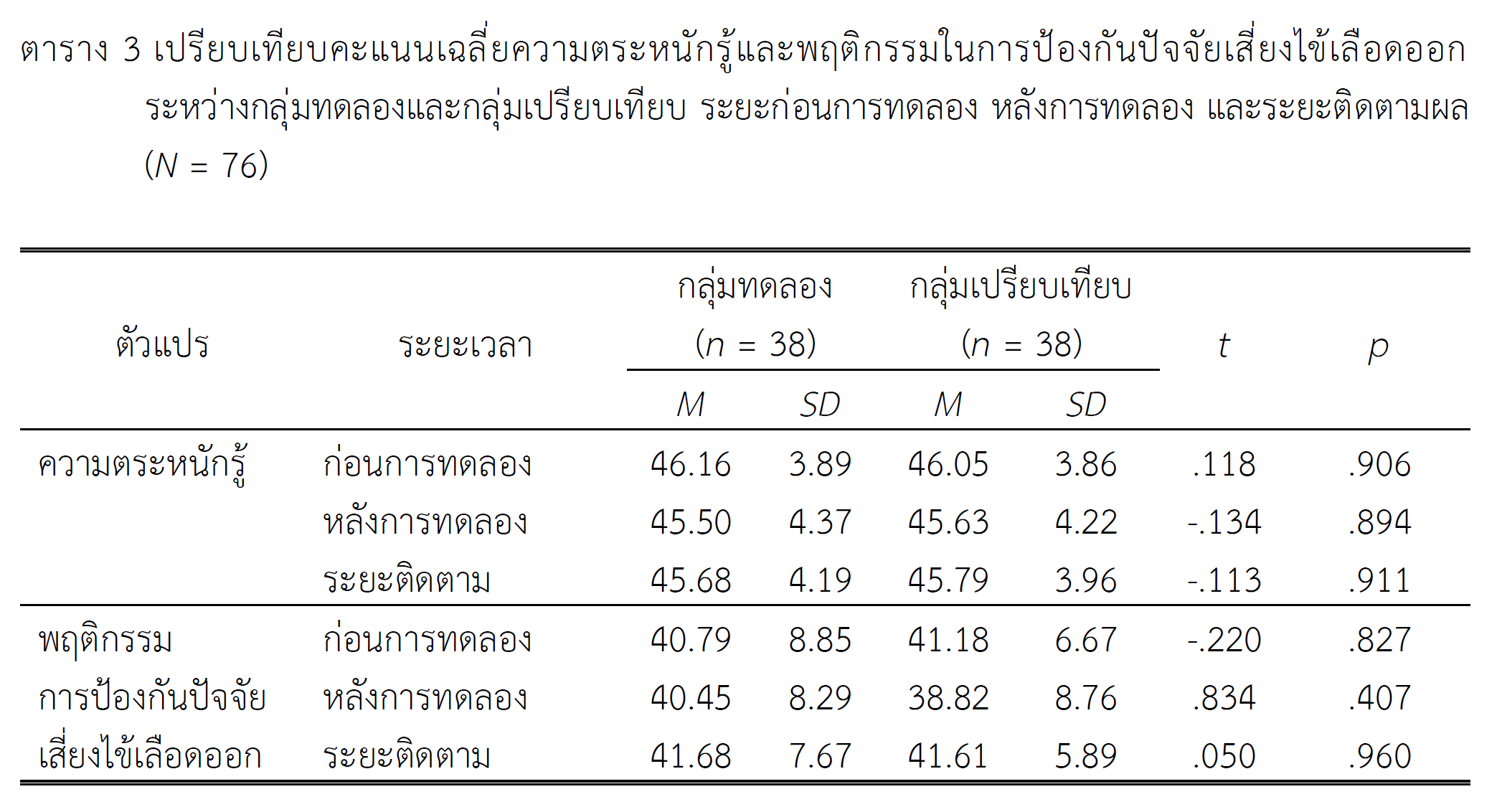
ผลการศึกษาพบว่า กลุ่มทดลองภายหลังการทดลองโปรแกรมการสร้างเสริมความรอบรู้ทางสุขภาพสามารถคงระดับความตระหนักรู้และพฤติกรรมการป้องกันปัจจัยเสี่ยงของโรคไข้เลือดออกได้จนถึงสัปดาห์ที่ 12 และเมื่อเปรียบเทียบความแตกต่างของคะแนนเฉลี่ยความตระหนักรู้และพฤติกรรมการป้องกันปัจจัยเสี่ยงของโรคไข้เลือดออก ระหว่างกลุ่มทดลองกับกลุ่มเปรียบเทียบพบว่า มีคะแนนเฉลี่ยทั้ง 3 ระยะ คือ ก่อนการทดลอง หลังการทดลอง และระยะติดตามผล ไม่แตกต่างกันทางสถิติ (p > .05) แต่กลุ่มเปรียบเทียบมีระดับพฤติกรรมการป้องกันปัจจัยเสี่ยงของโรคไข้เลือดออกเปลี่ยนแปลงโดยก่อนการทดลองอยู่ในระดับมาก หลังการทดลองสัปดาห์ที่ 4 อยู่ในระดับปานกลาง และสัปดาห์ที่ 12 กลับมาอยู่ในระดับมาก
ดังนั้น ควรนำโปรแกรมการสร้างเสริมความรอบรู้ทางสุขภาพไปใช้ในประชากรคนเมืองวัยผู้ใหญ่ เพื่อให้มีความตระหนักรู้และพฤติกรรมการป้องกันปัจจัยเสี่ยงของโรคไข้เลือดออกที่ยั่งยืนต่อไป
Downloads
เอกสารอ้างอิง
Bureau of Epidemiology. (2021). Report on the dengue fever situation in Dusit District. Ministry of Public Health.
Chanpen, P., Nititham, A., & Sirisopon, N. (2022). Health literacy and dengue control and prevention behaviors of people in Min Buri District Bangkok. Journal of The Royal Thai Army Nurses, 23(2), 78-87.
Department of Disease Control. (2020). Master plan for urban disease prevention and control, 2018-2021. Ministry of Public Health.
Department of Disease Control. (2021). Report on the situation of dengue fever in Thailand. Ministry of Public Health.
Jakkujantr, C., Kaeodumkoeng, K., & Kengganpanich, T. (2021). Effects of the health literacy promotion program on dengue hemorrhagic fever prevention by applying IMB model for grade 5 students, Bangkok Metropolitan Administration schools. Disease Control Journal, 47(3), 479-489.
Institute for Disease Control and Immigration Prevention, Department of Disease Control, Ministry of Public Health. (2024). Summary of important epidemiological events. Department of Disease Control, Ministry of Public Health.
Khurathong, S. (2016). Urban medicine. Vajira Medical Journal: Journal of Urban Medicine, 59(1), 1-4.
Konsnan, W., & Poum, A. (2020). Health literacy associated with preventing and controlling behavior of dengue hemorrhagic fever among village health volunteers in Nong Yai Sub-district, Prasat District, Surin Province. Journal of Health Science and Community Public Health, 3(1), 35-44.
Morris, D., Taylor, H., & Lee, S. (2022). Health literacy and dengue prevention behaviors: A meta-analysis. Preventive Medicine, 152, 106573.
Nawamat, D., & Phanom, N. (2020). Health literacy and dengue hemorrhagic fever prevention and control behaviors of the population in Nakhon Phanom Province. Nakhonphanom Hospital Journal, 7(1), 84-94.
Nontapet, O., Maneerattanasak, S., Jaroenpool, J., Phumee, A., Krachai, W., Napet, P., Rahman, M. S., & Suwanbamrung, C. (2022). Understanding dengue solution and larval indices surveillance system among village health volunteers in high- and low-risk dengue villages in southern Thailand. One Health, 15, 100440. https://doi.org/10.1016/j.onehlt.2022.100440
Nutbeam, D. (2008). The evolving concept of health literacy. Social Science & Medicine, 67(12), 2072-2078.
Nutbeam, D. (2024). Improving health literacy: New insights and strategies for the 21st century. Health Promotion International, 39(2), 150-160.
Pengjuntr, W. (2017). Health literacy. In Proceedings of the workshop on enhancing personnel capacity of the Department of Health: Health literacy towards Thailand. Ministry of Public Health.
Prochaska, J. O., & DiClemente, C. C. (1983). Stages and processes of self-change of smoking: Toward
an integrative model of change. Journal of Consulting and Clinical Psychology, 51(3), 390–395. https://doi.org/10.1037/0022-006X.51.3.390
Sookpool, A., Kingmala, C., Pangsuk, P., Yeanyoun, T., & Wongnum, W. (2020). Effectiveness of health literacy and health behavior development program for working people. Journal of Health Science, 29(3), 419-429.
Verplanken, B., & Orbell, S. (2022). Attitudes, habits, and behavior change. Annual Review of Psychology, 73, 327-352.
World Health Organization. (2021). Health literacy: The solid foundation for public health. Retrieved from https://www.who.int/news-room/fact-sheets/detail/health-literacy
World Health Organization. (2024). Dengue-global situation. Retrieved from https://www.who.int/emergencies/disease-outbreak-news/item/2024-DON518
ดาวน์โหลด
เผยแพร่แล้ว
รูปแบบการอ้างอิง
ฉบับ
ประเภทบทความ
สัญญาอนุญาต
ลิขสิทธิ์ (c) 2024 วารสารพยาบาลตำรวจและวิทยาศาสตร์สุขภาพ

อนุญาตภายใต้เงื่อนไข Creative Commons Attribution-NonCommercial-NoDerivatives 4.0 International License.
ผลงานที่ได้ตีพิมพ์แล้วจะเป็นลิขสิทธิ์ของวารสารพยาบาลตำรวจ