
ความชุก ปัจจัยเสี่ยง และผลลัพธ์ระยะสั้นของทารกแรกเกิดน้ำหนักน้อยที่คลอดหลัง มีการระบาดของโรคโควิด 19 ในโรงพยาบาลตติยภูมิแห่งหนึ่งในภาคเหนือของประเทศไทย
คำสำคัญ:
น้ำหนักแรกเกิดน้อย, ความดันโลหิตสูงขณะตั้งครรภ์, คลอดก่อนกำหนด, โภชนาการระยะตั้งครรภ์, ฝากครรภ์ตามเกณฑ์คุณภาพบทคัดย่อ
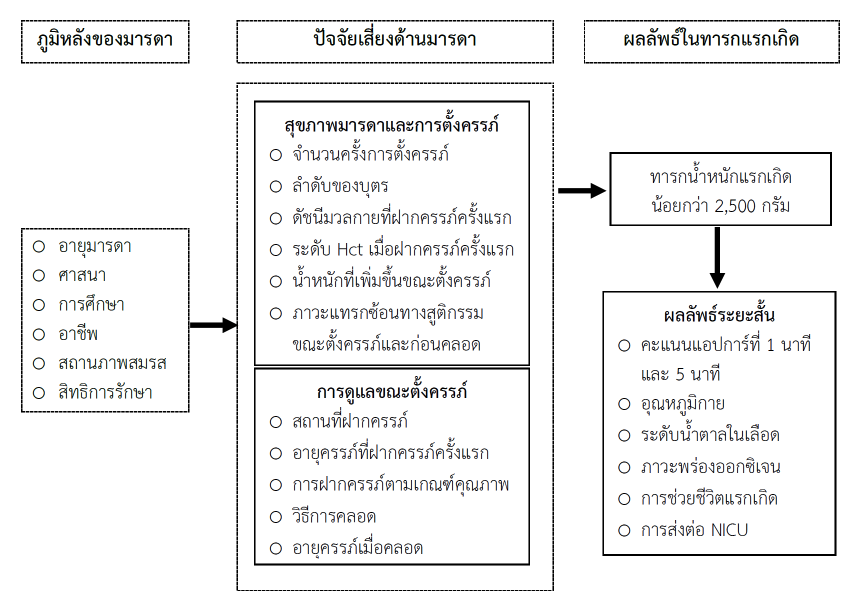
การศึกษาสืบย้อนแบบ Matched case-control study นี้ มีวัตถุประสงค์เพื่อประเมินความชุก และค้นหาปัจจัยเสี่ยงด้านมารดาและผลลัพธ์ระยะสั้นที่มีความสัมพันธ์กับภาวะน้ำหนักแรกเกิดน้อยในทารกแรกเกิดที่คลอดหลังมีการระบาดของโควิด 19 ที่โรงพยาบาลตติยภูมิแห่งหนึ่งในภาคเหนือของประเทศไทย ระหว่างวันที่ 1 ตุลาคม พ.ศ.2565 ถึง 30 เมษายน พ.ศ. 2566 ตัวอย่าง คือ ผู้คลอดสตรีไทย อายุมากกว่าหรือเท่ากับ 15 ปี ครรภ์เดี่ยว มีทารก
มีชีพ จำนวน 183 คน ทารกแรกเกิดน้ำหนักน้อย จำนวน 61 คน และทารกแรกเกิดน้ำหนักปกติ จำนวน 122 คน เก็บข้อมูลโดยใช้แบบบันทึกข้อมูลที่ผู้วิจัยสร้างขึ้นและผ่านการตรวจสอบความตรงเชิงเนื้อหาโดยผู้เชี่ยวชาญ จำนวน 3 ท่าน ได้ค่าดัชนีความตรงเชิงเนื้อหาเท่ากับ .87 วิเคราะห์ข้อมูลด้วยสถิติพรรณนา Chi-square test และ Binary logistic regression
ผลการศึกษาพบความชุกของภาวะน้ำหนักแรกเกิดน้อย ร้อยละ 9.32 ปัจจัยเสี่ยงด้านมารดาที่เพิ่มโอกาสเกิดทารกแรกเกิดน้ำหนักน้อย ได้แก่ น้ำหนักขณะตั้งครรภ์เพิ่ม < .50 กิโลกรัมต่อสัปดาห์ เพิ่มโอกาสเกิด LBW .21 เท่า (OR = .21; 95%CI = .09 - .61, p = .000) ฝากครรภ์ตามเกณฑ์คุณภาพ < 5 ครั้ง เพิ่มโอกาสเกิด LBW .30 เท่า (OR = .30; 95%CI = .15 - .58, p = .000) ภาวะแทรกซ้อนทางสูติกรรมเพิ่มโอกาสเกิด LBW 3.10 เท่า (OR = 3.10; 95%CI = .25 - 79.61, p = .007) และภาวะแทรกซ้อนก่อนคลอดเพิ่มโอกาสเกิด LBW 21 เท่า (OR = 21.00; = 2.56 - 171.93, p = .001) ทารกแรกเกิดน้ำหนักน้อยเสี่ยงต่อการมีคะแนนแอปการ์ที่ 1 นาทีและ 5 นาที < 7 เพิ่มขึ้น .10 เท่า (OR = .10; 95%CI = .02 - .38, p = .001) เสี่ยงต่อระดับน้ำตาลในเลือดต่ำเพิ่มขึ้น 7.77 เท่า (OR = 7.77; 95%CI = 2.00 - 29.45, p = .003) เสี่ยงต่อภาวะพร่องออกซิเจนรุนแรง/ได้รับการช่วยหายใจด้วย CPAP/ET tube เพิ่มขึ้น 19.35 เท่า (OR = 19.35; 95%CI = 5.46 - 68.52, p = .000) และได้รับการส่งต่อ NICU เพิ่มขึ้น 12.35 เท่า (OR = 12.35; 95%CI = 3.95 - 38.55, p = .000) เมื่อเทียบกับทารกแรกเกิดน้ำหนักปกติ
บุคลากรสุขภาพควรเพิ่มประสิทธิภาพการดูแลสตรีตั้งครรภ์ โดยการประเมินปัจจัยเสี่ยงต่อการเกิดทารกน้ำหนักแรกเกิดน้อย รณรงค์การฝากครรภ์ตามเกณฑ์คุณภาพ ส่งเสริมโภชนาการระยะตั้งครรภ์ และให้คำแนะนำการดูแลตนเองเพื่อลดโอกาสเกิดภาวะน้ำหนักแรกเกิดน้อย มีผลในการลดภาวะแทรกซ้อนที่เป็นสาเหตุของความเจ็บป่วย พิการ และการเสียชีวิตของทารกและเด็กเล็กในภูมิภาคนี้ต่อไป
Downloads
เอกสารอ้างอิง
Abubakari, A., Taabia, F. Z., & Ali, Z. (2019). Maternal determinants of low birth weight and neonatal asphyxia in the Upper West region of Ghana. Midwifery, 73, 1–7.
Adu-Bonsaffoh, K., Ntumy, M. Y., Obed, S. A., & Seffah, J. D. (2017). Perinatal outcomes of hypertensive disorders in pregnancy at a tertiary hospital in Ghana. BMC Pregnancy Childbirth, 17(1), 388–394.
Anil, K. C., Basel, P. L., & Singh, S. (2019). Low birth weight and its associated risk factors: Health facility-based case-control study. PLoS ONE, 15(6), e0234907. https://doi.org/10.1371/journal.pone.0234907
Chakreyavanich, R. (2020). Factors related to low birth weight in Health Region 5. Journal of Public Health Nursing, 34(3), 1–17.
Chmielewska, B., Barratt, I., Townsend, R., Kalafat, E., van der Meulen, J., Gurol-Urganci, I., . . . Khalil, A. (2021). Effects of the COVID-19 pandemic on maternal and perinatal outcomes: A systematic review and meta-analysis. Lancet Global Health, 9, e759–e772. https://doi.org/10.1016/S2214-109X(21)00079-6
Coutinho, P. R., Cecatti, J. G., Surita, F. G., Costa, M. L., & Morais, S. S. (2018). Perinatal outcomes associated with low birth weight in a historical cohort. Reproductive Health, 8(1), 18–22. https://doi.org/10.1186/1742-4755-8-18
de Knegt, V. E., Hedley, P. L., Hedermann, G., Wilstrup, C., Bækvad-Hansen, M, Thagaard, I. N., . . . Christiansen, M. (2023). The impact of the COVID-19 lockdown on birthweight among singleton term birth in Denmark. PLoS ONE, 18(4), e0283909. https://doi.org/10.1371/journal.pone.0283909
Department of Health, Ministry of Public Health. (2022). Service plan, mother and child branch. Public Health Administration Division.
Figueiredo, A. C. M. G., Gomes-Filho, I. S., Batista, J. E. T., Orrico, G. S., Porto, E. C. L., Cruz Pimenta, R. M., . . . Pereira, M. G. (2019). Maternal anemia and birth weight: A prospective cohort study. PLoS ONE, 14(3), e0212817. https://doi.org/10.1371/journal.pone.0212817
Fitriana, Y., Indarty, A., Mallongi, A., Mappajanci, M., Seweng, A., Hidayanty, H., Nur, R., & Syam, A. (2021). Risk factors for asphyxia neonatorum in public health centres of nosarara and pantoloan, Palu City. Gaceta Sanitaria, 35(S2), S131–S134. https://doi.org/10.1016/j.gaceta.2021.07.009
Hedley, P. L., Hedermann, G., Hagen, C. M., Bækvad-Hansen, M., Hjalgrim, H., Rostgaard, K., . . . Christiansen, M. (2022). Preterm birth, stillbirth and early neonatal mortality during the Danish COVID-19 lockdown. European Journal of Pediatrics, 181, 1175–1184. https://doi.org/10.1007/s00431-021-04297-4
Kaoian, V. (2020). A study of the maternal risk factors for low-birth-weight infants in Huaiyot hospital, Trang. Region 11 Medical Journal, 34(3), 63–72.
Kelsey, J. L., Whittemore, A. S., Evans, A. S., & Thompson, W. D. (1996). Methods in observational epidemiology. Oxford University Press, Oxford.
Khalil, A., von Dadelszen, P., Kalafat, E., Sebghati, M., Ladhani, S., Ugwumadu, A., . . . PregnaCOVID3 study group. (2021). Change in obstetric attendance and activities during the COVID-19 pandemic. Lancet Infectious Diseases, 21(5), e115. https://doi.org/10.1016/S1473-3099(20)30779-9
Khan, N., Mozumdar, A., & Kaur, S. (2020). Determinants of low birth weight in India: An investigation from the National Family Health Survey. American Journal of Human Biology, 32(3), e23355.
Lee, J. H., Youn, Y., Chang, Y. S., & The Korean Neonatal Network. (2020). Short-and long-term outcomes of very low birth weight infants in Korea: Korean Neonatal Network update in 2019. Clinical and Experimental Pediatrics, 63(8), 284-290. https://doi.org/10.3345/cep.2019.00822
Li, Z-n., Wang, S-r., & Wang, P. (2023). Associations between low birth weight and perinatal asphyxia: A hospital-based study. Medicine, 102(13), e33137.
Mathewson, K. J., Chow, C. H., Dobson, K. G., Pope, E. I., Schmidt, L. A., Van Lieshout, R. J. (2017). Mental health of extremely low birth weight survivors: A systematic review and meta-analysis. Psychological Bulletin, 143(4), 347–383. https://doi.org/10.1037/bul0000091
Muluneh, M. W., Mulugeta, S. S., Belay, A. T., & Moyehodie, Y. A. (2023). Determinants of low birth weight among newborns at Debre Tabor Referral Hospital, Northwest Ethiopia: A cross-sectional study. SAGE Open Nursing, 9, 1–8. https://doi.org/10.1177/23779608231167107
Nazira, K., Ali, S. M., & Firdaus, U. (2022). Morbidity profile and short-term outcomes of low-birth-weight neonates delivered in tertiary care center: A prospective observational study. International Journal of Contemporary Pediatrics, 9(8), 740-745. https://dx.doi.org/10.18203/2349-3291.ijcp20221857
Nur, R., Sese, R. G. C., Patui, N. S., & Fajriah, R. N. (2020). Detection mapping of women with high-risk pregnancy in antenatal care in Kamonji Public Health Center, Palu City, Indonesia. Systematic Reviews in Pharmcy, 11(2), 642–647. https://doi.org/10.5530/srp.2020.2.92
Phayuhasenarak, S. & Purinthapibal, S. (2020). Factors affecting birth of low-birth-weight babies of pregnant women attending antenatal care in Wang Wiset hospital, Trang province. Thailand Journal of Health Science, 29(3), 497–507.
Puisungnoen, N. (2023). Education in the prevalence of low-birth-weight infants after implementing of the new antenatal program for pregnant women at Debaratana Nakorn Ratchasima hospital. Medical Journal of Srisaket, Surin, Burirum Hospitals, 38(1), 143–152.
Ruiz, N. M., Íniguez, J. P. G., Gracia, S. R., & Villagrasa, M. P. S. (2022). Prospective study on influence of perinatal factors on the development of early neonatal hypoglycemia in late preterm and term infants. Anales de Pediatría, 96, 230–241.
Seema, S. (2022). Lockdown measures and COVID-19 disease control in Thailand. Library of Parliament, Office of the Secretariat of the House of Representatives.
Saini, A., Gaur, B. K., & Singh, P. (2018). Hypoglycemia in low birth weight neonates: Frequency, pattern, and likely determinants. International Journal of Contemporary Pediatrics, 5(2), 526-532. http://dx.doi.org/10.18203/2349-3291.ijcp20180548
Sertsu, A., Nigussie, K., Eyeberu, A., Tibebu, A., Negash, A., Getachew, T., . . . Dheresa, M. (2022). Determinants of neonatal hypoglycemia among neonates admitted at Hiwot Fana Comprehensive Specialized University hospital, Eastern Ethiopia: A retrospective cross-sectional study. SAGE Open Medicine, 10, 1–9. https://doi.org/10.1177/20503121221141801
Sharma, D., Shastri, S., & Sharma, P. (2016). Intrauterine growth restriction: Antenatal and postnatal aspects. Clinical Medicine Insights Pediatrics, 10, 67–83.
Shen, Z., Wang, Y., Ma, S., Zhan, Y. L., Wu, S. S., & Feng, Y. H. (2019). Risk factors for preterm birth, low birth weight and small for gestational age: A prospective cohort study. Clinical Journal of Epidemiology, 40(09), 1125-1129. https://doi.org/10.3760/cma.j
Shaohua, Y., Bin, Z., Mei, L., Jingfei, Z., Pingping, Q., Yanping, H., . . . Guoshun, M. (2022). Maternal risk factors and neonatal outcomes associated with low birth weight. Frontier in Genetics, 13, e1019321. https://doi.org/10.3389/fgene.2022.1019321
Talie, A., Taddele, M., & Alemayehu, M. (2017). Magnitude of low birth weight and associated factors among newborns delivered in Dangla Primary hospital, Amhara Regional State, Northwest Ethiopia. Journal of Pregnancy, 3587239. https://doi.org/10.1155/2019/3587239
Thapa, P., Poudyal, A., Poudel, R., Upadhyaya, D. P., Timalsina, A., Bhandari, R., . . . Adhikari, N. (2022). Prevalence of low birth weight and its associated factors: Hospital-based cross-sectional study in Nepal. PLOS Global Public Health, 2(11), e0001220. https://doi.org/10.1371/journal.pgph.0001220
UNICEF-WHO. (2019). UNICEF-WHO Low birthweight estimates: Levels and trends 2000–2015. World Health Organization, Geneva.
Zaveri, A., Paul, P., Saha, J., Barman, B., & Chouhan, P. (2020). Maternal determinants of low birth weight among Indian children: Evidence from the National Family Health Survey-4, 2015-2016. PLoS ONE, 15(12), e0244562. https://doi.org/10.1371/journal.pone.0244562
ดาวน์โหลด
เผยแพร่แล้ว
รูปแบบการอ้างอิง
ฉบับ
ประเภทบทความ
สัญญาอนุญาต
ลิขสิทธิ์ (c) 2024 วารสารพยาบาลตำรวจและวิทยาศาสตร์สุขภาพ

อนุญาตภายใต้เงื่อนไข Creative Commons Attribution-NonCommercial-NoDerivatives 4.0 International License.
ผลงานที่ได้ตีพิมพ์แล้วจะเป็นลิขสิทธิ์ของวารสารพยาบาลตำรวจ