ความสัมพันธ์ระหว่างการรับรู้ประโยชน์ การรับรู้สิ่งสนับสนุน และการรับรู้อุปสรรคในการจัดการอาการของผู้ป่วยมะเร็งหลังได้รับยาเคมีบำบัดในช่วงสถานการณ์การแพร่ระบาดของโรคโควิด 19
คำสำคัญ:
การรับรู้ประโยชน์, การรับรู้สิ่งสนับสนุน, การรับรู้อุปสรรค, ผู้ป่วยมะเร็ง, ยาเคมีบำบัด, โรคโควิด 19บทคัดย่อ
การวิจัยเชิงบรรยายนี้มีวัตถุประสงค์เพื่อศึกษาความสัมพันธ์ระหว่างการรับรู้ประโยชน์ การรับรู้สิ่งสนับสนุนและการรับรู้อุปสรรคในการจัดการอาการของผู้ป่วยมะเร็งหลังได้รับยาเคมีบำบัดในช่วงสถานการณ์การแพร่ระบาดของโรคโควิด 19 ตัวอย่าง คือ ผู้ป่วยมะเร็งที่ได้รับการรักษาด้วยยาเคมีบำบัดที่สถาบันมะเร็งแห่งชาติ จำนวน 415 คน เครื่องมือที่ใช้ในการศึกษาครั้งนี้ผ่านการตรวจสอบความตรงเชิงเนื้อหาโดยผู้เชี่ยวชาญ และหาค่าความเชื่อมั่นของแบบสอบถามการรับรู้ประโยชน์ การรับรู้สิ่งสนับสนุน และการรับรู้อุปสรรคในการจัดการอาการ ได้เท่ากับ .87, .92 และ .87 ตามลำดับ วิเคราะห์ข้อมูลโดยใช้สถิติเชิงพรรณนา สหสัมพันธ์แบบเพียร์สัน การวิเคราะห์แบบแปรปรวนทางเดียว และการเปรียบเทียบความแตกต่างของคะแนนเฉลี่ยรายคู่ด้วยวิธี Bonferroni
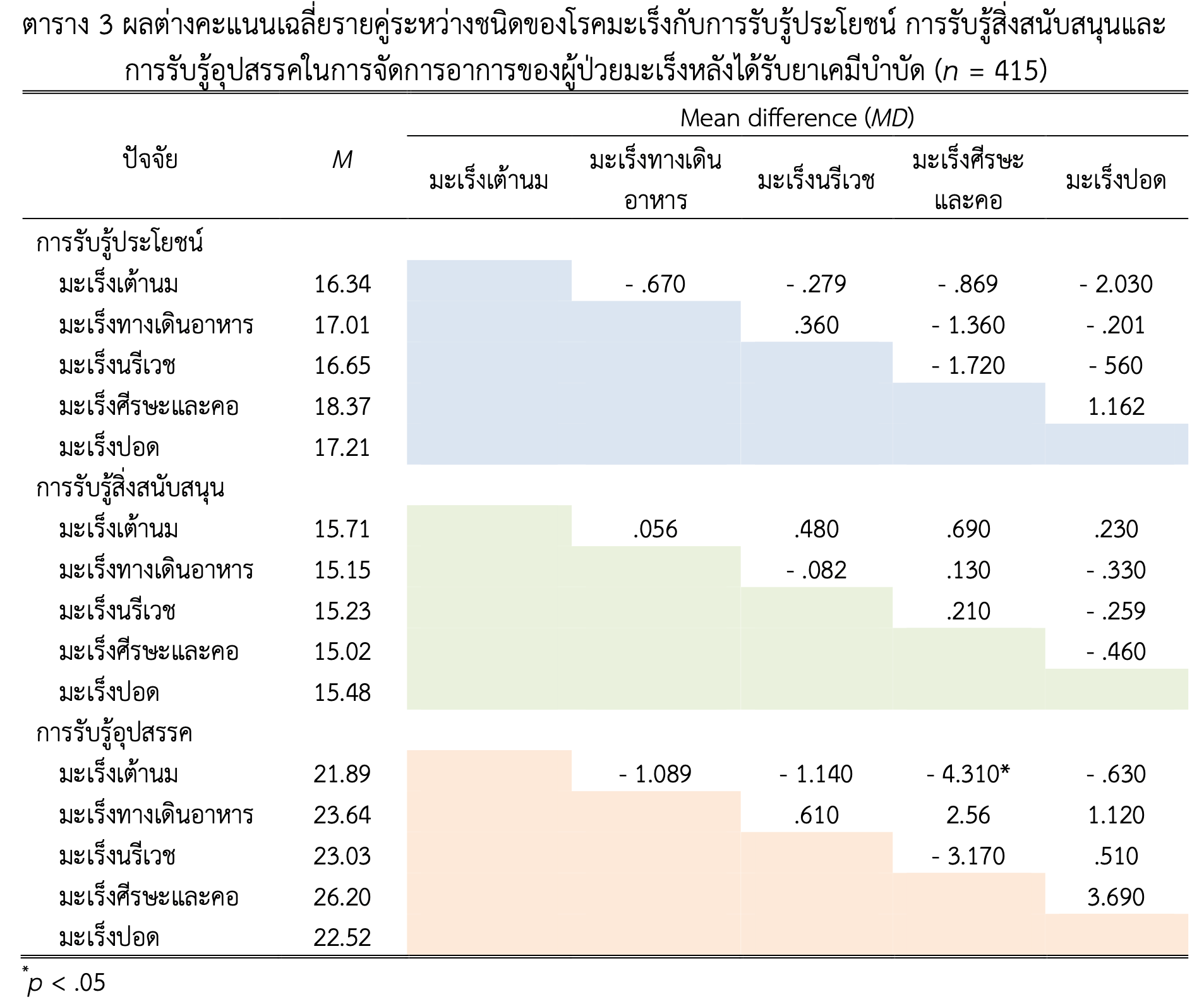
ผลการศึกษาพบว่า การรับรู้ประโยชน์มีความสัมพันธ์ทางบวกกับการรับรู้สิ่งสนับสนุน (r = .667) และมีความสัมพันธ์ทางลบกับการรับรู้อุปสรรค (r = -.244) ในขณะที่ การรับรู้สิ่งสนับสนุนมีความสัมพันธ์ทางลบกับการรับรู้อุปสรรค (r = -.173) อย่างไรก็ตาม การวิจัยนี้พบว่าการจัดการอาการของผู้ป่วยมะเร็งหลังได้รับยาเคมีบำบัดแต่ละชนิดไม่มีความแตกต่างกัน แต่การรับรู้อุปสรรคในการจัดการอาการของผู้ป่วยมะเร็งแต่ละชนิด มีความแตกต่างกัน อย่างมีนัยสำคัญทางสถิติ (F (4, 410) = 1.82, p = .022) โดยผู้ป่วยโรคมะเร็งศีรษะและคอมีการรับรู้อุปสรรคในการจัดการอาการมากกว่าผู้ป่วยโรคมะเร็งเต้านม อย่างมีนัยสำคัญทางสถิติ (MD = - 4.310, p < .05)
ดังนั้น บุคลากรทางสุขภาพควรส่งเสริมการรับรู้ประโยชน์และสนับสนุนการจัดการอาการเพื่อลดการรับรู้อุปสรรคในการจัดการอาการของผู้ป่วยมะเร็งในช่วงมีการแพร่ระบาดของโรคติดเชื้อ
Downloads
เอกสารอ้างอิง
Boonyasopun, U., Aree, P., Srisuphan, W., & Wongsuraprakit, S. (2018). Perception of benefits and barriers, perceived self efficacy, social support and eating behavior toward nutritive value and safety among women living in the inner city and outside city area. Christian University Journal, 25(1), 1-18.
Chinpatanapongsa, E., & Suwanpatikorn, K. (2014). The study of relationship between perceived benefit perceived barrier perceived self-efficacy and breast self-examination behaviour in nursing students. Journal of Public Health, 28(3), 14-29.
Cohen, A. (1977). Factors in successful occupational safety programs. Journal of Safety Research, 9(4), 168-178.
Hanna, T. P., King, W. D., Thibodeau, S., Jalink, M., Paulin, G. A., Harvey-Jones, E., . . . Aggarwal, A. (2020). Mortality due to cancer treatment delay: Systematic review and meta-analysis. British Medical Journal (Clinical research edition), 371, m4087. https://doi.org/10.1136/bmj.m4087
Hui, S. K., Huang, Y., Suher, J., & Inman, J. J. (2013). Deconstructing the "first moment of truth": Understanding unplanned consideration and purchase conversion using in-store video tracking. Journal of Marketing Research, 50(4), 445–462. https://doi.org/10.1509/jmr.12.0065
International Agency for Research on Cancer. (2022). The global cancer observatory: GCO. Retrieved from https://gco.iarc.fr
Joychoo, N., Pinyopasakul, W., & Chareonkitkarn, V. (2014). Relationships among age perceived benefits of health behaviors perceived barriers of health behaviors and health behaviors in patients with ischemic stroke. Ramathibodi Nursing Journal, 20(2), 236-248.
Karomprat, A., Chaichan, P., Santawesuk, U., & Sookprasert, A. (2017). Symptoms, symptom management and outcome in cancer patients undergoing chemotherapy. Srinagarind Medical Journal, 32(4), 326-331.
Kessels, E., Husson, O., & van der Feltz-Cornelis, C. M. (2018). The effect of exercise on cancer-related fatigue in cancer survivors: A systematic review and meta-analysis. Neuropsychiatric Disease and Treatment, 9(14), 479-494.
Khattak, S., Faheem, M., Nawaz, B., Khan, M., Khan, N. H., Ullah, N., . . . Ji, X. Y. (2022). Knowledge, attitude, and perception of cancer patients towards COVID-19 in Pakistan: A cross-sectional study. International journal of environmental research and public health, 19(13), 7926.
Leksuwankun, S., & Wonanan, P. (2020). Chemotherapy-induced nausea and vomiting. Journal of Basic and Applied Pharmacology, 42(2), 23–36.
Levin, I. R., & Rubin, S. D. (1991). Statistics for management (5th ed.). New York, NY: Prentice Hall.
Li, Y., Dang, J., Liang, D., & Yin, L. (2019). Thermal-responsive carbon monoxide (CO) delivery expedites metabolic exhaustion of cancer cells toward reversal of chemotherapy resistance. American Chemical Society, 5(6), 1044-1058.
Looyens, C., Giraud, R., Silva, I. N., & Bendjelid, K. 2021. Burkitt lymphoma and lactic acidosis: A case report and review of the literature. Physiological Reports, 9(4), 1-10.
Mhoryadee, K., Kanogsunthornra, N., & Panpakdee, O. (2018). Relationships between illness perception and pulmonary rehabilitation behaviors in persons with chronic obstructive pulmonary disease. Thai Journal of Cardio-Thoracic Nursing, 29(2), 96-110.
Miller, J. L., & Evers, J. (2022). Barriers to adherence to cancer treatments among head and neck cancer patients. Journal of the Advanced Practitioner in Oncology, 13(5), 515-523.
National Cancer Institute. (2020). Cancer registration at hospital level 2019. Bangkok: New Ordinary Printing (Thailand).
Nayak, M. G., George, A., Vidyasagar, M. S., Mathew, S., Nayak, S., Nayak, B. S., . . . Kamath, A. (2015). Symptoms experienced by cancer patients and barriers to symptom management. Indian journal of palliative care, 21(3), 349–354. https://doi.org/10.4103/0973-1075.164893
Newton, R. U., Hart, N. H., & Clay, T. (2020). Keeping patients with cancer exercising in the age of COVID-19. Journal of Oncology Practice, 16(10), 656-664.
Numsang, P., Kurat, S., Baothong, K., Somboonkit, D., Supanyabut, K., Pasaribut, R., . . . Boonmas, N. (2018). The life experiences of breast cancer patients who received chemotherapy. The Journal of Prapokklao Hospital Clinical Medical Education Center, 35(2), 140-152.
Phligbua, W., Pongthavornkamol, K., Lekdamrongkul, P., & Riangkam, C. (2020). Hematological cancer patients’ perceptions of facilitators and barriers to their participation in symptom management during hospitalization. Nursing Science Journal of Thailand, 38(4), 77–90.
Pongpradit, P., Arpanantikul, M., & Sirapo-ngam, Y. (2012). Selected factors related to health-promoting behaviors in women with breast cancer undergoing adjuvant chemotherapy. Ramathibodi Nursing Journal, 18(1), 70-83.
Selby, D., Cascella, A., Gardiner, K., Do, R., Moravan, V., Myers, J., . . . Chow, E. (2010). A single set of numerical cutpoints to define moderate and severe symptoms for the Edmonton symptom assessment system. Journal of pain and symptom management, 39(2), 241–249. https://doi.org/10.1016/j.jpainsymman.2009.06.010
Sukhokanjanachusak, K. (2021). The coronavirus 2019 (COVID-19) pandemic on treatment outcome and requirement of the cancer patient in Suratthani Hospital. Region 11 Medical Journal, 35(1), 124-136.
Treiman, K., Kranzler, E. C., Moultrie, R., Arena, L., Mack, N., Fortune, E., . . . Street, R. L. (2022). Patients' experiences with cancer care: Impact of the COVID-19 pandemic. Journal Patient Experience, 21(9), 237-437.
ดาวน์โหลด
เผยแพร่แล้ว
รูปแบบการอ้างอิง
ฉบับ
ประเภทบทความ
สัญญาอนุญาต
ลิขสิทธิ์ (c) 2023 วารสารพยาบาลตำรวจ

อนุญาตภายใต้เงื่อนไข Creative Commons Attribution-NonCommercial-NoDerivatives 4.0 International License.
ผลงานที่ได้ตีพิมพ์แล้วจะเป็นลิขสิทธิ์ของวารสารพยาบาลตำรวจ