
PARTICIPATORY LEARNING PROGRAMME OF CAPACITY DEVELOPMENT AMONG STUDENTS ON THE PREVENTION OF MYOPIA IN BANGKOK METROPOLITAN SCHOOLS
Keywords:
participatory learning, primary school student, preventive behaviours of myopia, visual examination skillsAbstract
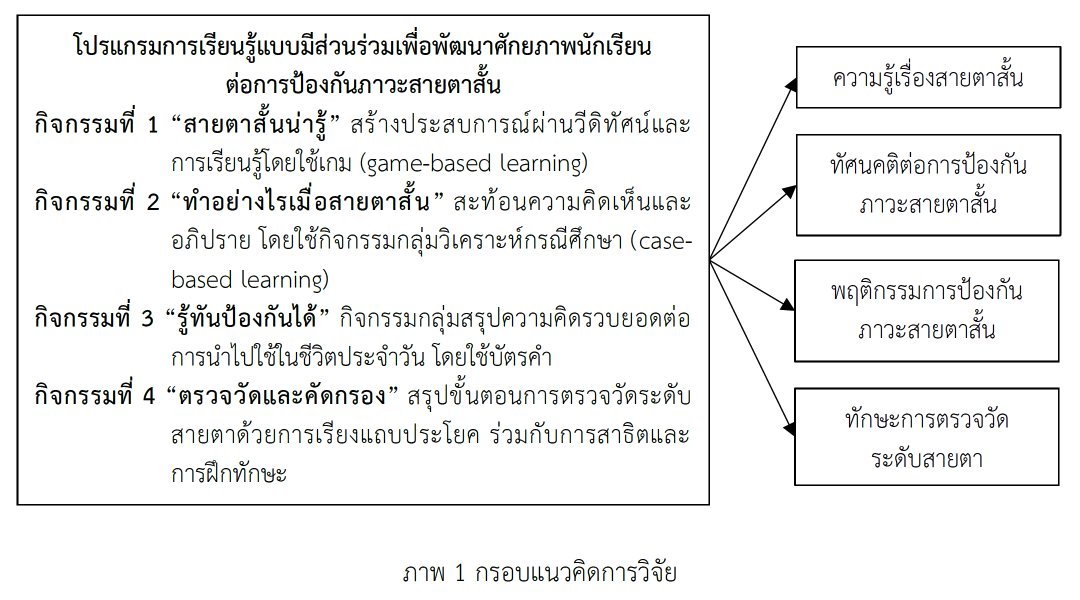
Myopia is a major health problem among school-age children. This quasi-experimental research aimed to examine the participatory learning programme on knowledge, attitudes, preventive behaviours, and visual examination skills. The sample comprised 64 fifth-grade students from primary schools in the Bangkok metropolitan district, obtained via purposive sampling to form an experimental group (n = 32) and a comparison group (n = 32). The programme was created by the researcher and consisted of video clips, group discussions, game-based learning, case-based learning, and visual examination skills training. The research instruments used to collect the data were assessment forms about knowledge of myopia, attitudes towards myopia, preventive behaviours of myopia, and visual examination skills before the intervention, after the intervention, and at the follow-up. The reliability scores were .78, .71, .73, and 1.00, respectively. The data were analyzed using descriptive statistics, independent t-test, and repeated measure ANOVA.
The results revealed that after the intervention was done, the mean scores for the knowledge, attitudes, preventive behaviours, and visual examination skills were significantly higher than before the intervention and those in the comparison group (p < .05). The experimental group had statistically significant different average scores of knowledges, attitudes towards myopia, preventive behaviours of myopia, and visual examination skills in each period (p < .05), which increased to the greatest value in the post-experimental period and slightly decreased in the follow-up period.
The teachers and healthcare providers were able to apply this intervention as a student development programme to create student leaders in eye healthcare for school-aged children in the future.
Downloads
References
Boonyawee, C. (2018). Childhood myopia. In G. Unghara (Eds.), Applied urban medicine. Bangkok: Faculty of Medicine Vajira Hospital, Navamindradhiraj University.
Bureau of Health Promotion, Department of Health, Ministry of Public Health. (2017). Manual of health promotion school (3rd ed.). Bangkok: The Office of Silpakorn University Academic Service.
Chantarachot, J., Tassanapitikul, T., & Empremsilapa, S. (2020). A vision screening to address refractive error of primary school students in a school of bangkok metropolitan province. Journal of public health nursing, 34(1), 1-12.
Department of Health, Ministry of Public Health. (2020). Thai children good eyesight project. Retrieved from http://rbpho.moph.go.th/upload-file/doc/files/07122020-023303-5410.pdf
Duanpan, N., Pantapat, S., & Singweratham, N. (2020). Development the model of student leaders participation in prevention and control of dengue hemorrhagic fever: A case study of Hatyai district, Songkhla province. Journal of Health Science, 29(6), 1011-1024.
Grzybowski, A., Kanclerz, P., Tsubota, K., Lanca, C., & Saw, S. M. (2020). A review on the epidemiology of myopia in school children worldwide. BMC ophthalmology, 20(1), 1-11. http://www.doi.org/10.1186/s12886-019-1220-0
Haarman, A. E. G., Enthoven, C. A., Tideman, J. W. L., Tedja, M. S., Verhoeven, V. J. M., & Klaver, C. C. W. (2020). The complication of myopia: A review and meta-analysis. Investigation Ophthalmology & Visual Science, 61(4). 1-19. http://www.doi.org/10.1167/iovs.61.4.49
Holden, B. A., Fricke, T. R., Wilson, D. A., Jong, M., Naidoo, K. S., Sankaridurg, P., . . . Resnikoff, S. (2016). Global prevalence of myopia and high myopia and temporal trends from 2000 through 2050. Ophthalmology, 123(5), 1036–1042.
Inthachai, S., Aungwattana, S., & Tuanrat, W. (2021). Effects of a capacity development program for student leaders through activity-based learning on knowledge and practices of visual examination in a school. Nursing Journal of the Ministry of Public Health, 31(1), 110-120.
Ittarat, M. (2017). Survey of visual acuity and refractive error among school children. Medical Journal of Srisaket Surin Buriram Hospitals, 32(1), 13-20.
Jiang, N., Chen, J., Cao, H., Liu, Y., Zhang, Y., Wang, Q., . . . Wang, J. (2022). Parents’ intentions toward preschool children’s myopia preventive behaviors: Combining the health belief model and the theory of planned behavior. Frontiers in Public Health, 10, 1-11. http://www.doi.org/10.3389/fpubh.2022.1036929
Jong, M., & Gifford, K. L. (2019). Clinical myopia management guidelines report. Retrieved from https://myopiainstitute.org/wp-content/uploads/2020/09/IMI-Clinical-Myopia-Management-Guidelines_FINALv2.pdf
Kolb, D. A. (1984). Experience learning: Experience as the source of learning and development. New Jersey, NJ: Prentice-Hall.
Nakam, N., Aungwattana, S., & Tuanrat W. (2021). Effects of the participatory learning program for student leaders on food management knowledge and practice in school. Chiang Mai Medical Journal, 60(1), 113-124.
Phungsai, A., Kawjaratwilai, T. (2014). The results of participation learning management on the attitude in physical education of Matthayomsuksa 5 students. Silpakorn Education Research Journal, 6(1), 233-245.
Punpom, D., Moolphate, S., & Khomchai, S. (2018). Effectiveness of a smoking cessation program applying participatory learning on behavior change for high school students in Chiang Mai province. Bulletin of Suanprung, 34(3), 196-212.
Queen Sirikit National Institute of Child Health, & Ministry of Public Health. (2014). Eye examination guide in kindergarten and primary school student (2nd ed.). Retrieved from http://www.amno.moph.go.th/amno_new/files/Eye%20examination%20guide.pdf
Ruktrakulvitaya, T., Silawan, T., Chaoratanakavi, S., Tongkeo, T., & Santiparp, P. (2021). The prevalence of refractive errors and corrected refractive errors of secondary school students in Muang district, Pathumthani province. Academic Journal of Community Public Health, 7(1), 60-73.
The Royal College of Pediatricians of Thailand & Pediatric society of Thailand. (2019). Guideline in child health supervision. Retrieved from http://www.thaipediatrics.org/Media/media-20200820112813.pdf
Thitiwichienlert, S. (2016). Myopia in children. Thammasat Medical Journal, 16(4), 672-683.
Twisk, W. R. (2003). Applied longitudinal data analysis for epidemiology: A practical guide. England: Cambridge University.
Downloads
Published
How to Cite
Issue
Section
License
Copyright (c) 2023 JOURNAL OF THE POLICE NURSES

This work is licensed under a Creative Commons Attribution-NonCommercial-NoDerivatives 4.0 International License.
ผลงานที่ได้ตีพิมพ์แล้วจะเป็นลิขสิทธิ์ของวารสารพยาบาลตำรวจ