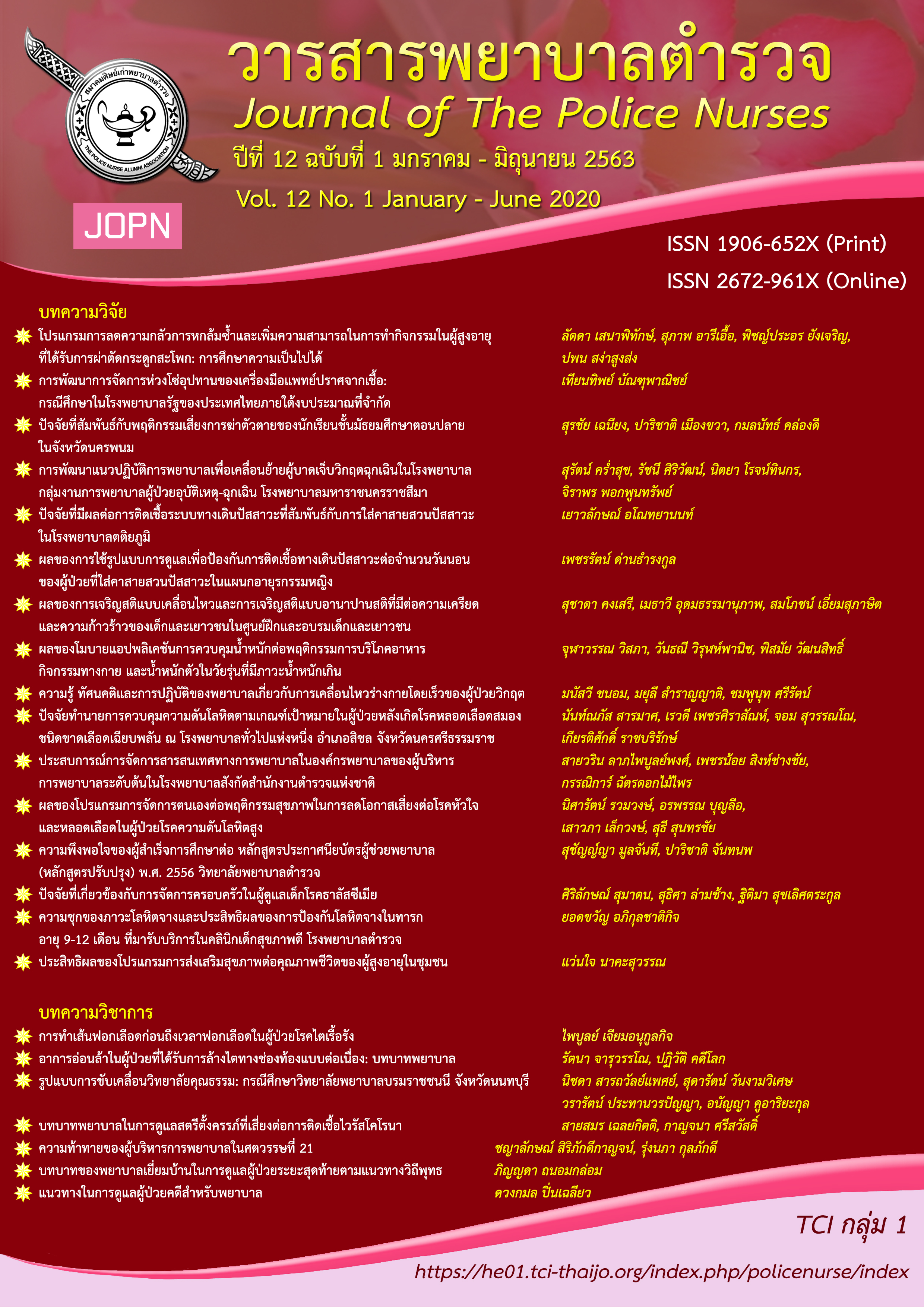
IMPROVING THE SUPPLY CHAIN MANAGEMENT OF STERILE MEDICAL DEVICES: A CASE OF THAILAND’S PUBLIC HOSPITALS UNDER FINANCIAL CONSTRAINTS
Keywords:
Thai public hospitals, central sterile supply department (CSSD), sterile medical devices, healthcare supply chain management, operations improvementAbstract
This research aimed at exploring the supply chain management of sterile medical devices in Thailand’s public hospitals and improving sterilization procedures given limited budget allocations. The key informants included three staff members from the sterilization unit and six members from various user departments at one of Thailand’s district hospitals, a 60-bed facility, referred to as “A”. Research instruments included a checklist, interview form, and record forms for reviews and observations. Content analysis was employed for qualitative data analysis. The first phase was conducted from January to May 2016. A clear picture of the device flow was revealed and mapped out, enabling the identification of weaknesses, root causes, and potential solutions. We determined that injury from sharp objects during hand-washing was a key problem. We found that (i) there were no practices for wiping and soaking instruments right after use, (ii) insufficient amounts of enzymatic detergents and washer-decontaminators, and (iii) there was a need to hire additional staff members. The investigation was further conducted into another public hospital, a 120-bed facility located in the same province, Hospital “B”. “B” effectively used a washing machine for the pre-washing of oxygen masks and tubing, which was subsequently recommended for adoption by “A”.
Later, from December 2019 to January 2020, we assessed the implementation, improvements, and flaws of the practices at Hospital “A”. Firstly, the hospital allocated a budget for a used washing machine. Next, among the most serious issues found were high injury rates and excessive staff workloads, in which “A” stated that was in the process of purchasing the enzyme mixing tool cleaner and requesting additional staff. Finally the monitoring and support by the director with the supplementation from the Ministry of Public Health (MOPH) was the most crucial aspect. Our study showed the necessity to evaluate and develop the practices of hospitals with limited budgets, and contributed to Thailand’s healthcare system.
Downloads
References
AbuKhousa, E., Al-Jaroodi, J., Lazarova-Molnar, S., & Mohamed, N. (2014). Simulation and modeling efforts to support decision making in healthcare supply chain management. The Scientific World Journal.
Adams, D. (2012). Needlestick and sharps injuries: Practice update. Nursing Standard, 26(37).
Banchanont, P. (2019). "Everyone wants to own a 30 baht policy" talk to Dr. Surapong Suebwonglee. The Matter. Retrieved from https://thematter.co/social/talk-surapong-suebwonglee-about-uhc/86904
Bandoophanit, T. (2015). Identifying green logistics best practice leading to the efficient management of resources and waste in Thailand’s Public hospitals (PhD). University of Bradford.
Bandoophanit, T., & Breen, L. (2018). Identifying reverse exchange practices: A comparative study of laundry logistics in Public hospitals (Thailand). Paper presented at the Logistics Research Network Conference, Plymouth.
Boonchaisri, P., Lertwatthanawilat, W., & Unahalekhaka, A. (2017). Reuse of single-use medical devices in secondary and tertiary hospital. Nursing Journal, 44(1).
Boonphasit, P. (2018). The development of medical management system In nursing department of Faorai hospital. Journal of Health Science and Community Public Health, 1(1).
Cole, R., Lindsay, C. F., & Barket, F. (2018). Reverse exchange of healthcare devices: The case of hearing aid equipment in the UK. Journal of Production Planning & Control, 29(13), 1045-1057.
Esain, A. E., Aitken, J., Williams, S. J., & Kumar, M. (2016). Reverse exchange: Classifications for public service SCM. Supply Chain Management: An International Journal, 21(2), 216-227.
Gholami, A., Borji, A., Lotfabadi, P., & Asghari, A. (2013). Risk factors of needlestick and sharps injuries among healthcare workers. International Journal of Hospital Research, 2(1), 31-38.
Honda, M., Honda, M., Chompikul, J., Chompikul, J., Rattanapan, C., Ratanapan, C., . . . Klungboonkrong, S. (2011). Sharps injuries among nurses in a Thai regional hospital: Prevalence and risk factors.
Humphries, R. M., & McDonnell, G. (2015). Superbugs on duodenoscopes: The challenge of cleaning and disinfection of reusable devices. Journal of clinical microbiology, 53(10), 3118-3125.
Kasatpibal, N., Whitney, J. D., Katechanok, S., Ngamsakulrat, S., Malairungsakul, B., Sirikulsathean, P., . . . Muangnart, T. (2016). Prevalence and risk factors of needlestick injuries, sharps injuries, and blood and body fluid exposures among operating room nurses in Thailand. American journal of infection control, 44(1), 85-90.
Kongtip, P., Nankongnab, N., Silpasuwan, P., Tipayamongkholgul, M., Kaewboonchoo, O., Luksamijarulkul, P., & Woskie, S. (2018). 723 Occupational health hazards, health problems encountered and personal protective equipment used in healthcare workers in hospitals, Thailand. BMJ Publishing Group Ltd.
Lancaster, T. D., & Montinola, G. R. (1997). Toward a methodology for the comparative study of political corruption. Crime, Law and Social Change, 27(3-4), 185-206.
Malhotra, N. K. (2010). Marketing research: An applied orientation. London: Pearson Education.
McGinnis, M. A., Kohn, J. W., & Spillan, J. E. (2010). A longitudinal study of logistics strategy: 1990–2008. Journal of Business Logistics, 31(1), 217-235.
Mehrbod, M., Tu, N., & Miao, L. (2012). A content analysis of the closed-loop logistics: A review. Journal of Supply Chain Management Systems, 1(2), 23-33.
Miles, M. B., & Huberman, A. M. (1994). Qualitative data analysis: An expanded sourcebook. Thousand Oaks; London: Sage Publications.
Ministry of Public Health. (2013). The administration structure of regional hospitals. Retrieved from http://infor.surinhospital.org/M/7(1)(2)/7(1)(2).pdf
Nacglud, R., & Noimuenwai, P. (2018). The development of the operating sterilization system based on lean concepts at Sichon hospital, Nakhon Si Thammarat province. Journal of Safety and Health, 11(1), 59-71.
Nagao, Y., Baba, H., Torii, K., Nagao, M., Hatakeyama, K., Iinuma, Y., . . . Ohta, M. (2007). A long-term study of sharps injuries among health care workers in Japan. American journal of infection control, 35(6), 407-411.
NHS. (2014). NHS, public health and social care carbon footprint 2012. Retrieved from http://www.sduhealth.org.uk/documents/carbon_footprint_summary_nhs_update_2013.pdf
NHS Estates. (2004). HBN 13 sterile services department. Norwich, UK.: Her Majesty’s Stationery Office. Retrieved from https://assets.publishing.service.gov.uk/government/uploads/system/uploads/attachment_data/file/148489/HBN_13.pdf
Panyaping, K., & Okwumabua, B. (2006). Medical waste management practices in Thailand. Life Science Journal, 3(2), 88-93.
Pongsrila, D., Tanakultanyasit, P., & Chatchawet, S. (2018). The effects of the “JET IN TIME” model of receiving and delivering medical equipment, central sterile supply department (CSSD), tertiary hospital. Region 11 Medical Journal, 32(4), 1383-1396.
Poosuwan, B. (2017). Thai public health system crisis unfolds, 558 government hospitals have negative maintenance payments of 12,700 million Baht. Thai Publica. Retrieved from https://thaipublica.org/2017/12/public-health-services-65/
Rewsuwan, W. (2015). The study of unit cost of service by modified full cost method, Wiengpapao hospital, Chiang Rai province (During the fiscal year 2013-2014). The Journal of Prapokklao Hospital Clinical Medical Education Center, 32(2), 157-172.
Robson, C. (2014). Real world research: A resource for users of social research methods in applied settings. Oxford: Wiley-Blackwell.
Rodrigue, J. P., Comtois, C., & Slack, B. (2013). Green logistics. In The geography of transport systems (3rd ed.). Taylor & Francis.
Sanguanchom, Y. (2010). Hospital sufficiency quality: Sustainable quality. Retrieved from http://www.academic.hcu.ac.th/forum/board_posts.asp?FID=416&UID=
Serrou, D., & Abouabdellah, A. (2016). Logistics in the hospital: Methodology for measuring performance. ARPN journal of engineering and applied sciences, 11(5), 2950-2956.
Sirikoopta, P., Sirivattanaket, P., & Tongchai, P. (2019). Service quality in central sterile supply department of Charoenkrung Pracharak hospital via SERVQUAL. Journal of Charoenkrung Pracharak Hospital, 15(2).
Stemler, S. (2001). An overview of content analysis. Practical assessment, research & evaluation, 7(17), 137-146.
Thiell, M., Zuluaga, J. P. S., Montañez, J. P. M., & van Hoof, B. (2011). Green logistics: Global practices and their implementation in emerging markets. In Green finance and sustainability: Environmentally-aware business models and technologies (pp. 334-357). IGI Global.
Unahalekhaka, A. (2017). How to improve quality in CSSD. Faculty of Nursing, Chiang Mai University. Retrieved from shorturl.at/zAHW2
van Vactor, J. D. (2011). A case study of collaborative communications within healthcare logistics. Leadership in health services, 24(1), 51-63.
Voss, C., Tsikriktsis, N., & Frohlich, M. (2002). Case research in operations management. International Journal of Operations & Production Management, 22(2), 195-219.
WHO. (2016). Decontamination and reprocessing of medical devices for health-care facilities. Retrieved from https://www.who.int/infection-prevention/publications/decontamination/en/
Yin, R. K. (2009). Case study research: Design and methods (Vol. 5). London: Sage.
Yoon, S. N., Lee, D., & Schniederjans, M. (2016). Effects of innovation leadership and supply chain innovation on supply chain efficiency: Focusing on hospital size. Technological Forecasting and Social Change, 113, 412-421.
Downloads
Published
How to Cite
Issue
Section
License
ผลงานที่ได้ตีพิมพ์แล้วจะเป็นลิขสิทธิ์ของวารสารพยาบาลตำรวจ