WITHERING RESPIRATION PM2.5: PERCEPTIONS OF HEALTH IMPACTS AND EXPERIENCES OF COPING AMONG OLDER ADULTS LIVING IN MARGINALIZED MEKONG RIVERSIDE COMMUNITIES
Keywords:
older adults, PM2.5, health impactsAbstract
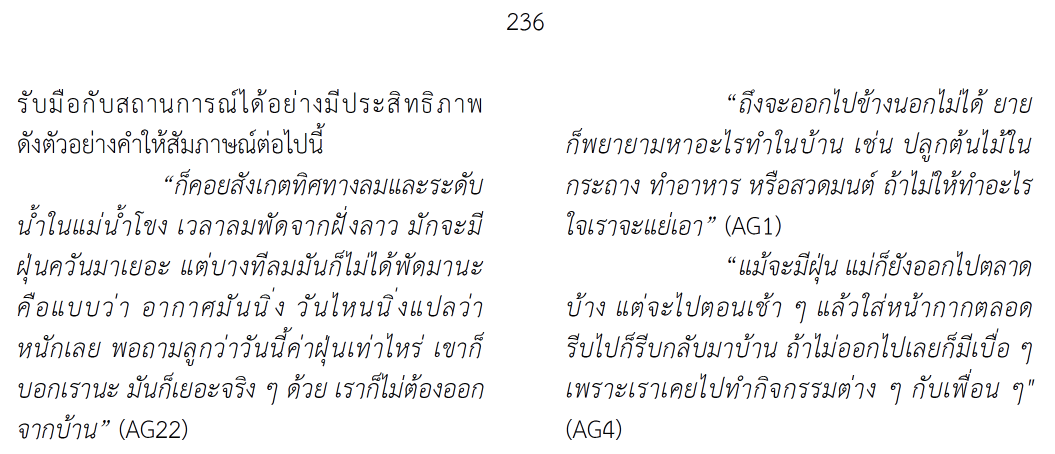
This qualitative research study examined the perceptions of health impacts and experiences of coping with PM2.5 dust among older adults living in marginalized communities along the Mekong River. Participants were purposively selected based on specific criteria: aged over 60 years, residing in Nakhon Phanom Municipality for more than one year, and able to speak and communicate in Thai. A total of 28 participants were recruited. Data were collected through in-depth interviews using a semi-structured interview guide and analyzed using thematic analysis.
The study revealed that older adults’s perceptions of health impacts of PM2.5 dust comprised three main themes: 1) Functional health literacy: perception and understanding of PM2.5 hazards through direct experience; 2) Interactive health literacy: self-management and communication amid uncertainty; and 3) Critical health literacy: analytical thinking ability but with gaps in support systems. In terms of coping experiences, elderly participants employed two main management strategies: 1) Proactive adaptation to confront hazardous dust exposure, and 2) Achieving life balance through the power of community networks.
The findings from this study provide foundational data for the development of air pollution management policies that account for the specific contexts of marginalized border communities, particularly areas along the Mekong River facing transboundary pollution.
Downloads
References
Chansuebsri, S., Kraisitnitikul, P., Wiriya, W., & Chantara, S. (2022). Fresh and aged PM2.5 and their ion composition in rural and urban atmospheres of Northern Thailand in relation to source identification. Chemosphere, 286, 131803. https://doi.org/10.1016/j.chemosphere.2021.131803
Diekelmann, N. L. (1992). Learning-as-testing: a Heideggerian hermeneutical analysis of the lived experiences of students and teachers in nursing. Advances in Nursing Science, 14(3), 72–83. https://doi.org/10.1097/00012272-199203000-00010
Guba, E. G., & Lincoln, Y. S. (1989). Fourth generation evaluation. Newbury Park, CA: Sage.
Heidegger, M. (1996). Being and time, translated by Joan Stambaugh. New York, NY: State University of New York Press.
Intarakamhang, U., & Health Impact Assessment Division (2020). Creating the situations report of environmental health literacy on preventing the health impacts from dust particulate matter of less than 2.5 micrometers (PM2.5) of village health volunteers in ecological industrial urban areas. Health Impact Assessment Division, Department of Health, Ministry of Public Health.
Junhasavasdikul, B., Wanikiat, P., Krobthong, A., & Chaiyasit K. (2020). Health effects of ambient air PM2.5, pathogenesis and alternative medicine treatment. Journal of Thai Traditional and Alternative Medicine, 18(1), 190-195.
Liu, L., Yan, Y., Nazhalati, N., Kuerban, A., Li, J., & Huang, L. (2020). The effect of PM2.5 exposure and risk perception on the mental stress of Nanjing citizens in China. Chemosphere, 254, 126797. https://doi.org/10.1016/j.chemosphere.2020.126797
Liu, X., Tu, R., Qiao, D., Niu, M., Li, R., Mao, Z., Huo, W., Chen, G., Xiang, H., Guo, Y., Li, S., & Wang, C. (2020). Association between long-term exposure to ambient air pollution and obesity in a Chinese rural population: The Henan rural cohort Study. Environmental Pollution, 260, 114077. https://doi.org/10.1016/j.envpol.2020.114077
Matthews, J. C., Chompoobut, C., Navasumrit, P., Khan, M. A. H., Wright, M. D., Ruchirawat, M., & Shallcross, D. E. (2023). Particle number concentration measurements on public transport in Bangkok, Thailand. International Journal of Environmental research and Public Health, 20(7), 5316. https://doi.org/10.3390/ijerph20075316
Muanhour, C., Kaewkerd, O., Amatayabundit, T., & Yodprong. S. (2024). Environmental health knowledge in preventing health impacts from PM2.5 dust particles of not more than 2.5 microns (PM2.5) of village health volunteers in Nakhon Phanom Province. Journal of Health and Environmental Studies, 9(1), 597-599.
Nguantad, S. (2025). The crisis of particulate matter 2.5 (PM2.5) affects the health of patients with acute exacerbation of chronic obstructive pulmonary disease: Role of nurses. Siriraj Medical Bulletin, 18(1), 30-40.
Nutbeam, D. (2008). The evolving concept of health literacy. Social Science & Medicine, 67(12), 2072–2078. https://doi.org/10.1016/j.socscimed.2008.09.050
Pollution Control Department. (2022). Situation and management of air and noise pollution problems. Retrieved from https://www.pcd.go.th/publication/30447/
Soontornmon, K., Wacharasint, S., Nasa, P., Charoenkun, K., & Chottanapund, S. (2025). Evaluation of the PM2.5 surveillance system in Nakhon Phanom Province, Thailand: A pilot case study. Journal of Health Systems Research, 19(1), 77-97.
Srikuankaew, A., Jiawiwatkul, A., & Thayansin, S. (2018). The relationship between happiness, health literacy and quality of life of elderly: A case study in Wiang Elderly School, Fang District, Chiang Mai Province. MFU Connexion: Journal of Humanities and Social Sciences, 7(2), 76-95.
Thai Meteorological Department. (2024). Current weather from the automatic weather station, Nakhon Phanom. Retrieved from https://www.tmd.go.th/weather/province/nakhon-phanom
Tipmalai, W., & Thammaapipon, S. (2019). Behavior and perception of the elderly rights through social networks. Journal of Management and Development Ubon Ratchathani Rajabhat University, 6(2), 247-264.
Wangsom, A., Udomkankaset, W., & Rueanrudipirom, K. (2025). Factors influencing self-protective behaviors from particulate matter 2.5 among older persons, Pathum Thani Province. Journal of Prachomklao College of Nursing, Phetchaburi Province, 8(1), 1-17.
Wirichai, R. (Ed). (2022). Guidelines/measures for health surveillance and risk communication to build literacy related to particulate matter smaller than 2.5 micrometers (PM2.5). Retrieved from https://ddc.moph.go.th/uploads/publish/1287120220815094919.pdf
World Health Organization. (2019). Health consequences of air pollution. Retrieved from https://www.who.int/news/item/25-06-2024-what-are-health-consequences-of-air-pollution-on-populations
Wu, Z., Chen, X., Li, G., Tian, L., Wang, Z., Xiong, X., . . . Pan, X. (2020). Attributable risk and economic cost of hospital admissions for mental disorders due to PM2.5 in Beijing. The Science of the Total Environment, 718, 137274. https://doi.org/10.1016/j.scitotenv.2020.137274
Yang, L., Zhang, Y., Qi, W., Zhao, T., Zhang, L., Zhou, L., Ye, L. (2021). Adverse effects of PM2.5 on cardiovascular diseases. Reviews on Environmental Health, 37(1), 71–80. https://doi.org/10.1515/reveh-2020-0155
Downloads
Published
How to Cite
Issue
Section
License
Copyright (c) 2025 JOURNAL OF THE POLICE NURSES AND HEALTH SCIENCE

This work is licensed under a Creative Commons Attribution-NonCommercial-NoDerivatives 4.0 International License.
ผลงานที่ได้ตีพิมพ์แล้วจะเป็นลิขสิทธิ์ของวารสารพยาบาลตำรวจ