การศึกษานำร่อง : การพัฒนารูปแบบการจัดการเรียนรู้โดยการโค้ชเพื่อการรู้คิดร่วมกับการใช้แนวคิดเน้นประสบการณ์เพื่อส่งเสริมสมรรถนะการใช้ยาอย่างสมเหตุผลของนักศึกษาพยาบาล
คำสำคัญ:
การโค้ชเพื่อการรู้คิด, การใช้แนวคิดเน้นประสบการณ์, สมรรถนะการใช้ยาอย่างสมเหตุผลบทคัดย่อ
การวิจัยครั้งนี้เป็นการศึกษานำร่อง มีวัตถุประสงค์เพื่อ 1) พัฒนารูปแบบการจัดการเรียนรู้โดยการโค้ชเพื่อการรู้คิดร่วมกับการใช้แนวคิดเน้นประสบการณ์ เพื่อส่งเสริมสมรรถนะการใช้ยาอย่างสมเหตุผลของนักศึกษาพยาบาล 2) หาคุณภาพของรูปแบบการจัดการเรียนรู้โดยการโค้ชเพื่อการรู้คิดร่วมกับการใช้แนวคิดเน้นประสบการณ์ เพื่อส่งเสริมสมรรถนะการใช้ยาอย่างสมเหตุผลของนักศึกษาพยาบาล ผู้ให้ข้อมูล ได้แก่ ระยะที่ 1 อาจารย์พยาบาลจำนวน 7 คน พยาบาลพี่เลี้ยง จำนวน
5 คน ผู้เชี่ยวชาญด้านการสอน จำนวน 3 คน นักศึกษาพยาบาล จำนวน 60 คน ระยะที่ 2 ผู้เชี่ยวชาญในการตรวจคุณภาพรูปแบบ จำนวน 5 คน ผู้เชี่ยวชาญในการสัมมนาอ้างอิงเพื่อรับรองรูปแบบ จำนวน 9 คน และนักศึกษาพยาบาล จำนวน 8 คน รวมทั้งสิ้น 97 คน เครื่องมือที่ใช้ในการวิจัย ได้แก่ 1) แบบวิเคราะห์เอกสาร 2) แบบสัมภาษณ์ 3) แบบสอบถาม 4) ประเด็นการสนทนากลุ่ม และ 5) แบบประเมินคุณภาพของรูปแบบการจัดการเรียนรู้ วิเคราะห์ข้อมูลโดยใช้ค่าเฉลี่ย ส่วนเบี่ยงเบนมาตรฐาน ร้อยละ และการวิเคราะห์เนื้อหา
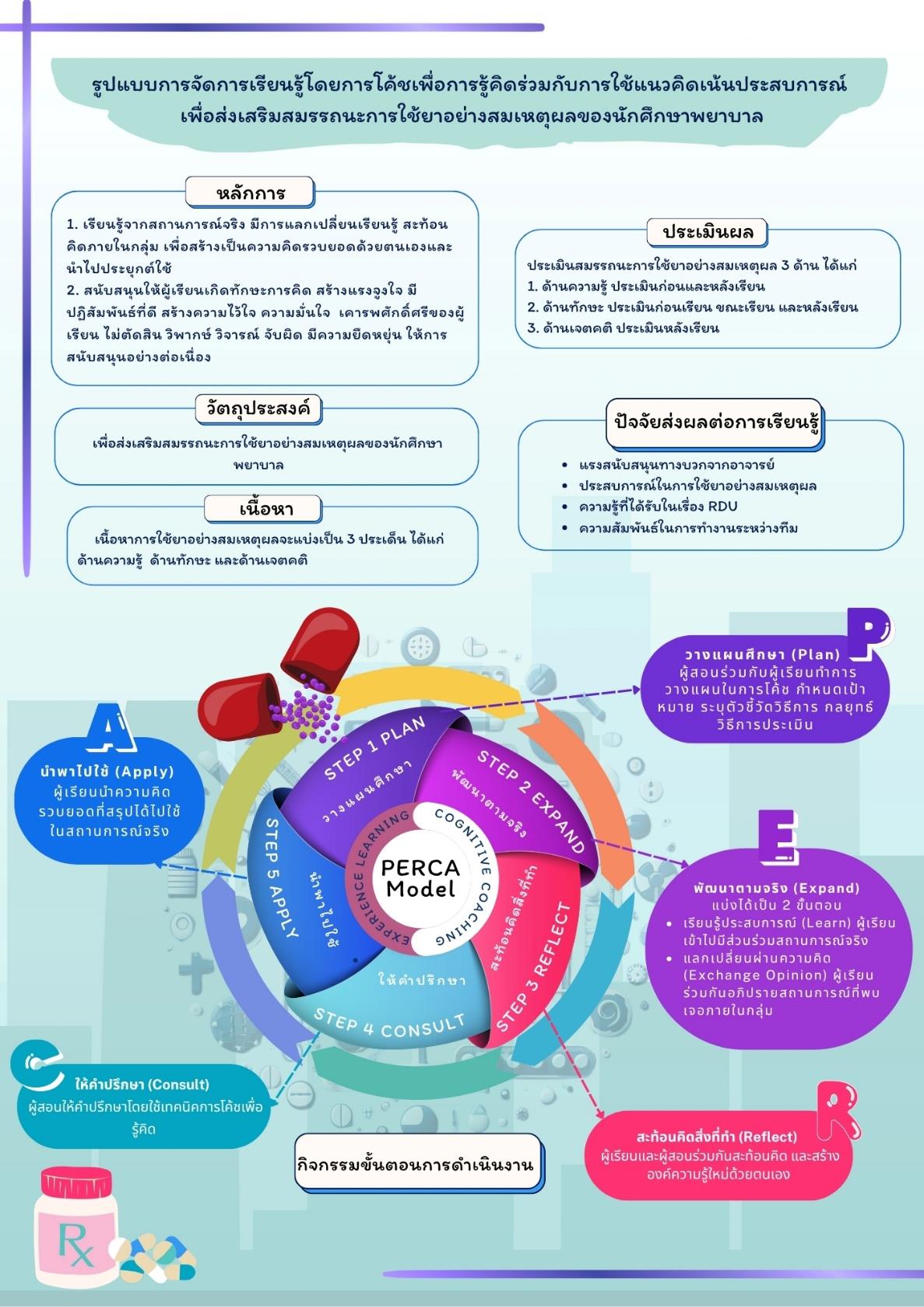
ผลการวิจัยพบว่า 1) รูปแบบการจัดการเรียนรู้โดยการโค้ชเพื่อการรู้คิดร่วมกับการใช้แนวคิดเน้นประสบการณ์ ประกอบด้วย 6 องค์ประกอบ ได้แก่ 1) หลักการ 2) วัตถุประสงค์ 3) เนื้อหา 4) กิจกรรมขั้นตอนการดำเนินงาน (PERCA Model) ประกอบด้วย 5 ขั้น ได้แก่ ขั้นที่ 1 วางแผนศึกษา (plan) ขั้นที่ 2 พัฒนาตามจริง (expand) แบ่งได้เป็น 2 ขั้น คือ ขั้นที่ 2.1 เรียนรู้ประสบการณ์ (learn) ขั้นที่ 2.2 แลกเปลี่ยนผ่านความคิด (exchange opinion) ขั้นที่ 3 สะท้อนคิดสิ่งที่ทำ (reflect) ขั้นที่ 4 ให้คำปรึกษา (consult) ขั้นที่ 5 นำพาไปใช้ (apply) 5) ประเมินผล 6) ปัจจัยส่งผลต่อการเรียนรู้ และ 2) ผลการประเมินคุณภาพของรูปแบบการจัดการเรียนรู้ที่พัฒนาขึ้น ประเมินโดยผู้เชี่ยวชาญ จำนวน 5 คน พบว่า คุณภาพโดยภาพรวมมีความเหมาะสมอยู่ในระดับมากที่สุด (M = 4.85, SD = .35) โดยด้านการกำหนดองค์ประกอบของรูปแบบมีความครอบคลุม สอดคล้องสัมพันธ์กัน มีความเหมาะสมอยู่ในระดับมากที่สุด และด้านองค์ประกอบของรูปแบบการจัดการเรียนรู้ ทั้ง 6 องค์ประกอบ มีความเหมาะสมอยู่ในระดับมากที่สุด
Downloads
เอกสารอ้างอิง
Abu-Shawish, R. K., Qadhi, S. A., & Yousef, W. (2022). Impact of cognitive coaching on self-efficacy, students, classroom management, and instructional practice in TEFL teacher education. The Journal of Positive Psychology, 6(5), 8017–8026.
Baddeley, A. D. (2007). Working memory, thought, and action. Oxford University Press.
Bresolin, P., Martini, J. G., Lazzari, D. D., Galindo, I. da S., Rodrigues, J., & Barbosa, M. H. P. A. (2019). Experiential learning and national curriculum guidelines for nursing undergraduate courses: Integrative review of the literature. Cogitare Enferm, 24.
Chaonarin, P., Keeratavanithsathian, S., Parayat, C., Charoenbhakdi, J., & Deawprasert, T. (2024). Learning experiences of nursing students using simulation-based learning at a private university in Bangkok. Journal of Health Sciences Scholarship, 11(2), 1–14.
Costa, A. L., & Garmston, R. J. (2002). Cognitive coaching: A foundation for renaissance schools (2nd ed.). Boston, MA: Allyn & Bacon.
Dewey, J. (1938). Experience and education. New York, NY: Macmillan.
Göker, S. D., & Göker, M. U. (2021). Cognitive coaching: Developing teachers of English as self-directed learners. The Journal of Asia TEFL, 18(3), 875–890.
Honey, P., & Mumford, A. (1992). The manual of learning style (2nd ed.). London, UK: Peter Honey and Alan Mumford.
Kolb, D. A. (1984). Experiential learning: Experience as the source of learning and development. Englewood Cliffs, NJ: Prentice-Hall.
Kruse, K. M. (2009). Instructional to instructional design and ADDIE model. Retrieved from http://carbon.ucdenver.edu/~mryder/itc/idmodels.html
Murphy, F., & Timmins, F. (2009). Experience-based learning (EBL): Exploring professional teaching through critical reflection and reflexivity. Nurse Education in Practice, 9(1), 72–80.
National Drug System Development Committee, Food and Drug Administration, Ministry of Public Health (Thailand). (2024). Thailand's national drug system development action plan 2023–2027. Nonthaburi: Aksorn Graphic and Design Publishing House.
Phaokunha, R., Thanyasawad, T., & Yoochareonsuk, K. (2021). Knowledge, attitude and behaviors in rational antibiotics drug use of nursing students. Journal of The Royal Thai Army Nurses, 22(3), 143–150.
Phatphol, M. (2015). A model for developing elementary school teachers in coaching for critical thinking. Silpakorn University Journal, 8(2), 593–612.
Phonui, P., Thiangchanya, P., & Laimak, S. (2022). Development of coaching model using the PPCE process with new nurses to enhance drug literacy for elderly patients. Journal of Health and Nursing Education, 28(2), 1–17.
Rogers, W. T., Hauserman, C. P., & Skytt, J. (2016). Using cognitive coaching to build school leadership capacity: A case study in Alberta. Canadian Journal of Education, 39(3), 1–29.
Sarakshetrin, A., Rongmuang, D., Kaewraya, K., Sroisri, P., & Chaisuk, I. (2020). Competencies in rational use of antibiotics among nursing students in Prachomklao College of Nursing, Phetchaburi province. The Southern College Network Journal of Nursing and Public Health, 7(2), 206–218.
Seneewong Na Ayuttaya, S., Ritronsak, S., & Chakkaew, W. (2021). Authentic experiential learning. Thammasat Journal, 40(2), 116–129.
Suapumee, N., Naksrisang, W., & Singhasem, P. (2017). Management of experiential learning in nursing education. Nursing Journal of the Ministry of Public Health, 27(1), 12–21.
Sub-committee on the Promotion of Rational Drug Use. (2015). Rational drug use hospital manual. Nonthaburi: The Agricultural Cooperative Federation of Thailand Publisher.
Sutthiya, K., Sinlarat, P., & Fakkao, S. (2018). The development of an instructional model based on authentic experiences to enhance self-directed learning characteristics of lower secondary students. Journal of Graduate Studies Valaya Alongkron Rajabhat University, 12(3), 1–15.
Suwannapong, K., Leungratanamart, L., Wongwiseskul, S., Turner, K., & Theinpichet, S. (2021). Factors associated with competency in rational drug use of nursing graduates. Journal of The Royal Thai Army Nurses, 13(2), 378–387.
Thienpichate, S., Charoensuk, S., & Ruenreng, T. (2019). Manual for teaching rational drug use. In the Bachelor of Nursing Science curriculum. Bangkok: Danex Intercorporation.
Turner, K., Radabutr, M., Laokosin, N., Thadakant, S., & Vaisurasingha, L. (2019). An evaluation of the processes of integrating the rational drug use curriculum into the bachelor of nursing science program, academic year B.E. 2561. Journal of Health Science Research, 13(2), 103-116.
Wongyai, W., & Phatphol, M. (2015). Coaching for critical thinking (5th ed.). Bangkok: Joransanitwong Printing.
World Health Organization. (2002). Promoting rational use of medicines: Core components. Retrieved from https://iris.who.int/bitstream/handle/10665/67438/WHO_EDM_2002.3.pdf
World Health Organization. (2012). The pursuit of responsible use of medicines: Sharing and learning from country experiences. WHO Press.
ดาวน์โหลด
เผยแพร่แล้ว
รูปแบบการอ้างอิง
ฉบับ
ประเภทบทความ
สัญญาอนุญาต
ลิขสิทธิ์ (c) 2025 วารสารพยาบาลตำรวจและวิทยาศาสตร์สุขภาพ

อนุญาตภายใต้เงื่อนไข Creative Commons Attribution-NonCommercial-NoDerivatives 4.0 International License.
ผลงานที่ได้ตีพิมพ์แล้วจะเป็นลิขสิทธิ์ของวารสารพยาบาลตำรวจ