DEVELOPMENT OF A SERVICES SYSTEM FOR IMPOVERISHED BEDBOUND PATIENTS IN THE BANGKOK AREA
Keywords:
healthcare service system, bedbound patients, impoverished patientsAbstract
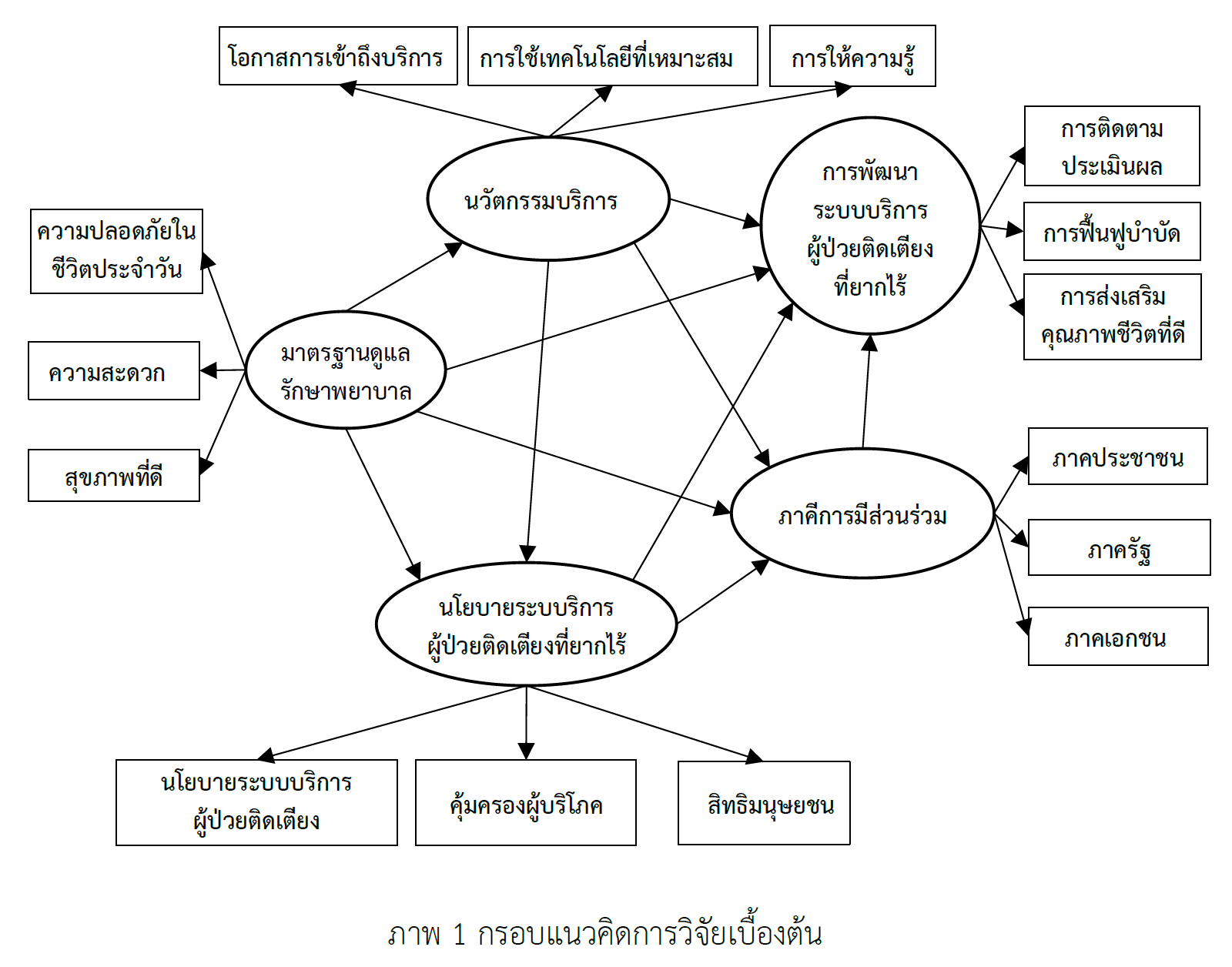
This mixed-methods study aimed to: 1) assess the development level of service systems for impoverished bedridden patients, service innovations, standards of care, service policies, and stakeholder participation; 2) examine the influence of service innovations, standards of care, service policies, and stakeholder participation on the development of these service systems; and 3) propose strategic guidelines for service system improvement. The quantitative phase involved 350 bedridden patients selected through multistage random sampling. Data were analyzed using descriptive statistics, structural equation modeling (SEM), and path analysis. The qualitative phase consisted of in-depth interviews with 15 informants selected through purposive selection, with data analyzed through content analysis.
The results revealed that: 1) The highest mean score was for the development of service systems for impoverished bedridden patients, followed by standards of care, service policy, service innovation, and stakeholder participation, respectively. 2) The SEM model showed good fit with the empirical data (Chi-square = 70.9, df = 44, p = .06, GFI = .99, AGFI = .99, CFI = .99, RMR = .043, RMSEA = .042). Standards of care had the greatest total influence on service system development for impoverished bedridden patients, followed by stakeholder participation, service policy, and service innovation. 3) The proposed development guidelines included: 3.1) expanding service accessibility through mobile health units and centralized data systems; 3.2) applying digital and Internet of Things (IoT) technologies aligned with local community contexts; 3.3) developing and implementing practical, standardized care protocols; 3.4) ensuring sustained policy and budgetary integration; and 3.5) fostering multisectoral and community-wide engagement to build equitable, inclusive, and sustainable care systems.
Downloads
References
Badr, J., Motulsky, A., & Denis, J. L. (2024). Digital health technologies and inequalities: A scoping review of potential impacts and policy recommendations. Health Policy, 146, 105122. https://doi.org/10.1016/j.healthpol.2024.105122
Bangkok Metropolitan Administration Act, B.E. 2528. (1985). Royal Thai Government Gazette, Vol. 102, Part 115 Special Issue, pp. 1-28. Retrieved from http://www.ratchakitcha.soc.go.th/DATA/PDF/2528/A/115/1.PDF
Choi, N. G., DiNitto, D. M., & Marti, C. N. (2016). Older-adult marijuana users and ex-users: Comparisons of sociodemographic characteristics and mental and substance use disorders. Drug and Alcohol Dependence, 165, 94-102. https://doi.org/10.1016/j.drugalcdep.2016.05.023
Coleman, S., Gorecki, C., Nelson, E. A., Closs, S. J., Defloor, T., Halfens, R., Farrin, A., Brown, J., Schoonhoven, L., & Nixon, J. (2013). Patient risk factors for pressure ulcer development: Systematic review. International Journal of Nursing Studies, 50(7), 974-1003. https://doi.org/10.1016/j.ijnurstu. 2012.11.019
Costello, A. B., & Osborn, J. W. (2005). Best practices in exploratory factor analysis: Four recommendations for getting the most from your analysis. Practical Assessment, Research & Evaluation, 10(7). https://doi.org/10.7275/jyj1-4868
Digital Government Development Agency (Public Organization). (2024). Information on continuous home care for patients and the elderly (homebound/bedridden). Retrieved from https://data.go.th/dataset/doh006
Foundation of Thai Gerontology Research and Development institute. (2022). Situation of the Thai elderly 2021. Nakhon Pathom: Institute for Population and Social Research, Mahidol University. Retrieved from https://thaitgri.org/?p=40101
Health Department, Bangkok. (2024). List of public health centers. Retrieved from https://webportal.bangkok. go.th/health
Leibowitz, A., Livaditis, L., Daftary, G., Pelton-Cairns, L., Regis, C., & Taveras, E. (2021). Using mobile clinics to deliver care to difficult-to-reach populations: A COVID-19 practice we should keep. Preventive Medicine Reports, 24, 101551. https://doi.org/10.1016/j.pmedr.2021.101551
Liu, L., & Zhang, Y. (2021). Chinese patients' intention to use different types of internet hospitals: Cross-sectional study on virtual visits. Journal of Medical Internet Research, 23(8), e25978. https://doi.org/10.2196/25978
Mienkird, W. (2020). Elderly people in shelters for the homeless. Bangkok: Charansanitwong Printing.
Mohamed, A. M. M., Abd Allah, E. S., Aboserea, M. M., & Mohammed, R. A. (2023). Training program for caregivers on prevention of pressure ulcers among elderly patients. International Journal of Chemical and Biochemical Sciences, 24(10), 1516-1524. Retrieved from https://www.iscientific.org/wp-content/uploads/191-ijcbs-23-24-10-191e.pdf
National Health Commission Office. (2020). Bangkok health charter 2020. Nonthaburi: National Health Commission Office. Retrieved from https://prt.parliament.go.th/items/04cbcfab-99b9-40ca-bc27-a883d79b9027/full
Office of the National Economic and Social Development Board. (2018). National strategy (2018–2037). Royal Thai Government Gazette. Retrieved from https://www.ratchakitcha.soc.go.th/DATA/PDF/2561/A/082/T_0001.PDF
O’Mara-Eves, A., Brunton, G., Oliver, S., Kavanagh, J., Jamal, F., & Thomas, J. (2015). The effectiveness of community engagement in public health interventions for disadvantaged groups: A meta-analysis. BMC Public Health, 15(1), 129. https://doi.org/10.1186/s12889-015-1352-y
Rejeb, A., Rejeb, K., Treiblmaier, H., Appolloni, A., Alghamdi, S., Alhasawi, Y., & Iranmanesh, M. (2023). The internet of things (IoT) in healthcare: Taking stock and moving forward. Internet of Things, 22, 100721. https://doi.org/10.1016/j.iot.2023.100721
van Velthoven, M. H., Cordon, C., & Challagalla, G. (2019). Digitization of healthcare organizations: The digital health landscape and information theory. International Journal of Medical Informatics, 124, 49-57. https://doi.org/10.1016/j.ijmedinf.2019.01.007
Downloads
Published
How to Cite
Issue
Section
License
Copyright (c) 2025 JOURNAL OF THE POLICE NURSES AND HEALTH SCIENCE

This work is licensed under a Creative Commons Attribution-NonCommercial-NoDerivatives 4.0 International License.
ผลงานที่ได้ตีพิมพ์แล้วจะเป็นลิขสิทธิ์ของวารสารพยาบาลตำรวจ