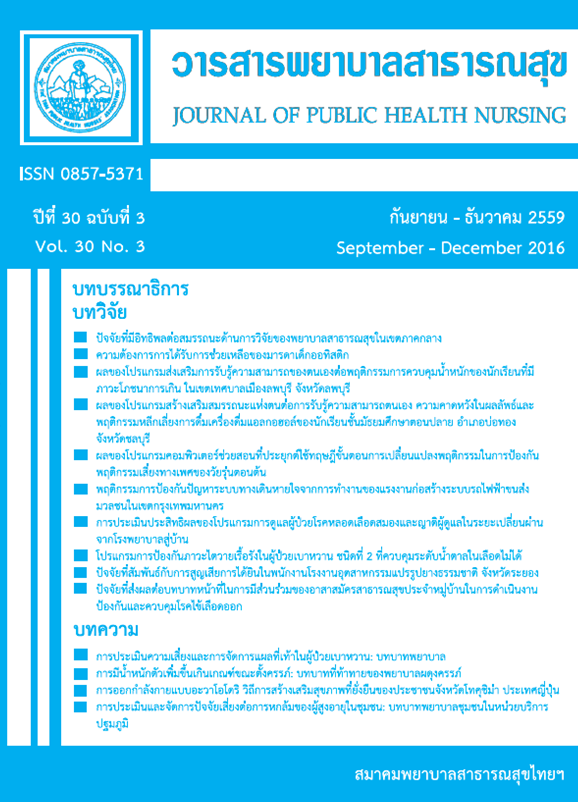
โปรแกรมการป้องกันภาวะไตวายเรื้อรังในผู้ป่วยเบาหวาน ชนิดที่ 2 ที่ควบคุมระดับน้ำตาลในเลือดไม่ได้
บทคัดย่อ
การวิจัยกึ่งทดลองนี้ มีวัตถุประสงค์เพื่อศึกษาผลของโปรแกรมการป้องกันภาวะไตวายเรื้อรัง ในผู้ป่วยเบาหวานชนิดที่ 2 ที่ควบคุมระดับน้ำตาลในเลือดไม่ได้ โดยประยุกต์ทฤษฎีใช้แรงจูงใจในการป้องกันโรคร่วมกับแนวคิดแรงสนับสนุนทางสังคม กลุ่มตัวอย่างคือ ผู้ป่วยอายุ 40-60 ปี ที่มาตรวจรักษาที่คลินิกเบาหวาน โรงพยาบาลสิรินธร จังหวัดอุบลราชธานี จำนวน 60 คน แบ่งเป็นกลุ่มทดลองและกลุ่มเปรียบเทียบ กลุ่มละ 30 คน ระยะเวลาศึกษา 6 สัปดาห์ เป็นระยะทดลอง 2 สัปดาห์ และระยะติดตามผล 4 สัปดาห์ เก็บรวบรวมข้อมูลด้วยแบบสอบถามในระยะก่อนการทดลอง หลังการทดลอง และระยะติดตามผล วิเคราะห์ข้อมูลด้วยสถิติ ค่าเฉลี่ย ร้อยละ ส่วนเบี่ยงเบนมาตรฐาน Chi-square, Repeated measure ANOVA และ Independent t-test
ผลการวิจัยพบว่ากลุ่มทดลองมีคะแนนเฉลี่ยการรับรู้ความรุนแรงของภาวะไตวายเรื้อรัง การรับรู้โอกาสเสี่ยงต่อการเกิดภาวะไตวายเรื้อรัง การรับรู้ความสามารถของตนเองในการปฏิบัติพฤติกรรม การรับรู้ความคาดหวังในผลลัพธ์ของการปฏิบัติพฤติกรรม และการปฏิบัติพฤติกรรมเพื่อป้องกันภาวะไตวายเรื้อรัง ดีขึ้นกว่าก่อนการทดลอง และดีกว่ากลุ่มเปรียบเทียบอย่างมีนัยสำคัญทางสถิติ (p-value <0.05)
ข้อเสนอแนะจากผลการวิจัยครั้งนี้คือโปรแกรมดังกล่าว ร่วมกับการให้แรงสนับสนุนทางสังคมจากบุคคลในครอบครัว สามารถทำให้ผู้ป่วยมีการเปลี่ยนแปลงพฤติกรรมเพื่อป้องกันการเกิดภาวะไตวายเรื้อรังดีขึ้น ซึ่งสามารถนำไปประยุกต์ใช้กับประชากรกลุ่มโรคเรื้อรังที่มีลักษณะใกล้เคียงกันได้
CHRONIC KIDNEY DISEASE PREVENTING PROGRAM AMONG UNCONTROLLED DIABETIC PATIENTS
The purpose of this Quasi-Experimental research was to study the effects of the chronic kidney disease-preventing program among uncontrolled type II diabetic patients applying protection-motivation theory and social support. The samples were 60 uncontrolled type II diabetic patients aged 40-60 years old who’re visited a diabetic clinic at Sirinthron hospital, Ubonrachathani province that divided into an experimental and a comparison group which consisted of 30 patients in each group. The research was conducted over a period of 6 weeks, 2 weeks were allotted for the intervention and another 4 weeks provided for follow-up. The data collection was conducted by questionnaire for the pre-test, post-test and follow-up periods. The data were then analyzed by statistical means for frequency percentage, mean, standard deviation, Chi-square, Repeated measure ANOVA and Independent t-test.
The finding revealed that the experimental group had a significantly higher mean score of perceived severity of chronic kidney disease, possible risks of chronic kidney disease self-efficacy in practicing chronic kidney disease preventive behaviors, the effectiveness of practicing. chronic kidney disease preventive behaviors and preventive behaviors than the pre-test stage and those in the comparison group (p-value <0.05). From this research’s result recommends that the program along with social support from family members, shows it to be beneficial in a positive change for the chronic kidney disease preventing behavior in experimental group which can be applied to other similar groups of chronic disease populations.
ดาวน์โหลด
รูปแบบการอ้างอิง
ฉบับ
ประเภทบทความ
สัญญาอนุญาต
บทความที่ตีพิมพ์และแผนภูมิรูปภาพถือเป็นลิขสิทธิ์ของวารสารพยาบาลสาธารณสุข (Thai Public Health Nurses Association)