
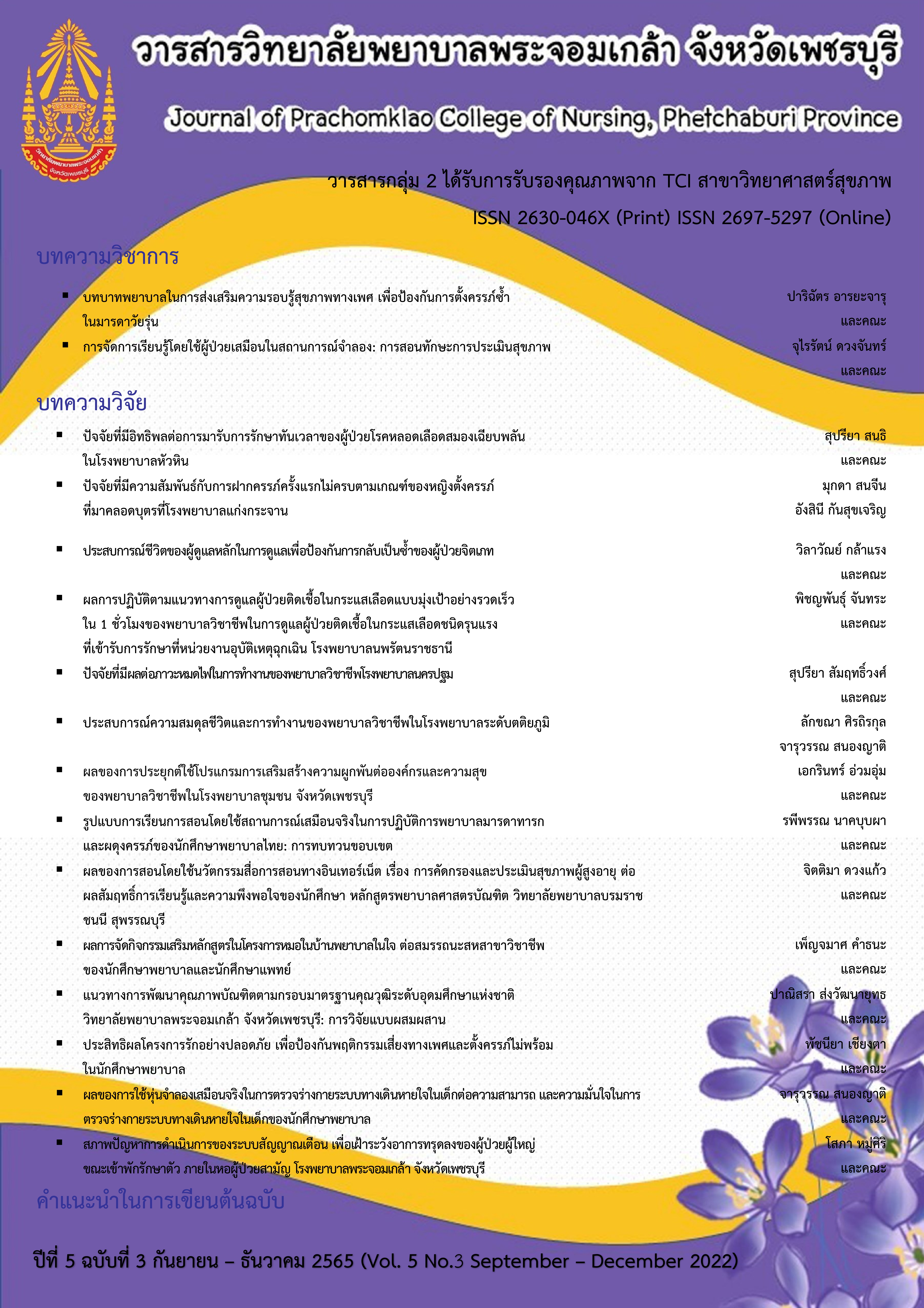
สภาพปัญหาการดำเนินการของระบบสัญญาณเตือน เพื่อเฝ้าระวังอาการทรุดลงของผู้ป่วยผู้ใหญ่ขณะเข้าพักรักษาตัว ภายในหอผู้ป่วยสามัญ โรงพยาบาลพระจอมเกล้าจังหวัดเพชรบุรี
Article Sidebar
Main Article Content
บทคัดย่อ
ระบบสัญญาณเตือนเพื่อเฝ้าระวังอาการทรุดลงของผู้ป่วยผู้ใหญ่ในโรงพยาบาลพระจอมเกล้าจังหวัดเพชรบุรี ได้ดำเนินการมาแล้วระยะหนึ่ง จึงควรมีการติดตามการดำเนินงาน การวิจัยเชิงคุณภาพนี้ มีวัตถุประสงค์เพื่อศึกษาการรับรู้ปัญหาและอุปสรรคการดำเนินการ และข้อเสนอแนะในการปรับปรุงระบบสัญญาณเตือน เก็บรวบรวมข้อมูลโดยการสนทนากลุ่มผู้บริหารโรงพยาบาล หัวหน้าหอผู้ป่วย และพยาบาลผู้ปฏิบัติ เลือกกลุ่มตัวอย่างแบบเจาะจง จำนวน 22 คน เครื่องมือที่ใช้ในการวิจัย เป็นแนวคำถามในการสนทนากลุ่มที่ผ่านการตรวจสอบความตรงโดยผู้ทรงคุณวุฒิ และวิเคราะห์ข้อมูลโดยวิเคราะห์เนื้อหา ผลการวิจัยพบว่า
1. ประเด็นปัญหาและอุปสรรค ได้แก่ 1) บุคลากรขาดความรู้ ความเข้าใจ ทักษะและความตระหนัก 2) ขั้นตอนและเกณฑ์การใช้ PCK MEWS ยังไม่เหมาะสมกับบริบทของแต่ละหอผู้ป่วย 3) การรายงานอาการของผู้ป่วยโดยใช้คะแนน PCK MEWS คลาดเคลื่อน และ 4) ไม่มั่นใจในความถูกต้องของคะแนนการประเมิน
2. ความคิดเห็นและข้อเสนอแนะในการปรับปรุง ได้แก่ 1) พัฒนาปรับปรุงระบบ PCK MEWS ให้เหมาะสม 2) ประชุมชี้แจงเสริมสร้างความรู้ความเข้าใจ 3) นำรูปแบบการรายงานอาการมาใช้ร่วมกันกับ PCK MEWS 4) จัดการประเมินและอุปกรณ์ที่ได้มาตรฐาน 5) กำกับติดตามและเพิ่มช่องทางการรับฟังปัญหา และ 6) นำเทคโนโลยีสารสนเทศมาใช้ในการปรับปรุงระบบ
ผลการวิจัยนี้ สามารถนำไปใช้ในการพัฒนา PCK MEWS ให้เป็นมาตรฐานเพื่อการดูแลผู้ป่วยได้อย่างมีประสิทธิภาพต่อไป
Downloads
Article Details

อนุญาตภายใต้เงื่อนไข Creative Commons Attribution-NonCommercial-NoDerivatives 4.0 International License.
เนื้อหาและข้อมูลที่เผยแพร่ในวารสารวิทยาลัยพยาบาลพระจอมเกล้า จังหวัดเพชรบุรี ถือเป็นข้อคิดเห็นและความรับผิดชอบของผู้นิพนธ์บทความโดยตรง บทความ เนื้อหา ข้อมูล รูปภาพ ฯลฯ ที่ได้รับการเผยแพร่ในวารสารนี้ ถือเป็นลิขสิทธิ์ของวารสารฯ หากบุคคลหรือหน่วยงานใดต้องการนำทั้งหมดหรือส่วนหนึ่งส่วนใดไปเผยแพร่หรือเพื่อกระทำการใด ๆ จะต้องอ้างอิงวิทยาลัยพยาบาลพระจอมเกล้า จังหวัดเพชรบุรี ทุกครั้ง
เอกสารอ้างอิง
กลุ่มการพยาบาล โรงพยาบาลพระจอมเกล้าจังหวัดเพชรบุรี. (2562). รายงานประจำปี. โรงพยาบาลพระจอมเกล้าจังหวัดเพชรบุรี.
จุไรรัตน์ ดวงจันทร์. (2563). การสื่อสารเพื่อส่งต่อข้อมูลทางการพยาบาลด้วยเทคนิคเอสบาร์. วารสารพยาบาลศาสตร์ มหาวิทยาลัยสยาม, 21(41), 91-103.
เพชรรัตน์ ยอดเจริญ. (2564). การเฝ้าระวังการเปลี่ยนแปลงอาการโดยใช้ MEW score. วารสารโรงพยาบาลธรรมศาสตร์เฉลิมพระเกียรติออนไลน์, 6(2), 35-37.
พิศาล ชุ่มชื่น, และ นิตยศรี ดวงอาทิตย์. (2564). เครื่องมือประเมินการเฝ้าระวังและป้องกันการเข้าสู่ภาวะวิกฤตของผู้ป่วย. วารสารแพทย์เขต 4-5, 40(2), 307-322.
ยุพดี ธัมมิกะกุล. (2563). ผลของการใช้แนวปฏิบัติการพยาบาลการบันทึกสัญญาณเตือนภาวะวิกฤติในผู้ป่วยที่มี การติดเชื้อในกระแสเลือด แผนกผู้ป่วยในโรงพยาบาลท่ายาง จังหวัดเพชรบุรี. วารสารวิทยาลัยพยาบาลพระจอมเกล้า จังหวัดเพชรบุรี, 3(1), 31-46.
หรรษา เทียนทอง, และ พุทธชาติ สมณา. (2559). Enjoy quality every moment in global and national health care. ใน อนุวัฒน์ ศุภชุติกุล (บ.ก.), ประชุมวิชาการประจำปี ครั้งที่ 17 คุณภาพในทุกลมหายใจ. สถาบันรับรองคุณภาพสถานพยาบาล (องค์การมหาชน).
สถาบันรับรองคุณภาพสถานพยาบาล (องค์การมหาชน). (2562). มาตรฐานโรงพยาบาลและบริการสุขภาพ ฉบับที่ 4 (พิมพ์ครั้งที่ 2). สถาบันรับรองคุณภาพสถานพยาบาล (องค์การ มหาชน).
แสงจันทร์ หนองนา, นิลเนตร สุดสวาท, และ ดวงสุดา วัฒนธัญญการ. (2563). ประสิทธิผลของการจัดการการส่งเวรด้วยรูปแบบ SBAR ของพยาบาลวิชาชีพ ในโรงพยาบาลเอกชนแห่งหนึ่ง. วารสารการพยาบาลและสุขภาพ สสอท., 2(1), 45 – 57.
แสงโสม ช่วยช่วง. (2561). ผลของการใช้แนวทางการประเมินสัญญาณเตือนการเข้าสู่ภาวะวิกฤต (MEWS) ในการประเมินและเฝ้าระวังอาการเปลี่ยนแปลงผู้ป่วยในการห้องตรวจสวนหัวใจ โรงพยาบาลตรัง. วารสารพยาบาลโรคหัวใจและทรวงอก, 29(1), 72-82.
Smith, M. B., Chiovaro, J. C., O’Neil, M., Kansagara, D., Quiñones, A. R., Freeman, M., Motu’apaoka, M. L., & Slatore, C. G. (2014). Early warning system scores for clinical deterioration in hospitalized patients: a systematic review. Annals of the American Thoracic Society, 11(9), 1454-1465.
Clarke, V., & Braun, V. (2013). Teaching thematic analysis: Overcoming challenges and developing strategies for effective learning. The Psychologist, 26(2), 120-123.
Collins, D., & Loveys, A. (2011). Value and outcomes: what the system has meant to our practice and our patients. In Margaret Schulte, D. B. A. (Ed.), Go-live: Smart strategies from Davies award-winning EHR implementations (pp.135-148). HiMSS.
Lam, T. S., Mak, P. S. K., Siu, W. S., Lam, M. Y., Cheung, T. F., & Rainer, T. H. (2006). Validation of a Modified Early Warning Score (MEWS) in emergency department observation ward patients. Hong Kong Journal of Emergency Medicine, 13(1), 24-30.
Le Lagadec, M. D., & Dwyer, T. (2017). Scoping review: The use of early warning systems for the identification of in-hospital patients at risk of deterioration. Australian Critical Care, 30(4), 211-218.
Lincoln, Y. S., & Guba, E. (1985) Naturalistic Inquiry. Sage.
Nishijima, I., Oyadomari, S., Maedomari, S., Toma, R., Igei, C., Kobata, S., Koyama, J., Tomori, R., Kawamitsu, N., Yamamoto, Y., Tsuchida, M., Tokeshi, Y., Ikemura, R., Miyagi, K., Okiyama, K., & Iha, K. (2016). Use of a modified early warning score system to reduce the rate of in-hospital cardiac arrest. Journal of Intensive Care, 4, Article 12. https://jintensivecare.biomedcentral.com/articles/10.1186/s40560-016-0134-
Rocha, T. F. D., Neves, J. G., & Viegas, K. (2016). Modified early warning score: evaluation of trauma patients. Revista Brasileira de Enfermagem, 69, 906-911.
Temgoua, M. N., Tochie, J. N., Agbor, V. N., Tianyi, F. L., Tankeu, R., & Danwang, C. (2018). Simple mortality predictive models for improving critical care in resource-limited settings: An insight on the modified early warning score and rapid emergency medical score. International Journal of Applied and Basic Medical Research, 8(3), 199-201.
Wang, A. Y., Fang, C. C., Chen, S. C., Tsai, S. H., & Kao, W. F. (2016). Peri-arrest Modified Early Warning Score (MEWS) predicts the outcome of in-hospital cardiac arrest. Journal of the Formosan Medical Association, 115(2), 76-82.
