
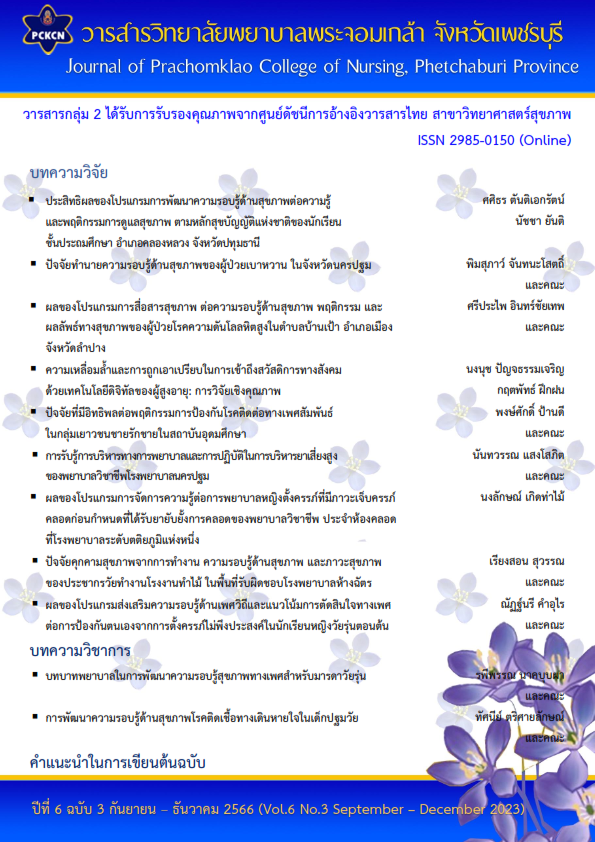
ปัจจัยคุกคามสุขภาพจากการทำงาน ความรอบรู้ด้านสุขภาพ และภาวะสุขภาพ ของประชากรวัยทำงานโรงงานทำไม้ ในพื้นที่รับผิดชอบ โรงพยาบาลห้างฉัตร
Article Sidebar
Main Article Content
บทคัดย่อ
การวิจัยแบบผสมผสานนี้ มีวัตถุประสงค์ 1) เพื่อศึกษาปัจจัยและหาความสัมพันธ์ระหว่างปัจจัยคุกคามสุขภาพจากการทำงานและภาวะสุขภาพ 2) เพื่อเปรียบเทียบความรอบรู้ด้านสุขภาพระหว่างกลุ่มที่มีภาวะสุขภาพแตกต่างกันในประชากรทำงานโรงงานทำไม้ และ 3) เพื่อสังเคราะห์ข้อเสนอแนะเชิงนโยบายในการป้องกันปัญหาสุขภาพและการเกิดโรคไม่ติดต่อเรื้อรังของประชากรวัยทำงาน โรงงานทำไม้ เก็บข้อมูลเชิงปริมาณ ในประชากรอายุ 15-59 ปี จำนวน 130 คน ด้วยแบบสอบถามปัจจัยคุกคามสุขภาพจากการทำงาน เก็บข้อมูลเชิงคุณภาพ ด้วยการสุ่มอย่างง่าย จำนวน 30 คน ด้วยแบบบันทึกข้อมูลด้านสุขภาพ และการสนทนากลุ่มย่อย และการสัมภาษณ์เชิงลึก วิเคราะห์ข้อมูลเชิงปริมาณด้วยสถิติเชิงพรรณนา วิเคราะห์ข้อมูลเชิงคุณภาพด้วยการวิเคราะห์แก่นสาระ
ผลการวิจัย พบว่า ปัจจัยคุกคามสุขภาพจากการทำงานด้านกายภาพ มีฝุ่นละออง มีค่าเฉลี่ยสูงสุด (M = 3.60, SD = 1.44) ปัญหาสุขภาพส่วนใหญ่ ได้แก่ ปวดศีรษะ อ่อนเพลียจากการทำงานในที่อากาศร้อนอบอ้าว (ร้อยละ 80) ความรอบรู้ด้านสุขภาพทุกด้านระดับดี ค่าเฉลี่ยสูงสุด ได้แก่ ด้านความรู้ความเข้าใจ (M = 3.72, SD = .89) ปัจจัยคุกคามสุขภาพจากการทำงาน มีความสัมพันธ์ทางบวกกับภาวะสุขภาพของประชากรทำงานโรงงานทำไม้ (r = .534) สะท้อนให้เห็นว่า ความรอบรู้ทางสุขภาพของประชากรทำงาน ป้องกันตนเองด้านสุขภาพจากการทำงาน นำไปสู่สุขภาวะที่ดีต่อไป
Downloads
Article Details

อนุญาตภายใต้เงื่อนไข Creative Commons Attribution-NonCommercial-NoDerivatives 4.0 International License.
เนื้อหาและข้อมูลที่เผยแพร่ในวารสารวิทยาลัยพยาบาลพระจอมเกล้า จังหวัดเพชรบุรี ถือเป็นข้อคิดเห็นและความรับผิดชอบของผู้นิพนธ์บทความโดยตรง บทความ เนื้อหา ข้อมูล รูปภาพ ฯลฯ ที่ได้รับการเผยแพร่ในวารสารนี้ ถือเป็นลิขสิทธิ์ของวารสารฯ หากบุคคลหรือหน่วยงานใดต้องการนำทั้งหมดหรือส่วนหนึ่งส่วนใดไปเผยแพร่หรือเพื่อกระทำการใด ๆ จะต้องอ้างอิงวิทยาลัยพยาบาลพระจอมเกล้า จังหวัดเพชรบุรี ทุกครั้ง
เอกสารอ้างอิง
Bleck, D., & Wettberg, W. (2012). Waste collection in developing countries–Tackling occupational safety and health hazards at their source. Waste Management, 32(11), 2009-2017.
Bloom, B. S. (1971). Handbook on formative and summative evaluation of student learning. McGraw-Hill.
Boontein, P., Anuritprasert, B., & Saneha, C. (2017). Factors related to metabolic syndrome among patients at out-patient department. Nursing Science Journal of Thailand, 35(4), 74-86. (in Thai)
Creswell, J. W., Fetters, M. D., & Ivankova, N. V. (2004). Designing a mixed methods study in primary care. The Annals of Family Medicine, 2(1), 7-12.
Daniel, W. W. (1995). Biostatistics: A foundation of analysis in the health sciences (6th ed.) John Wiley & Sons.
Division of Health Education, Department of Health Service Support. (2017). Assessment of health literacy and health behaviors according to principle 3E2S, working age group, aged 15 - 59 years. Health Systems Research Institute. (in Thai)
Division of Non Communicable Disease. (2018). Report on the situation of NCD disease 2018, diabetes, high blood pressure and related factors. Nonthaburi: Aksorn graphic and design publishing limited partnership. (in Thai) exposure revised criteria 1998. http://www.cdc.gov/niosh/docs/98-
Grizzle, A., Moore, P., Dezuanni, M., Asthana, S., Wilson, C., Banda, F., & Onumah, C. (2014). Media and information literacy: Policy and strategy guidelines. Unesco.
Hangchat Hospital. (2020). Annual health check-up report 2020. Hangchat Hospital. (in Thai)
Hangchat Hospital. (2021). Annual health check-up report 2021. Hangchat Hospital. (in Thai)
Khongtong, P. (2018). Factors related to chronic illness. Srinakharinwirot Research and Development Journal of Humanities and Social Sciences, 10(19), 116-126. (in Thai)
Lerdpornsawan, N., Chanprasit, C., & Kaewthummanukul, T. (2017). Occupational health hazards and health status related to risk among waste collectors. Nursing Journal, 44(2), 139-150. (in Thai)
Levy, B. S., Wegman, D. H., Baron, S. L., & Sokas, R. K. (2011). Occupational and environmental health: Recognizing and preventing disease and injury (6th ed.). Oxford University Press.
National Department of Health. (2018). Concepts and principles of a health literacy organization. Department of Health Project Office. (in Thai)
National Institute for Occupational Safety and Health. (2023). Occupational noise exposure. https://www.cdc.gov/niosh/docs/98-126/default.html
Nutbeam, D. (2000). Health literacy as a public health goal: A challenge for contemporary health education and communication strategies into the 21st century. Health Promotion International, 15(3), 259-267.
Nutbeam, D. (2008). The evolving concept of health literacy. Social Science & Medicine, 67(12), 72-78.
Office of Occupational and Environmental Diseases, Department of Disease control, Ministry of Public Health. (2017). Report on the situation of diseases and health hazards from occupations and the environment in 2017. https://ddc.moph.go.th/uploads/ckeditor2//files/01_envocc_situation_60.pdf. (in Thai)
Roma, W., Tanasugarn, C., Tipayamongkholgul, M., Aimyong, N., Neelapaichi, N., Kloyiam, S., & Samnuanklang, M. (2018). National health literacy survey project for Thai people aged 15 years and above (phase 1). Health Systems Research Institute. (in Thai)
Rungruang, J., Jivacate, N., & Leelukkanaveera, Y. (2021). Factors for prediction of occupational lung disease prevention behaviors among employees in wood industries in Samut Prakran Province. Journal of Health and Nursing Research, 37(2), 157-169. (in Thai)
Sasang, U., Krongyuth, K., & Chananin, Y. (2022). Factors associated with self-care behaviors of patients with Non-Communicable Diseases. Journal of Nursing and Education, 14(4), 45-58. (in Thai)
Tantranont, K., Wisutthananon, A., Suthakorn, W., Supavititpatana, B., Lirtmunlikaporn, S., & Kampoun, S. (2020). Factors associated with health literacy among working population, Nong Pa Krang subdistrict, Mueang district, Chiang Mai province. Lanna Public Health Journal, 16(2), 61-71. (in Thai)
Thongma, P. (2020). Health literacy and health outcomes in hypertensive patients. Thai Red Cross Nursing Journal, 13(1), 50-62. (in Thai)
Thongtip, S., & Pitakpong, A. (2019). Relationship between perception of noise protection and the use of hearing protection devices among stone-mortar workers in Phayao province. Srinagarind Medical Journal, 34(2), 155-160. (in Thai)
