
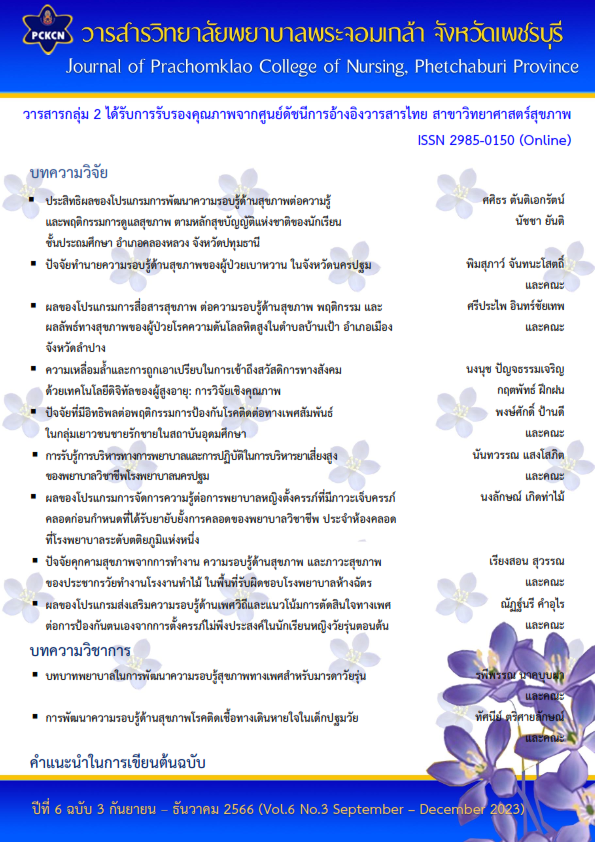
The Factors Affecting Sexual Transmitted Diseases Preventive Behaviors among Youth MSM in Higher Education Institutions
Article Sidebar
Main Article Content
Abstract
This descriptive research investigates the factors that predict preventive behaviours among young “Men who have Sex with Men: MSM” in higher education institutions. The information-motivation-behavioral (IMB) model was used as the conceptual framework in this study. The sample consisted of 100 young MSM aged 18-25 who were enrolled in higher education institutions in Phetchaburi Province. Data were collected through questionnaires administered via Google Forms, which covered demographic information, personal details, knowledge of diseases and sexually transmitted infections (STIs) prevention, influence from partners, attitudes towards STIs prevention, and ease of access to condoms, peer influence, ease of accessing emotionally stimulating media, and STIs preventive behaviours. Descriptive statistics and Stepwise multiple regression analysis were used to analyze the data. The content validity of the questionnaires was tested by experts. The KR-20 coefficient is .75. Cronbach's alpha coefficients are .78, .80, .97, .75, .86, .93, .94, and .89, respectively.
The findings reveal that education, the influence of partners, accessibility to condoms, and self-efficacy against STIs prevention (Beta = .71, .27, -.16, p < .05) are significant factors that could predict the preventive behaviour of STIs among young MSN in higher education institutions (R2 = .619).
The results of this study can be employed in the process of planning and coordinating projects that aim to enhance bargaining skills with sexual partners, provide condom services throughout educational institutions, dormitories, as well as in residential communities and promote self-efficacy against STIs prevention to promote behaviours that prevent STIs.
Downloads
Article Details

This work is licensed under a Creative Commons Attribution-NonCommercial-NoDerivatives 4.0 International License.
Content and information published in the Journal of Prachomklao College of Nursing, Phetchaburi Province are the comment and responsibility of the authors. Articles, information, images, etc. published in this journal are the copyright of the Journal of Prachomklao College of Nursing, Phetchaburi Province. If any person or entity wants to take all or part of it for publication for any purposes, please reference the Journal of Prachomklao College of Nursing, Phetchaburi Province.
References
Bloom, B. S., Madaus, G. F., & Hastings, J. T. (1971). Handbook on formative and summative evaluation of student learning. McGraw-Hill.
Buapan, C., Rutchanagul, P., & Buaboon, N. (2016). Factors predicting condom use behavior among men who have sex with men in Bangkok. Journal of Boromarajonani College of Nursing, Bangkok, 34(2), 62-73. (in Thai)
Centers for disease control and prevention: CDC. (2019, 11 April). STD facts – What gay, bisexual and other men who have sex with men need to know about sexually transmitted diseases. https://www.cdc.gov/std/life-stages-populations/stdfact-msm.htm
Charoensiri, S., Toonsiri, C., & Leelukkanaveera, Y. (2019). Factors affecting sexually transmitted infection preventive behaviors among male students in non-formal education. Journal of Phrapokklao College of Nursing, 30(2), 14-25. (in Thai)
Chondaeng, K., Rutchanagul, P., & Buaboon, N. (2018). Factors influencing HIV preventive behaviors among male adolescents in a correctional institution. Journal of Nursing and Health Care, 36(1), 43-51 (in Thai)
Department of Disease Control, Ministry of Public health. (2021). Sexually transmitted disease. https://catalog.nso.go.th/group/os-01 (in Thai)
Faul, F., Erdfelder, E., Buchner, A., & Lang, A. G. (2009). Statistical power analyses using G* Power 3.1: Tests for correlation and regression analyses. Behavior Research Methods, 41(4), 1149-1160.
Fisher, J. D., & Fisher, W. A. (1992). Changing AIDS-risk behavior. Psychological Bulletin, 111(3), 455-474. https://doi.org/10.1037/0033-2909.111.3.455
Institute for Population and Social Research, Mahidol University. (2016). MSM in Thailand, Who is this?, How many are there?, Who knows?. Population and Development Newsletter, 36(6), 1-3.
Jansen, K., Steffen, G., Potthoff, A., Schuppe, A. K., Beer, D., Jessen, H., Scholten, S., Spornraft-Ragaller, P., Bremer, V., Tiemann, C., & MSM Screening Study group. (2020). STI in times of PrEP: High prevalence of chlamydia, gonorrhea, and mycoplasma at different anatomic sites in men who have sex with men in Germany. BMC Infectious Diseases, 20, Article 110. https://doi.org/10.1186/s12879-020-4831-4
Ketsing, W. (1995). Statistics used in research. Research Division, Office of the Commission National Education.
Monsima, T. (2011). Health behaviors regarding prevention of sexually transmitted diseases of College of Physical Education Students Northeast. Srinakharinwirot University. (in Thai)
National Statistical Office of Thailand. (2020). Demography/ population. http://statbbi. nso.go.th/staticreport/page/sector/th/01.aspx (in Thai)
Ochonye, B., Folayan, M. O., Fatusi, A. O., Bello, B. M., Ajidagba, B., Emmanuel, G., Paul Umoh, P., Yusuf, A., & Jaiyebo, T. (2019). Sexual practices, sexual behavior and HIV risk profile of key populations in Nigeria. BMC Public Health, 19(1), Article 1210. https://doi.org/10.1186/s12889-019-7553-z
Sookrak, N., Srisuriyawate, R., & Homsin, P. (2018). Predicted factors of consistent condom use among men who have sex with men (MSM) undergraduate students in higher education institutions, Chonburi Province. Journal of Public Health Nursing, 32(3), 83-99. (in Thai)
Srisathitnarakun, B. (2010). The methodology in nursing research. U & I Intermedia. (in Thai)
Suriyasarn, B. (2015). Gender identity and sexual orientation in Thailand, 2019. International Labour Organization. (in Thai)
Suwan, G., Janprasert, S., & Homsin, P. (2017). Results of development Health beliefs in military personnel's intentions and behaviors to prevent sexually transmitted diseases. Stationed in Nakhon Ratchasima Province. Journal of The Royal Thai Army Nurses, 18(1), 237-244. (in Thai)
Suwannaphant, K., Khottarin, S., Kansin, S., & Vonok L. (2019). Health literacy factors associated with risk behaviours in HIV infection among high school male students, Bueng Kan Province. Journal of The Office of ODPC 7 Khon Kaen, 26(2), 71-82. (in Thai)
World Health Organization. (2004). The ICD-10 Classification of mental and behavioural disorders: Clinical descriptions and diagnostic guidelines. https://cdn.who.int/media/docs/default-source/classification/other-classifications/9241544228_eng.pdf
