
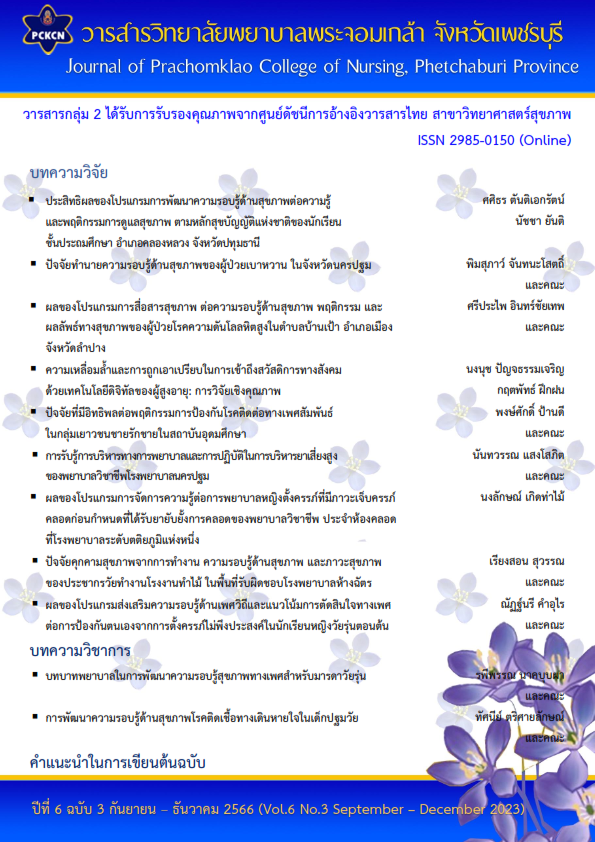
บทบาทพยาบาลในการพัฒนาความรอบรู้สุขภาพทางเพศสำหรับมารดาวัยรุ่น
Article Sidebar
Main Article Content
บทคัดย่อ
การขาดความรอบรู้ด้านสุขภาพ จะส่งผลต่อสุขภาพ ระดับความรอบรู้ด้านสุขภาพที่ไม่เพียงพอ สะท้อนถึงระบบบริการและการเข้าถึงข้อมูลบริการทางสุขภาพที่มีความซับซ้อนเกินกว่าที่ประชาชนจำนวนหนึ่งจะสามารถเข้าถึงและใช้ประโยชน์ได้ โดยเฉพาะในกลุ่มมารดาวัยรุ่นเป็นกลุ่มประชากรหนึ่งที่มีข้อจำกัดในระดับการศึกษา เนื่องจากการตั้งครรภ์ทำให้ต้องหยุดพักการเรียน อาจทำให้ไม่ประสบความสำเร็จในการดำรงบทบาทการเป็นมารดา พยาบาลวิชาชีพนับเป็นบุคลากรที่ใกล้ชิด สามารถประเมิน คัดกรอง และพัฒนาความรอบรู้สุขภาพทางเพศในมารดาวัยรุ่นให้มีระดับที่เพียงพอและสามารถดูแลตนเองและทารกได้
การพัฒนาความรอบรู้สุขภาพทางเพศสำหรับมารดาวัยรุ่นหลังคลอด โดยประยุกต์ใช้บทบาทพยาบาลวิชาชีพทั้ง 4 ด้าน ได้แก่ การรักษาพยาบาล การป้องกัน การฟื้นฟูสภาพ และการส่งเสริมสุขภาพ ร่วมกับแนวคิดของ Nutbeam (2008) ประกอบด้วย 6 องค์ประกอบที่สำคัญ คือ 1) ทักษะการเข้าถึงข้อมูลสุขภาพและบริการสุขภาพ ที่เชื่อถือได้ 2) ทักษะความรู้ความเข้าใจ สามารถตีความ นำความรู้ที่ได้รับไปป้องกันการตั้งครรภ์ซ้ำ และป้องกันติดเชื้อโรคติดต่อทางเพศสัมพันธ์ได้ 3) ทักษะการสื่อสาร สามารถขอรับคำปรึกษาปัญหาหลังคลอดจากพยาบาลหรือบุคลากรทางการแพทย์ได้อย่างถูกต้องเหมาะสม 4) ทักษะการตัดสินใจ เลือกวิธีการดูแลตนเองและทารกที่สอดคล้องกับค่านิยมและความต้องการที่แท้จริงของตนเอง 5) ทักษะการจัดการตนเอง มารับบริการตรวจหลังคลอดตามนัดและสามารถเลือกวิธีคุมกำเนิดที่เหมาะสม และ 6) ทักษะการรู้เท่าทันสื่อ สามารถแยกแยะข้อมูลที่ถูกต้องและข้อมูลที่ไม่ถูกต้อง นำมาสู่การดูแลตนเองและทารกหลังคลอดได้อย่างมีประสิทธิภาพ
Downloads
Article Details

อนุญาตภายใต้เงื่อนไข Creative Commons Attribution-NonCommercial-NoDerivatives 4.0 International License.
เนื้อหาและข้อมูลที่เผยแพร่ในวารสารวิทยาลัยพยาบาลพระจอมเกล้า จังหวัดเพชรบุรี ถือเป็นข้อคิดเห็นและความรับผิดชอบของผู้นิพนธ์บทความโดยตรง บทความ เนื้อหา ข้อมูล รูปภาพ ฯลฯ ที่ได้รับการเผยแพร่ในวารสารนี้ ถือเป็นลิขสิทธิ์ของวารสารฯ หากบุคคลหรือหน่วยงานใดต้องการนำทั้งหมดหรือส่วนหนึ่งส่วนใดไปเผยแพร่หรือเพื่อกระทำการใด ๆ จะต้องอ้างอิงวิทยาลัยพยาบาลพระจอมเกล้า จังหวัดเพชรบุรี ทุกครั้ง
เอกสารอ้างอิง
Anucha, C., Arayajaru, P., Pataipakaipet, K., & Ngoenying, S. (2022). Prevalence and factors related to repeat pregnancy among adolescent mothers. Journal of Public Health Nursing, 36(1), 53–66. (in Thai)
Aungsataporn, S., Phaloprakarn, C., & Tangjitgamol, S. (2019). Characteristics associated with loss to post-partum follow-up among adolescent mothers. Journal of Obstetrics and Gynaecology Research, 45(5), 981-986. https://doi.org/10.1111/jog.13935
Bucknall, A., & Bick, D. (2019). Repeat pregnancies in teenage mothers: An exploratory study. Journal of Advanced Nursing, 75(11), 2923-2933.
Dallas, C. M. (2013). Rapid repeat pregnancy among unmarried, African American adolescent parent couples. Western Journal of Nursing Research, 35(2), 177-192.
Department of Reproductive Health, Ministry of Public Health. (2023). Annual report https://rh.anamai.moph.go.th/th/department-early-report/download/?did=212085&id=100907&reload= (in Thai)
Department of Reproductive Health, Ministry of Public Health. (2021). Integrated care guidelines for adolescent mothers. https://rh.anamai.moph.go.th/th/yfhs-guide/3314#wow-book/ (in Thai)
Erfina, E., Widyawati, W., McKenna, L., Reisenhofer, S., & Ismail, D. (2019). Exploring Indonesian adolescent women’s healthcare needs as they transition to motherhood: A qualitative study. Women and Birth, 32(6), 544-551. https://doi.org/10.1016/j.wombi.2019.02.007
Kaengdamkoeng, K. (2021). Health literacy: Process practices evaluation tools. Deol Digital Print. (in Thai)
Namutebi, M., Kabahinda, D., Mbalinda, S. N., Nabunya, R., Nanfuka, D. G., Kabiri, L., Ngabirano, T. D., & Muwanguzi, P. A. (2022). Teenage first-time mothers’ perceptions about their health care needs in the immediate and early postpartum period in Uganda. BMC Pregnancy and Childbirth, 22(1), Article 743. https://doi.org/10.1186/s12884-022-05062-7
Naunboonruang, P., Lorga, T., & Supong, S. (2017). Postpartum health literacy among teen mothers in Lampang Province, Thailand. 2017 ANPOR Annual Conference Proceedings, 5(1), 165-172. https://journal.anpor.net/index.php/proceedings/article/view/16
Nursing Council. (2019). Nursing council announcement on standards of antenatal care, B.E. 2019. https://www.tnmc.or.th/images/userfiles/files/A222.PDF (in Thai)
Nursing Division, Office of the Permanent Secretary, Ministry of Public Health. (2019). Book of roles and responsibilities of professional nurses. Suetawan. (in Thai)
Nutbeam, D. (2008). The evolving concept of health literacy. Social Science & Medicine, 67(12), 2072-2078.
Pancharern, S., Kontha, J., & Jongkae, P. (2020). Factors related to the intention to repeat pregnancy among pregnant adolescents. Journal of Social Science and Buddhistic Anthropology, 5(10), 231-247. (in Thai)
Pavelová, L., Archalousová, A., Slezáková, Z., Zrubcová, D., Solgajová, A., Spáčilová, Z., Krištofová, E., & Slamková, A. (2021). The need for nurse interventions in sex education in adolescents. International Journal of Environmental Research and Public Health, 18(2), Article 492. https://doi.org/10.3390/ijerph18020492
Puapornpong, P. (2014). Breastfeeding assessment. Journal of Medicine and Health Sciences, 21(1), 4-15. (in Thai)
Renkert, S., & Nutbeam, D. O. N. (2001). Opportunities to improve maternal health literacy through antenatal education: An exploratory study. Health Promotion International, 16(4), 381-388.
Sananpanichkul, P. & Leaungsomnapa, Y. (2015). Adolescent pregnancy: Maternal factors effect on fetal outcome. The Journal of Prapokklao Hospital Clinical Medical Education Center, 32(2), 147-156. (in Thai)
Stafford, J. D., Goggins, E. R., Lathrop, E., & Haddad, L. B. (2021). Health literacy and associated outcomes in the postpartum period at Grady Memorial Hospital. Maternal and Child Health Journal, 25(4), 599-605. https://doi.org/10.1007/s10995-020-03030-1
Taheri, A., Pourshahriari, M., Abdollahi, A., Hosseinian, S., & Allen, K. A. (2021). Psychometric assessment of the Persian translation of the Social and Emotional Health Survey-Secondary (SEHS-S) with female adolescents. International Journal of Mental Health, 50(1), 16-32.
Talungchit, P., Kwadkweang, S., & Limsiri, P. (2020). Mother‐role development program and postpartum health‐service utilization by adolescent mothers: A randomized, controlled trial. Journal of Obstetrics and Gynaecology Research, 47(2), 653-660. https://doi.org/10.1111/jog.14576
Vieira, C. L., Flores, P. V., de Camargo, K. R., Pinheiro, R. S., Cabral, C. S., Aguiar, F. P., & Coeli, C. M. (2016). Rapid repeat pregnancy in Brazilian adolescents: interaction between maternal schooling and age. Journal of Pediatric and Adolescent Gynecology, 29(4), 382-385.
Wilkie, G. L., Leung, K., Kumaraswami, T., Barlow, E., & Simas, T. A. M. (2016). Effects of obstetric complications on adolescent postpartum contraception and rapid repeat pregnancy. Journal of pediatric and adolescent gynecology, 29(6), 612-616.
World Health Organization. (2023). World health statistics 2023: Monitoring health for the SDGs, sustainable development goals. https://www.who.int/publications/i/item/9789240074323
