
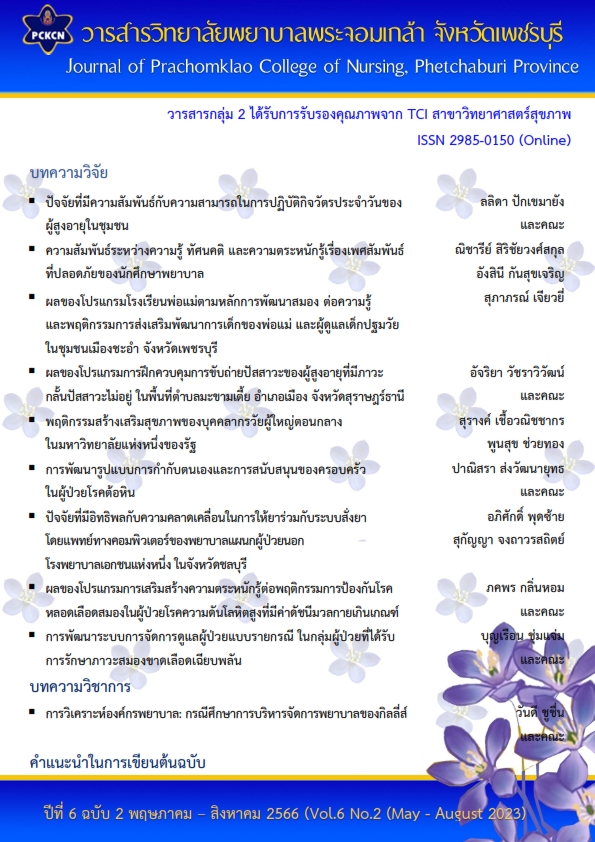
Development of a Case Management System for Acute Ischemic Stroke Patients
Article Sidebar
Main Article Content
Abstract
The research and development aim to: 1) develop a case-based management system for patients with acute ischemic stroke, and 2) study the outcomes of the case-based management system for patients with acute ischemic stroke at Nopparat Rajathanee Hospital. The research was conducted between August 17, 2022, and May 9, 2023, divided into four phases: 1) planning phase, 2) implementation phase, 3) observation phase, and 4) reflection phase. The purposed sampling consisted of 11 professional nurses and 60 patients who received treatment for acute ischemic stroke. Data were collected by using five questionnaires, including personal information, assessment of neurological severity, follow-up assessment of case management outcomes, nurse satisfaction assessment, and nurse knowledge test. The Cronbach's alpha reliability coefficients were .85, .93, and .94 for the respective instruments. Statistical analysis was performed using descriptive statistics, Wilcoxon signed-rank test and Mann-Whitney U tests. The research findings revealed that:
1. The developed case management system included: 1) fast-track service system, including patient screening, monitoring, and evaluation; 2) individualized counseling system; and 3) follow-up system for patients returning home during at 1, 2, and 4 weeks.
2. After implementing the system: 1) Nurses' knowledge and satisfaction significantly increased compared to before system use (Z = 52.00, p < .05; Z = 65.00 p < .01); 2) Patient outcomes showed significant reduction in neurological deterioration, aspiration pneumonia, urinary tract infections, pressure ulcers (F = 6.30, 6.56, 6.30, 6.56; p < .05). However, hospitalization costs and length of stay did not differ significantly.
The developed system effectively reduced complications, and trends suggested potential reduction in costs and hospital stays. The role of nurses is crucial in system development, improving communication, and enhancing treatment efficiency.
Downloads
Article Details

This work is licensed under a Creative Commons Attribution-NonCommercial-NoDerivatives 4.0 International License.
Content and information published in the Journal of Prachomklao College of Nursing, Phetchaburi Province are the comment and responsibility of the authors. Articles, information, images, etc. published in this journal are the copyright of the Journal of Prachomklao College of Nursing, Phetchaburi Province. If any person or entity wants to take all or part of it for publication for any purposes, please reference the Journal of Prachomklao College of Nursing, Phetchaburi Province.
References
Amporn, P., Somsri, P., Daekuntod, T., Natsansia, P., & Boonkong, P. (2018). The management model for sudden stroke occlusion patients in the emergency room of Sakon Nakhon Hospital. Journal of Nursing and Health Care, 36(3), 207-220. (in Thai)
Benjamin, E. J., Muntner, P., Alonso, A., Bittencourt, M. S., Callaway, C. W., Carson, A. P., Chamberlain, A. M., Chang, A. R., Cheng, S., Das, S. R., Delling, F. N., Djousse, L., Elkind, M. S.V., Ferguson, J. F., Fornage, M., Jordan, L. C., Khan, S. S., Kissela, B. M., Knutson, K. L., … & American Heart Association Council on Epidemiology and Prevention Statistics Committee and Stroke Statistics Subcommittee. (2019). Heart disease and stroke statistics-2019 update: A report from the American Heart Association. Circulation, 139(10), 56-528. https://doi.org/ 10.1161/CIR.0000000000000659
Boman, E., Gaarde, K., Levy-Malmberg, R., Wong, F. K. Y., & Fagerström, L. (2022). Using the PEPPA framework to develop the nurse practitioner role in emergency care: Critical reflections. Nordic Journal of Nursing Research, 42(3), 117-122.
Bovim, M. R., Askim, T., Lydersen, S., Fjærtoft, H., & Indredavik, B. (2016). Complications in the first week after stroke: A 10-year comparison. BMC Neurology, 16, Article 133. https://doi.org/10.1186/s12883-016-0654-8
Case Management Society of America. (2016). Standards of practice for case management. https://www.abqaurp.org/DOCS/2016%20CM%20standards%20of%20practice.pdf.
Institution of Neurology, Department of Medical Services. (2019). Treatment guidelines for stroke or occlusion in doctors. Thana Press. (in Thai)
Gillies, D. A. (1994). Nursing management: A system approach. (3rd ed). W.B. Saunders.
Heldner, M. R., Chaloulos-Iakovidis, P., Panos, L., Volbers, B., Kaesmacher, J., Dobrocky, T., Mordasini, P., Marwan El-Koussy, M., Gralla,J., Marcel Arnold, M., Fischer, U., Mattle, H. P., & Jung, S. (2020). Outcome of patients with large vessel occlusion in the anterior circulation and low NIHSS score. Journal of Neurology, 267(6), 1651-1662.
Jongasakul, A., Sisan, S., Liyankeua, K., & Karunjeanchai, S. (2020). The management model for stroke patients to restore daily functional activities at Phrae Hospital. Region 4-5 Medical Journal, 39(3), 454-471. (in Thai)
Kummarg, U., Sindhu, S., & Muengtaweepongsa, S. (2018). The early outcomes of nurse case management in patients with acute ischemic stroke treated with intravenous recombinant tissue plasminogen activator: A prospective randomized controlled trial. Neurology Research International, 2018, Article 1717843. https://doi.org/10.1155/2018/1717843
Law, Z. K., Dineen, R., England, T. J., Cala, L., Mistri, A. K., Appleton, J. P., Serefnur Ozturk, S., Bereczki, D., Ciccone, A., Bath, P. M., Sprigg, N., & TICH-2 investigators. (2021). Predictors and outcomes of neurological deterioration in intracerebral hemorrhage: Results from the TICH-2 randomized controlled trial. Translational Stroke Research, 12, 275-283.
Lukewich, J. A., Tranmer, J. E., Kirkland, M. C., & Walsh, A. J. (2019). Exploring the utility of the Nursing Role Effectiveness Model in evaluating nursing contributions in primary health care: A scoping review. Nursing Open, 6(3), 685-697.
Lukewich, J., Martin-Misener, R., Norful, A. A., Poitras, M. E., Bryant-Lukosius, D., Asghari, S., Marshall, E. G., Mathews, M., Swab, M., Ryan, D., & Tranmer, J. (2022). Effectiveness of registered nurses on patient outcomes in primary care: A systematic review. BMC Health Services Research, 22(1), 1-34. https://doi.org/10.1186/s12913-022-07866-x
Norsan, S., & Wattanannathon, W. (2017). Case management nursing: The role of caring for dependent elderly in the community. Journal of Nursing Science and Health, 40(2), 138-145. (in Thai)
Ministry of Public Health, Department of Disease Control. (2020). Stroke morbidity and mortality rates. http://www.thaincd.com/2016/mission/documents.php?tid=32&gid=1-020 (in Thai)
McLaughlin-Davis, M. (2018). The integrated case management program: Essential for today's case manager. Professional Case Management, 23(3), 147-149. https://doi.org/10.1097/NCM.0000000000000288
Pinyopasakul, W., & Rungchivan, V. (2022). Development of stroke patient care systems: Nursing concepts and competencies. In Kotsitamongoen, S., Kongmuangpak, M., & Pinyopasakul, W. (Eds.), Nursing stroke patients towards excellent nursing outcomes (pp.270-330). Niyomwittaya. (in Thai)
Polit, D. F., & Beck, C. T. (2022). Essentials of nursing research: Appraising evidence for nursing practice (10th ed.). Wolters Kluwer Health Division.
Powell, R. A., & Single, H. M. (1996). Focus groups. International Journal for Quality in Health Care, 8(5), 499-504. http://dx.doi.org/10.1093/intqhc/8.5.499
Puangchan, K., & Jinvawin, S. (2020). The results of using nursing guidelines for the care of stroke or occlusion patients in acute hospitals. Phrae Hospital Journal, 28(2), 1-17. (in Thai)
Schlesselman, J. J. (1973). Planning a longitudinal study: I. Sample size determination. Journal of Chronic Diseases, 26(9), 553-560.
Whittemore, R., & Knafl, K. (2005). The integrative review: updated methodology. Journal of Advanced Nursing, 52(5), 546-553.
World Stroke Organization: WSO. (2020). World stroke organization (WSO) annual report 2020. https://www.worldstroke.org/assets/downloads/WSO_Annual_Report_2020_online.pdf
Xiong, Y., Wakhloo, A. K., & Fisher, M. (2022). Advances in acute ischemic stroke therapy. Circulation Research, 130(8), 1230-1251. https://doi.org/10.1161/CIRCRESAHA.121.319948
