
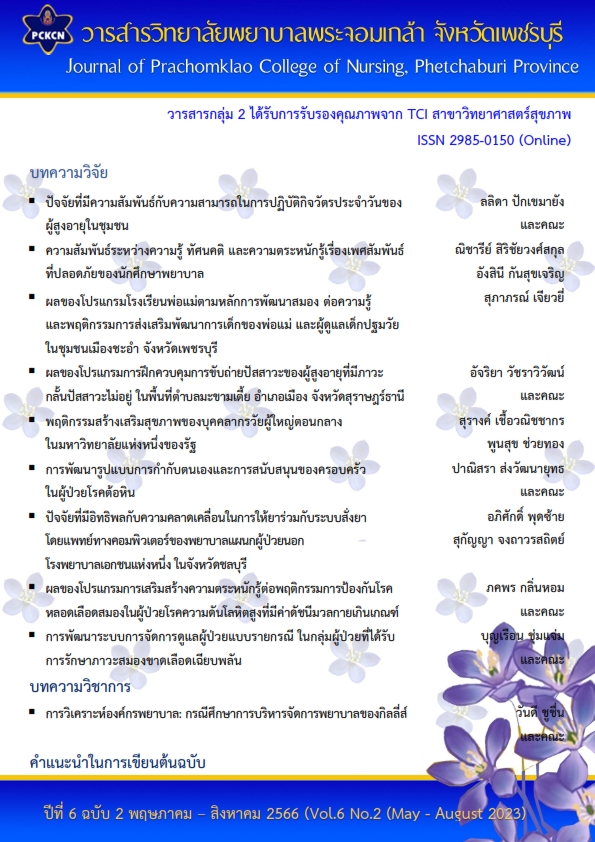
Effect of Urinary Excretion Control Training Program in Older People with Urinary Incontinence in Makham Tia Sub-district, Mueang District, Surat Thani Province
Article Sidebar
Main Article Content
Abstract
This quasi-experimental research is a one-group pre-and-post-experimental study for 1) comparing mean knowledge, self-care behaviour and the severity of urinary incontinence before and after using the urinary control training program for the elderly with urinary incontinence and 2) assessing the satisfaction of the elderly with the program. The sample consists of 30 elderly females with urinary incontinence. Data were collected by using a knowledge test. There was a Kuder-Richardson confidence value of 20 equal to .70 and a self-care behavior questionnaire. Cronbach's alpha coefficient of confidence was .80. Data were analyzed by using descriptive statistics, and an independent t-test.
The results show that after using the program, the sample group’s knowledge mean, and self-care behaviour was higher than before receiving the program. There is statistical significance at the .01 level (t = 5.25, 12.66). There is a decrease in urinary frequency severity for 2 persons, representing 6.67%, while there is a decrease in urinary frequency severity. 6 people, equal to 20.00 per cent and the level of satisfaction with the urinary control training program is at a high level (M = 4.24, SD = .42).
The urinary control training program should be implemented according to the nursing role as follows: 1) screening risk groups, 2) preventing problems, 3) solving problems, 4) organizing an urination program, and 5) restoring urinary incontinence. To be used in the dependent elderly who need close care to strengthen the pelvic floor muscles and bladder sphincter
Downloads
Article Details

This work is licensed under a Creative Commons Attribution-NonCommercial-NoDerivatives 4.0 International License.
Content and information published in the Journal of Prachomklao College of Nursing, Phetchaburi Province are the comment and responsibility of the authors. Articles, information, images, etc. published in this journal are the copyright of the Journal of Prachomklao College of Nursing, Phetchaburi Province. If any person or entity wants to take all or part of it for publication for any purposes, please reference the Journal of Prachomklao College of Nursing, Phetchaburi Province.
References
Faul, F., Erdfelder, E., Lang, A. G., & Buchner, A. (2007). G* Power 3: A flexible statistical power analysis program for the social, behavioral, and biomedical sciences. Behavior Research Methods, 39(2), 175-191.
Fumaneeshoat, O., & Phaktongsuk, P. (2017). Prevalence of urinary incontinence in the elderly in Banpru Municipality, Hat Yai District, Songkhla Province, Thailand. Songklanagarind Medical Journal, 35(2), 133-138. (in Thai)
Inkum, J. (2015). Urinary incontinence in the elderly. Journal of Medicine and Health Sciences, 22(1), 58-68. (in Thai)
Jirawaranan, S., & Jaipang, C. (2019). Urinary incontinence in the elderly: Role of nurses. Vajira Nursing Journal, 21(2), 77-87. (in Thai)
Numchaisrika, O., & Thaithae, S. (2019). Effects of empowerment program and using smartphone application on self-management behaviors in the women with urinary incontinence. Kuakarun Journal of Nursing, 26(2), 78-62. (in Thai)
Orem, D. E., Taylor, S. G., & Renpenning, K. M. (2001). Nursing: Concepts of practice (6th ed.). Mosby.
Phithanthananukul, P. (2020). Urinary incontinence in the elderly. Journal of Health Science Boromarajonani College of Nursing Sanphasitthiprasong, 4(1), 20-36. (in Thai)
Pongmeta, S., Nuansing, T., Singweratham, N., Nawsuwan, K., & Khammathit, A. (2021). The effect of an exercise program to reduce the severity of urinary incontinence among female elderly at Ban Dung municipal elderly school, Ban Dung District, Udon Thani Province. Journal of Community Health Council, 3(3), 75-84. (in Thai)
Ruangpraphan, C. (2000). Basic statistics with examples of analysis using Minitab SPSS and SAS. Khon Kaen University. (in Thai)
Sribenjalak, W., & Limpawattana, P. (2013). Urinary incontinence in the elderly. North-Eastern Thai Journal of Neuroscience, 8(2), 82-92. (in Thai)
Wongsri, P., & Chintapanyakul, T. (2018). The application of Orem's theory to the care and counseling of patients with heart failure. Journal of the Police Nurses, 10(1), 209-213. (in Thai)
World Health Organization. (2017). Integrated care for older people guidelines (ICOPE) about evidence profile: Urinary incontinence. World Health Organization.
