
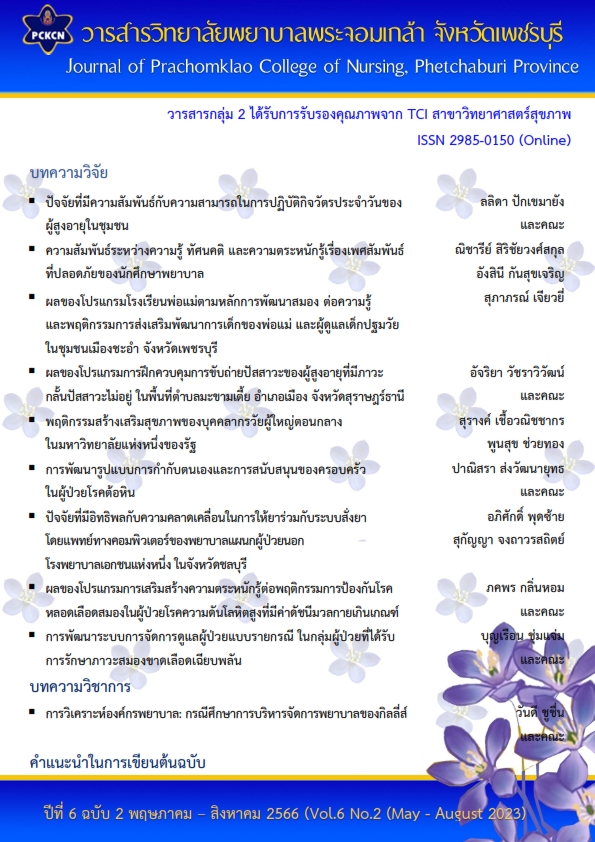
Factors influencing Medication Administration Errors with Computerized Physician Order Entry System of Nurses in Out-patient Department : A Private Hospital in Chonburi Province
Article Sidebar
Main Article Content
Abstract
The descriptive research aims to study factors influencing medication administration errors of outpatient nurses with computerized physician order entry systems (CPOE) of nurses in the outpatient department. The sample consists of 92 out-patient nurses from a private hospital in Chonburi Province. The data were collected from Individual factors, workplace environments factors and experiences of dispensing errors in medication administration with CPOE. The analysis is based on descriptive statistics and logistic regression analysis in the enter methods were used.
The study's findings show that among the 92 sample nurses in the outpatient department from the particular private hospital in Chonburi Province of 92 people, there are 19 people or a level of 20.65% have undergone dispensing errors in medication administration with CPOE whereas 73 people or a level 79.34 % have not. The logistic regression analysis reveals that the communication between multidisciplinary teams is at (ORadj = 8.44, 95%CI: 1.46-48.15, p < .05), and a high level of complexity of patient care along with dynamic work which is at (ORadj = 9.66, 95%CI: 2.07-44.92, p < .01) are predicted at 26.30 % with statistical significance at the .01 level.
These results imply that the hospital should take CPOE content into a training program regarding CPOE, as well as improve communicative ways between multidisciplinary teams. Nursing management in the care of complex patients, too, should be developed to reduce medication administration errors and to provide the most efficient services.
Downloads
Article Details

This work is licensed under a Creative Commons Attribution-NonCommercial-NoDerivatives 4.0 International License.
Content and information published in the Journal of Prachomklao College of Nursing, Phetchaburi Province are the comment and responsibility of the authors. Articles, information, images, etc. published in this journal are the copyright of the Journal of Prachomklao College of Nursing, Phetchaburi Province. If any person or entity wants to take all or part of it for publication for any purposes, please reference the Journal of Prachomklao College of Nursing, Phetchaburi Province.
References
Ambwani, S., Misra, A. K., & Kumar, R. (2019). Medication errors: Is it the hidden part of the submerged iceberg in our health-care system?. International Journal of Applied and Basic Medical Research, 9(3), 135-142.
Amiri, P., Rahimi, B., & Khalkhali, H. R. (2020). Nurses' attitudes toward computerized provider order entry (CPOE) system: A feasibility study prior to implementation. Journal of Clinical Research in Paramedical Sciences, 9(2), Article e101420. https://doi.org/10.5812/jcrps.101420
Aziz, N. G., Osman, G. A., & Rasheed, H. A. (2018). Nurses’ experiences and perceptions of medication administration errors. Zanco Journal of Medical Sciences, 22(2), 217-226. https://doi.org/10.15218/zjms.2018.029
Bangkok Pattaya Hospital. (2019) Medication error management policy of Bangkok Pattaya Hospital. Bangkok Pattaya Hospital. (in Thai)
Best, J. W. (1977). Research in education (3rd ed.). Prentice-Hall.
Bloom, B. S. (1971). Handbook on formative and summative evaluation of student learning. McGraw-Hill.
Hayavi-haghighi, M. H., Alipour, J., & Dehghani, M. (2021). Nursing errors and Computerized Provider Order Entry (CPOE). Informatics in Medicine Unlocked, 25, Article 100648. https://doi.org/10.1016/j.imu.2021.100648
Korb-Savoldelli, V., Boussadi, A., Durieux, P., & Sabatier, B. (2018). Prevalence of computerized physician order entry systems–related medication prescription errors: A systematic review. International Journal of Medical Informatics, 111, 112-122. https://doi.org/10.1016/j.ijmedinf.2017.12.022
Krejcie, R. V., & Morgan, D. W. (1970). Determining sample size for research activities. Educational and psychological measurement, 30(3), 607-610.
Larouzée, J., & Guarnieri, F. (2015). From theory to practice: itinerary of Reasons’ Swiss Cheese Model. In ESREL 2015, European Safety and Reliability Association (ESRA) (pp. 817-824). HAL Open Science. https://hal-mines-paristech.archives-ouvertes.fr/hal-01207359
Lemeshow, S., Hosmer, D. W., Klar, J., Lwanga, S. K., & World Health Organization. (1990). Adequacy of sample size in health studies. Wiley.
Lerdsirisopon, S., Angkasuvan, W., Viengteerawat, S., Limapichat, R., Prapongsena, P., Ariyanuchitkul, T., Lapisatepun, W., Boonsombat, T., Sintavanuruk, K. & Chongarunngamsang, W. (2018). Medication errors and adverse drug events: Analysis from perioperative anesthetic adverse events in Thailand (PAAD Thai study). Journal of the Medical Association of Thailand, 101(6), 829-836. (in Thai)
Liang, M. Q., Thibault, M., Jouvet, P., Lebel, D., Schuster, T., Moreault, M. P., & Motulsky, A. (2023). Improving medication safety in a paediatric hospital: A mixed-methods evaluation of a newly implemented computerised provider order entry system. BMJ Health & Care Informatics, 30(1), Article e100622. https://www.ncbi.nlm.nih.gov/pmc/articles/PMC9930550/pdf/bmjhci-2022-100622.pdf
Parry, A. M., Barriball, K. L., & While, A. E. (2015). Factors contributing to registered nurse medication administration error: A narrative review. International Journal of Nursing Studies, 52(1), 403-420.
Sabzi, Z., Mohammadi, R., Talebi, R., & Roshandel, G. R. (2019). Medication errors and their relationship with care complexity and work dynamics. Open Access Macedonian Journal of Medical Sciences, 7(21), 3579-3583. https://doi.org/10.3889/oamjms.2019.722
Steven, J. (1996). Applied multivariate statistics for the social sciences (6thed.). Routledge.
Tariq, R. A., Vashisht, R., Sinha, A., & Scherbak, Y. (2023, 2 May). Medication dispensing errors and prevention. National Library of Medicine. https://www.ncbi.nlm.nih.gov/books/NBK519065/
The Healthcare Accreditation Institute. (2020). The 2nd world patient safety day and the 4th Thailand patient and personnel safety day. The Healthcare Accreditation Institute. (In Thai)
Vicente Oliveros, N., Gramage Caro, T., Pérez Menéndez‐Conde, C., Álvarez‐Diaz, A. M., Martín‐Aragón Álvarez, S., Bermejo Vicedo, T., & Delgado Silveira, E. (2017). A continuous usability evaluation of an electronic medication administration record application. Journal of Evaluation in Clinical Practice, 23(6), 1395-1400.
Wondmieneh, A., Alemu, W., Tadele, N., & Demis, A. (2020). Medication administration errors and contributing factors among nurses: A cross sectional study in tertiary hospitals, Addis Ababa, Ethiopia. BMC Nursing, 19(1), Article 4. https://doi.org/10.1186/s12912-020-0397-0
World Health Organization. (2014). Reporting and learning systems for medication errors: The role of pharmacovigilance centres. World Health Organization. https://apps.who.int/iris/handle/10665/137036
World Health Organization. (2017, 29 March). WHO launches global effort to halve medication-related errors in 5 years. https://www.who.int/news/item/29-03-2017-who-launches-global-effort-to-halve-medication-related-errors-in-5-years
