
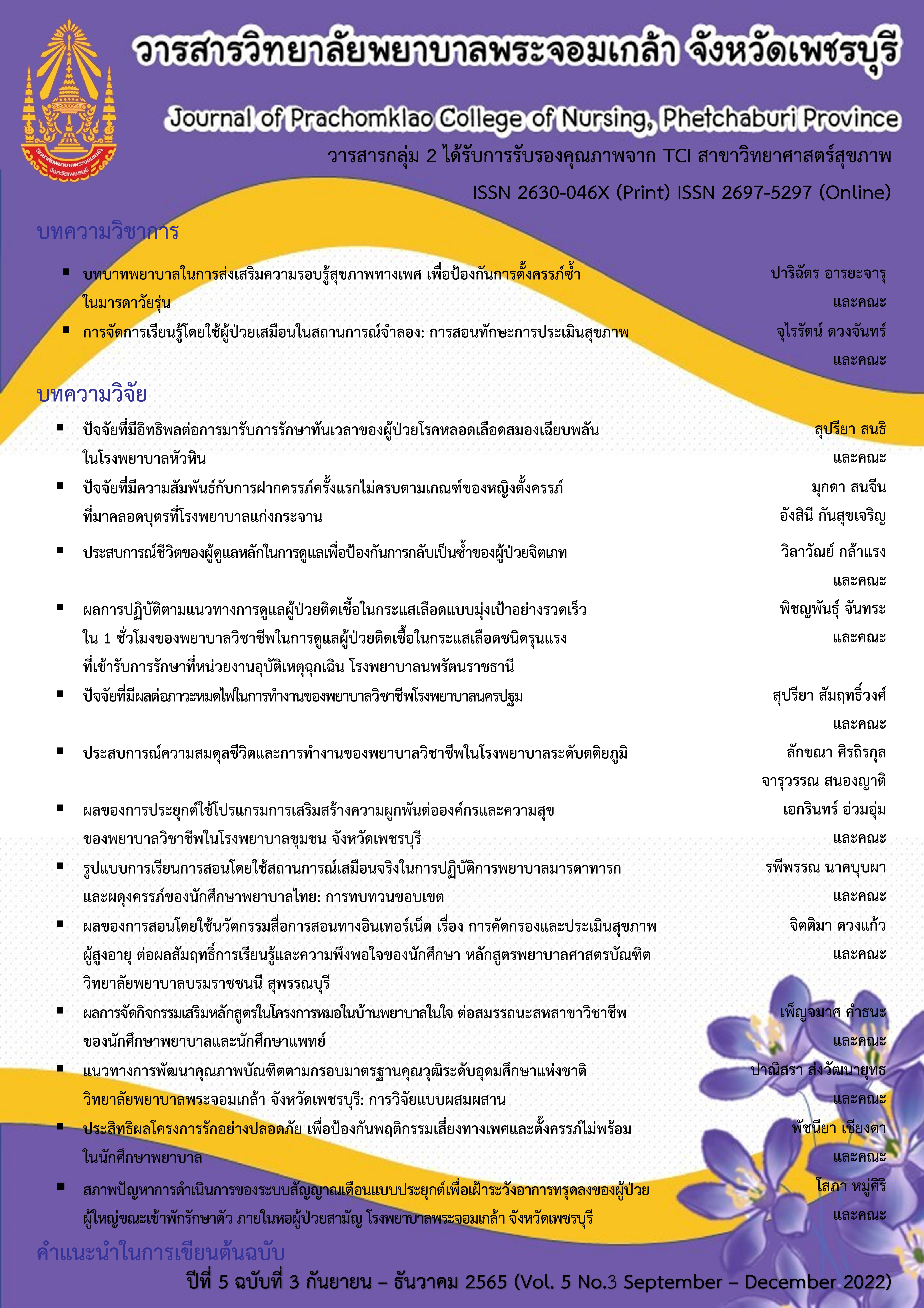
The 1-hour Sepsis Bundle Practical Outcomes of Registered Nurses in Caring for Severe Sepsis Patients at the Emergency Department, Nopparat Rajathanee Hospital
Article Sidebar
Main Article Content
Abstract
This retrospective descriptive study aims to examine the outcomes of practicing the 1-hour Sepsis Bundle among registered nurses in caring for severe sepsis patients admitted to the Emergency Department, Nopparat Rajathanee Hospital. The study samples were 73 patients selected from the medical records of those diagnosed with severe sepsis who received treatments between 1st June – 31st June 2020 at the Emergency Department, Nopparat Rajathanee Hospital. A personal data record form for patients with severe sepsis and a record form of caring processes and outcomes according to the 1-hour Sepsis Bundle practices has been used as a collection of data. Descriptive statistics have been applied to analyze the data.
The results reveal that most of the nurses provided care for patients with severe sepsis under the 1-hour Sepsis Bundle practices. The serum lactate was collected within 1 hour representing 95.90%, hemoculture 2 samples were collected before antimicrobial therapy within 1 hour representing 98.60%, and 95.90% received broad-acting antimicrobials within 1 hour. Moreover, 93.10% received intravenous crystalloid fluid within 1 hour, and 80.80% received a vasopressor. The outcome of the 1-hour Sepsis Bundle practices showed that 16.40% had a shock after 6-hour specific treatment and a 28.80% mortality rate was found.
Based on the study results, it may be concluded that following the 1-hour Sepsis Bundle practices may prevent and reduce severe symptoms of sepsis after a 6-hours specific treatment, especially the circulatory system that can rapidly return to normal.
Downloads
Article Details

This work is licensed under a Creative Commons Attribution-NonCommercial-NoDerivatives 4.0 International License.
Content and information published in the Journal of Prachomklao College of Nursing, Phetchaburi Province are the comment and responsibility of the authors. Articles, information, images, etc. published in this journal are the copyright of the Journal of Prachomklao College of Nursing, Phetchaburi Province. If any person or entity wants to take all or part of it for publication for any purposes, please reference the Journal of Prachomklao College of Nursing, Phetchaburi Province.
References
กองยุทธศาสตร์และแผนงาน กระทรวงสาธารณสุข. (2563). รายละเอียดตัวชี้วัดกระทรวงสาธารณสุข ประจำปีงบประมาณ 2564. http://bps.moph.go.th/new_bps/sites/default/files/kpi_template _edit%201.pdf
พรพิมล อรรถพรกุศล, จิราภรณ์ คุ้มศรี, สินจัย เขือนเพชร, นัยนา วัฒนากูล, พรนภา เอียมลออ, เพียงพิมพ์ ตันติลีปิกร, ยุทธนา สมานมิตร, และ นฤมล สวรรค์ปัญญาเลิศ. (2563). ระบาดวิทยาการติดเชื้อในกระแสเลือด โรงพยาบาลนพรัตนราชธานี ปี 2018. วารสารกรมการแพทย์, 45(4), 175-183.
รินนิภา สวนสุข, เยาวภา เพียรพานิช, และ สาวิตริี รินทีี. (2565). การพัฒนารูปแบบการพยาบาลผู้ป่วยที่มีภาวะติดเชื้อในกระแสเลือด. วารสารสมาคมเวชศาสตร์ป้องกันแห่งประเทศไทย, 12(1), 170-189.
ศจีรัตน์ โกศล, ประภาพร ชูกำเหนิด, และ ปราโมทย์ ทองสุข. (2564). การพัฒนารูปแบบการจัดการการเฝ้าระวังการติดเชื้อในกระแสเลือดในผู้ป่วยมะเร็งเม็ดเลือดขาวของโรงพยาบาลสุราษฎร์ธานี. วารสารเทคโนโลยีภาคใต้, 14(1), 97-111.
สุทธิชัย แก้วหาวงค์, และ ดลวิวัฒน์ แสนโสม. (2563). ผลของการใช้โปรแกรมการพยาบาลระยะ 1 ชั่วโมงแรกต่อผลลัพธ์ที่คัดสรรในผู้ป่วยกลุ่มอาการติดเชื้อในกระแสเลือดที่แผนกงานฉุกเฉิน. วารสารการพยาบาลและการดูแลสุขภาพ, 38(1), 196-206.
อาภรณ์ นิยมพฤกษ์, พิชญพันธุ์ จันทระ, พัชรี ยิ้มแย้ม, และ น้ำอ้อย ภักดีวงษ์. (2556). การพัฒนาระบบการดูแลผู้ป่วยกลุ่มอาการติดเชื้อในกระแสเลือดโดยใช้หลักฐานเชิงประจักษ์. วารสารสมาคมพยาบาลฯสาขาภาคตะวันออกเฉียงเหนือ, 31(2), 14-24.
Boonmee, P., Ruangsomboon, O., Limsuwat, C., & Chakorn, T. (2020). Predictors of mortality in elderly and very elderly emergency patients with sepsis: A retrospective study. The Western Journal of Emergency Medicine, 21(6), 210–218. https://doi.org/10.5811/westjem.2020.7.47405
Bouza, C., & López-Cuadrado, T. (2019). Epidemiology and Trends of Sepsis in Young Adults Aged 20-44 Years: A Nationwide Population-Based Study. Journal of Clinical Medicine, 9(1), Article 77. https://doi.org/10.3390/jcm9010077
Branco, M. J. C., Lucas, A. P. M., Marques, R. M. D., & Sousa, P. P. (2020). The role of the nurse in caring for the critical patient with sepsis. Revista Brasileira de Enfermagem, 73(4), Article e20190031. https://doi.org/10.1590/0034-7167-2019-0031
Donabedian, A. (2005). Evaluating the quality of medical care. The Milbank Quarterly, 83(4), 691–729. https://doi.org/10.1111/j.1468-0009.2005.00397.x
Evans, L. M., Rhodes, A., Alhazzani, W., Antonelli, M., Coopersmith, C. M., French, C., Machado, F. R., Mcintyre, L., Ostermann, M., Prescott, H. C., Schorr, C., Simpson, S., Wiersinga, W. J., Alshamsi, F., Angus, D. C., Arabi, Y., Azevedo, L., Beale, R., Beilman, G., … & Levy, M. M. (2021). Surviving sepsis campaign: International guidelines for management of sepsis and septic shock 2021. Critical Care Medicine, 49(11), 1063-1143. https://doi.org/10.1097/CCM.0000000000005337
Glass, G. V., McGaw, B., & Smith, M. L. (1981). Meta-Analysis in Social Research. Sage.
Harley, A., Johnston, A. N. B., Denny, K. J., Keijzers, G., Crilly, J., & Massey, D. (2019). Emergency nurses' knowledge and understanding of their role in recognizing and responding to patients with sepsis: A qualitative study. International emergency nursing, 43, 106–112. https://doi.org/10.1016/j.ienj.2019.01.005
Knaus, W. A., Draper, E. A., Wagner, D. P., & Zimmerman, J. E. (1985). APACHE II: a severity of disease classification system. Critical Care Medicine, 13(10), 818–829.
Levy, M. M., Evans, L. E., & Rhodes, A. (2018). The surviving sepsis campaign bundle: 2018 update. Intensive care medicine, 44(6), 925-928. https://doi.org/10.1097/CCM. 0000000000003119
Martin-Loeches, I., Guia, M. C., Vallecoccia, M. S., Suarez, D., Ibarz, M., Irazabal, M., Ferrer, R., & Artigas, A. (2019). Risk factors for mortality in elderly and very elderly critically ill patients with sepsis: a prospective, observational, multicenter cohort study. Annals of Intensive Care, 9(1), Article 26. https://doi.org/10.1186/s13613-019-0495-x
Polit, D. F., & Beck, C. T. (2022). Essentials of nursing research: Appraising evidence for nursing practice (10th ed.). Wolters Kluwer Health.
Rhodes, A., Evans, L. E., Alhazzani, W., Levy, M. M., Antonelli, M., Ferrer, R., Kumar, Sevransky, J. E., Sprung, C. L., Nunnally, M. E., Rochwerg, B., Rubenfeld, G. D., Angus, D. C., Annane, D., Beale, R. J., Bellinghan, G. J., Bernard, G. R., Chiche, J., Coopersmith, C.,... & Dellinger, R. P. (2017). Surviving sepsis campaign: International guidelines for management of sepsis and septic shock: 2016. Intensive Care Medicine, 43(3), 304–377. https://doi.org/10.1007/s00134-017-4683-6
World Health Organization. (2020, 26 August). Sepsis. https://www.who.int/news-room/fact-sheets/detail/sepsis#:~:text=Sepsis%20is%20a%20life-threatening, multiple%%2020 organ%20failure%20and%20death
