
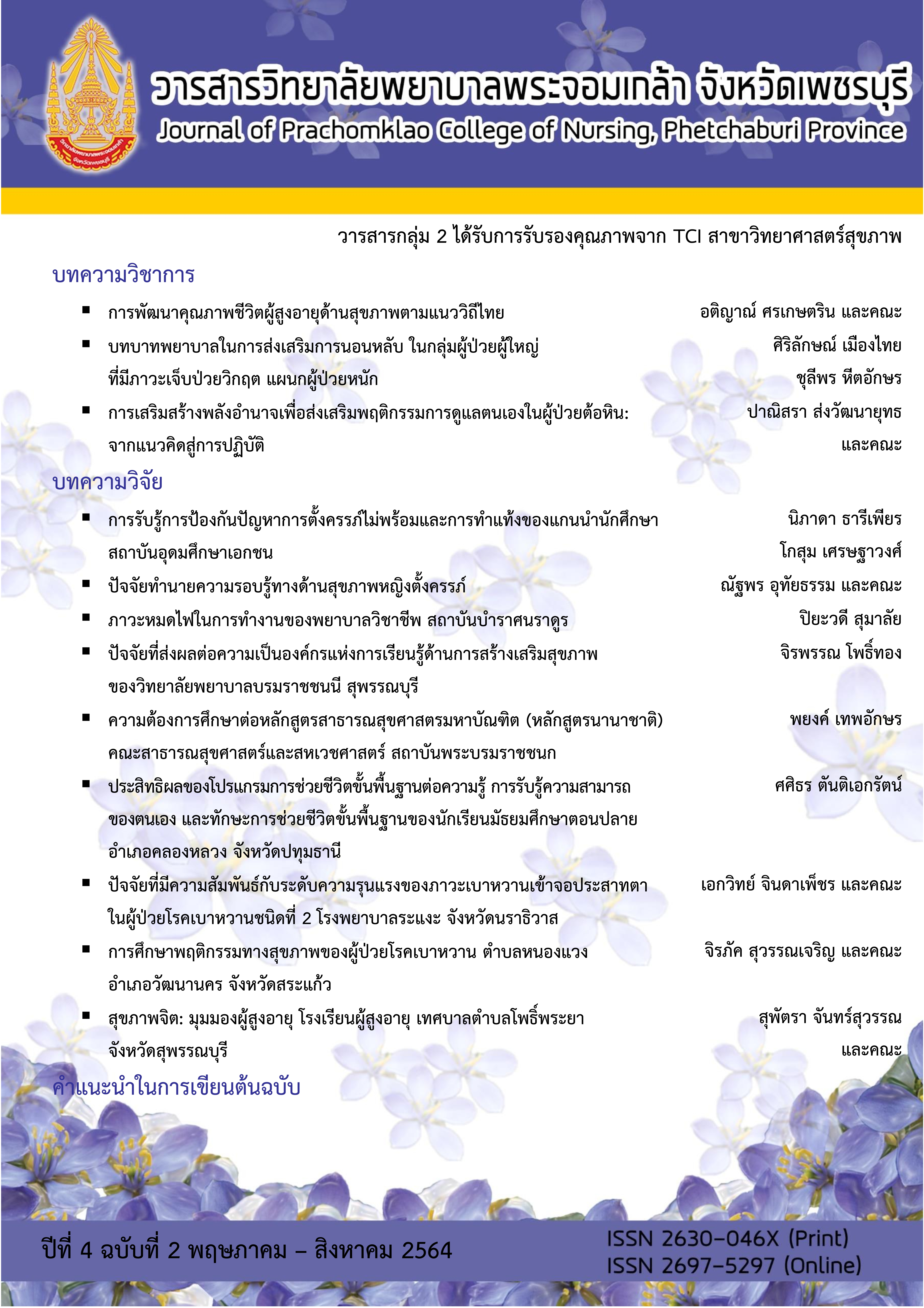
Empowerment in Glaucoma Patients for Promoting Self-Care Behavior: From Concept to Practice
Article Sidebar
Main Article Content
Abstract
Promoting self-care behaviors in glaucoma patients is essential for helping patients to properly take care of themselves in order to reduce intraocular pressure and visual loss problem. The empowerment will help glaucoma patients consider their own problem thoroughly as well as seeking for any alternative treatments which are more appropriate for each one along with being encourage self-control and behavioral improvement.
There are the four steps of the self-empowering process: 1) to build up a relationship, familiarity, and cooperation between nurses and patients 2) to ponder ones’ actual situation by analyzing individual behavior along with realizing the significance of self-caring in order to avoid negative sequela 3) to alternately design ones’ self-caring methods by learning from the prototype along with making ones’ own self-commitment and solitary updating the health-recording platform 4) to maintain the effective ways by informing ones’ experience according to the commitment, then sharing, encouraging others and concluding the results. All lead to positive outcomes in order to find out more suitable approaches to self-care for glaucoma patients.
Downloads
Article Details
Content and information published in the Journal of Prachomklao College of Nursing, Phetchaburi Province are the comment and responsibility of the authors. Articles, information, images, etc. published in this journal are the copyright of the Journal of Prachomklao College of Nursing, Phetchaburi Province. If any person or entity wants to take all or part of it for publication for any purposes, please reference the Journal of Prachomklao College of Nursing, Phetchaburi Province.
References
กุนนที พุ่มสงวน. (2557). การสร้างเสริมพลังอำนาจทางสุขภาพ: บทบาทที่สำคัญของพยาบาล. วารสารพยาบาลทหารบก. 15(3), 86-90.
กรกฎ เจริญสุข, สิริมา ชุ่มศรี, และพรทิพา ศุภราศรี. (2562). ผลของการเสริมพลังอำนาจในผู้ดูแลต่อความสามารถในการดูแลเด็กที่มีการติดเชื้อทางเดินหายใจส่วนล่างเฉียบพลัน. วารสารหัวหินสุขใจไกลกังวล, 4(2), 58-70.
จารวี คณิตาภิลักษณ์, ทศพร คำผลศิริ, และลินจง โปธิบาล. (2563). ผลของโปรแกรมการเสริมสร้างพลังอำนาจต่อคุณภาพชีวิตของผู้สูงอายุ ที่เป็นโรคหลอดเลือดสมอง. พยาบาลสาร, 47(1), 222-230.
จิรัชยา เจียวก๊ก, สุภาวี หมัดอะด้ำ, และอัสมา เกษตรกาลาม์. (2558). การรับรู้และพฤติกรรมในการดูแลตนเองของผู้ป่วยต้อหิน. วารสารจักษุธรรมศาสตร์, 8(2), 29-45.
พรรักษ์ ศรีพล. (2561). ความชุกของการสูญเสียการมองเห็นในต้อหิน. ชัยภูมิเวชสาร, 38(2), 46-55.
เพ็ญนภา แดงด้อมยุทธ์, ชุติมา มาลัย, และสุพรรณี กัณหดิลก. (2560). การเสริมสร้างพลังอำนาจ: บทบาทพยาบาล. วารสารกองการพยาบาล, 44(2), 159-168.
นริสา วงศ์พนารักษ์. (2557). สัมพันธภาพเพื่อการบำบัด: การประยุกต์ใช้ในกระบวนการพยาบาล. วารสารพยาบาลทหารบก, 15(2), 84-91.
ไปรมา กลิ่นนิรัญ. (2558). ผลของการเสริมสร้างพลังอำนาจต่อพฤติกรรมการดูแลตนเองของผู้ป่วยความดันโลหิตสูงของโรงพยาบาลท่าโรงช้าง อำเภอพุนพิน จังหวัดสุราษฎร์ธานี. วารสารการพัฒนาสุขภาพชุมชน มหาวิทยาลัยขอนแก่น, 3(2), 213-230.
รัชนี ปานเพ็ชร, และเพ็ญนภา แดงด้อมยุทธ์. (2553). การศึกษาใช้โปรแกรมการเสริมสร้างพลังอำนาจต่อพฤติกรรมการใช้ยาตามเกณฑ์การรักษาของผู้ป่วยจิตเภท สถาบันจิตเวชศาสตร์สมเด็จเจ้าพระยา. วารสารการพยาบาลจิตเวชและสุขภาพจิต, 24(1), 94-107.
ลาลิน เจริญจิตต์, ทวีลักษณ์ วรรณฤทธิ์, และเบญจมาศ สุขสถิตย์. (2563). การเสริมสร้างพลังอำนาจในผู้ที่ได้รับการผ่าตัดทำทางเบี่ยงหลอดเลือดหัวใจ: กรณีศึกษา. พยาบาลสาร, 47(1), 242-254.
วิศนี ตันติเสวี, สุภรัตน์ จริยโกศล, วรรณกรณ์ พฤกษากร, สุภณัฐ อภิญญาวสีสุข, และปัจฉิมา จันทเรนทร์ (บ.ก.). (2561). ตำราจักษุวิทยา สำหรับนิสิตแพทย์และแพทย์ปฏิบัติทั่วไป (ฉบับปรับปรุง). กรุงเทพฯ: พิมพ์ดี.
สมชาย พรวิจิตรพิศาล, พิมพ์ปรียา ขจรชัยกุล, และฉัตรชนก บุริประเสริฐ. (2561). ความเข้าใจเรื่องการใช้ยาหยอดตาผู้ป่วยนอกโรคต้อหิน โรงพยาบาลจุฬาลงกรณ์. จุฬาลงกรณ์เวชสาร, 62(2), 187-195.
สุภาพร แนวบุตร. (2558). ผลของโปรแกรมการเสริมสร้างพลังอำนาจต่อความสามารถในการดูแลตนเองของผู้ดูแลผู้ป่วยในครอบครัว. วารสารการพยาบาลและการศึกษา, 8(4), 30-40.
สุรีรัตน์ ปิงสุทธิวงศ์. (2562). การพยาบาลผู้ป่วยโรคเบาหวานชนิดที่ 2 ที่ไม่สามารถควบคุมระดับน้ำตาลในเลือดได้ในชุมชน. วารสารวิทยาลัยพยาบาลพระจอมเกล้า จังหวัดเพชรบุรี, 2(3), 59-74.
สุวัฒนา ชุณหคล้าย, และสุจิตรา ลิ้มอํานวยลาภ. (2557). ผลของโปรแกรมการเสริมสร้างพลังอำนาจต่อพฤติกรรมความร่วมมือในการรักษาและความดันตาของผู้ป่วยโรคต้อหิน. ใน มหาวิทยาลัยขอนแก่น, Graduate Research Conference 2014 Khon Kaen University (น. 1814-1823). ขอนแก่น: มหาวิทยาลัยขอนแก่น.
Amiri, W., Khademian, Z., & Nikandish, R. (2018). The effect of nurse empowerment educational program on patient safety culture: A randomized controlled trial. BMC Medical Education, 18, 158.
Ayele, F. A., Zeraye, B., Assefa, Y., Legesse, K., Azale, T., & Burton, M. J. (2017). The impact of glaucoma on quality of life in Ethiopia: A case-control study. BMC Ophthalmology, 17(1), 1-9.
Flatau, A., Solano, F., Idrees, S., Jefferys, J. L., Volpe, P., Damion, C., & Quigley, H. A. (2016). Measured changes in limbal strain during simulated sleep in face down position using an instrumented contact lens in healthy adults and adults with glaucoma. JAMA Ophthalmology, 134(4), 375-382.
Gibson, C. H. (1991). A concept analysis of empowerment. Journal of Advanced Nursing, 16, 354-361.
Gibson, C. H. (1995). The process of empowerment in mothers of chronically ill children. Journal of Advanced Nursing, 21(6), 1201-1210.
Hecht, I., Achiron, A., Man, V., & Burgansky-Eliash, Z. (2017). Modifiable factors in the management of glaucoma: A systematic review of current evidence. Graefe's Archive for Clinical and Experimental Ophthalmology, 255(4), 789-796.
Kang, J. M., & Lin, S. (2018). Ginkgo biloba and its potential role in glaucoma. Current Opinion in Ophthalmology, 29(2), 116-120.
Kim, J., Aschard, H., Kang, J. H., Lentjes, M. A., Do, R., Wiggs, J. L., ... & Modifiable Risk Factors for Glaucoma Collaboration. (2020). Intraocular pressure, glaucoma and dietary caffeine consumption: A gene–diet interaction study from the UK Biobank. Ophthalmology, 128(6), 866-876.
Lee, C. S., Owen, J. P., Yanagihara, R. T., Lorch, A., Pershing, S., Hyman, L., ... & Lee, A. Y. (2020). Smoking is associated with higher intraocular pressure regardless of glaucoma: A retrospective study of 12.5 million patients using the intelligent research in sight (IRIS®) registry. Ophthalmology Glaucoma, 3(4), 253-261.
Lim, N., Fan, C. H., Yong, M. K., Wong, E. P., & Yip, L. W. (2016). Assessment of depression, anxiety, and quality of life in Singaporean patients with glaucoma. Journal of Glaucoma, 25(7), 605-612.
Park, S., Kho, Y. L., Kim, H. J., Kim, J., & Lee, E. H. (2015). Impact of glaucoma on quality of life and activities of daily living. Hong Kong Journal of Occupational Therapy, 25(1), 39-44.
Renard, J. P., Rouland, J. F., Bron, A., Sellem, E., Nordmann, J. P., Baudouin, C., ... & Delcourt, C. (2013). Nutritional, lifestyle and environmental factors in ocular hypertension and primary open-angle glaucoma: An exploratory case–control study. Acta Ophthalmologica, 91(6), 505-513.
