
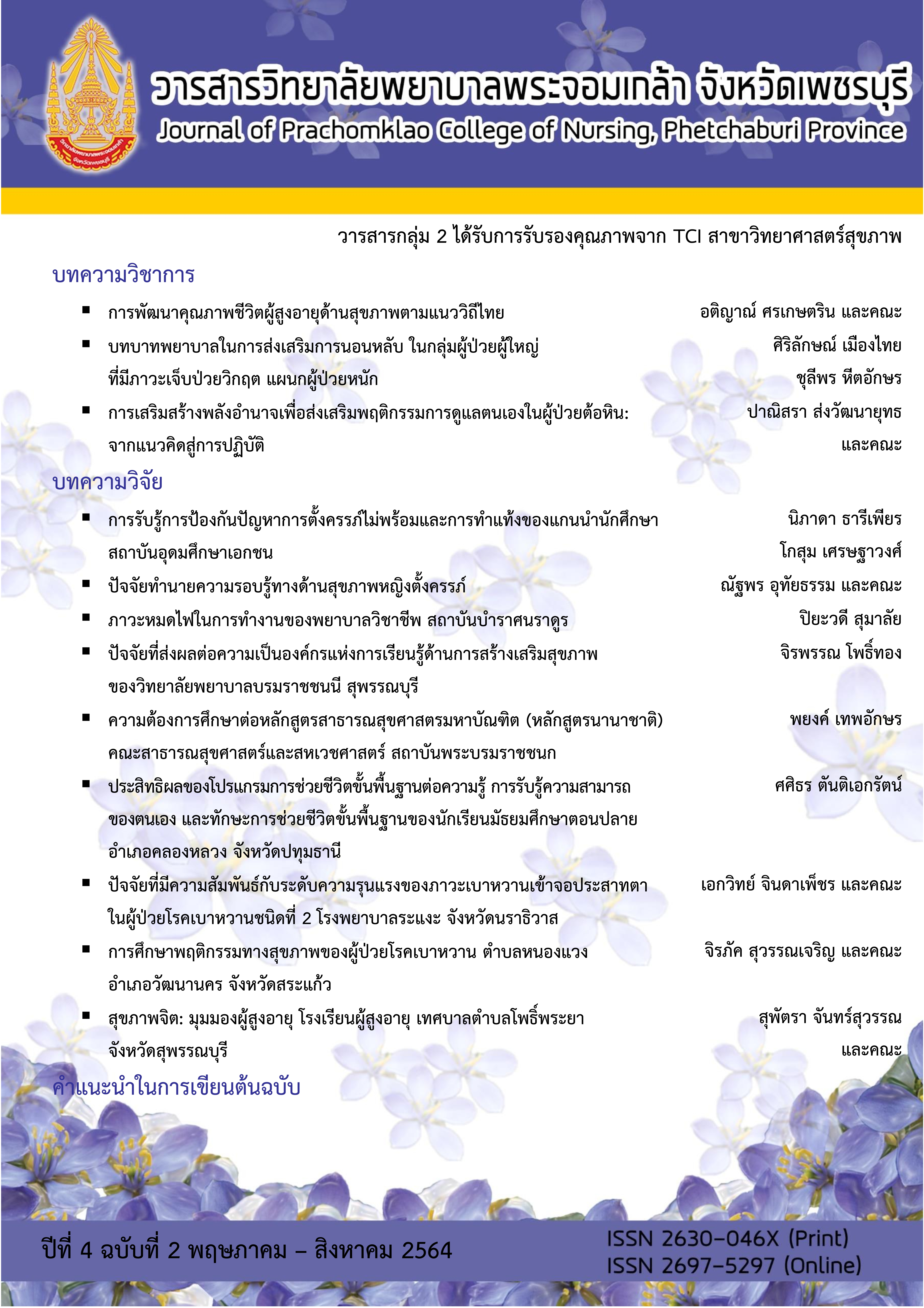
ปัจจัยทำนายความรอบรู้ทางด้านสุขภาพหญิงตั้งครรภ์
Article Sidebar
Main Article Content
บทคัดย่อ
การวิจัยเชิงบรรยายนี้ มีวัตถุประสงค์เพื่อศึกษาระดับความรอบรู้ด้านสุขภาพและอำนาจการทำนายของปัจจัยส่วนบุคคล การมองโลกในแง่ดี และการเห็นคุณค่าในตนเอง ต่อความรอบรู้ด้านสุขภาพของหญิงตั้งครรภ์ จำนวน 120 คน ที่มาฝากครรภ์ ณ แผนกฝากครรภ์ โรงพยาบาลพระจอมเกล้า สุ่มตัวอย่างแบบแบบง่าย เก็บข้อมูลโดยใช้แบบสอบถามปัจจัยส่วนบุคคล แบบสอบถามความรอบรู้ทางสุขภาพในขณะตั้งครรภ์ และแบบสอบถามการเห็นคุณค่าในตนเองและการมองโลกในแง่ดี มีค่าความเชื่อมั่นสัมประสิทธิ์แอลฟาของครอนบาค เท่ากับ .80 และ .82 ตามลำดับ วิเคราะห์ข้อมูลด้วยสถิติพรรณนา สหสัมพันธ์แบบเพียร์สัน และการถดถอยพหุคูณแบบขั้นตอน
ผลการศึกษา พบว่า ความรอบรูดานสุขภาพของหญิงตั้งครรภ์โดยรวม มีค่าเฉลี่ยอยู่ในระดับมาก (M = 4.13, SD = .38) การเห็นคุณค่าในตนเอง การมองโลกในแง่ดี และสถานภาพสมรสคู่ สามารถร่วมกันทำนายความแปรปรวนของความรอบรู้ด้านสุขภาพของหญิงตั้งครรภ์ ได้ร้อยละ 42.60 อย่างมีนัยสำคัญทางสถิติที่ระดับ .01 (F = 28.75, p = .00)
การวิจัยครั้งนี้ ชี้ให้เห็นว่า บุคลากรสุขภาพที่มีส่วนเกี่ยวข้องในการดูแลหญิงตั้งครรภ์ ควรให้การส่งเสริมความรอบรู้ด้านสุขภาพ การมองโลกในแง่ดี และการเห็นคุณค่าในตนเอง ในขณะตั้งครรภ์ รวมทั้งพัฒนาแนวทางการดูแลที่ส่งเสริมความรอบรู้ด้านสุขภาพ เพื่อผลลัพธ์ที่ดีของการตั้งครรภ์
Downloads
Article Details
เนื้อหาและข้อมูลที่เผยแพร่ในวารสารวิทยาลัยพยาบาลพระจอมเกล้า จังหวัดเพชรบุรี ถือเป็นข้อคิดเห็นและความรับผิดชอบของผู้นิพนธ์บทความโดยตรง บทความ เนื้อหา ข้อมูล รูปภาพ ฯลฯ ที่ได้รับการเผยแพร่ในวารสารนี้ ถือเป็นลิขสิทธิ์ของวารสารฯ หากบุคคลหรือหน่วยงานใดต้องการนำทั้งหมดหรือส่วนหนึ่งส่วนใดไปเผยแพร่หรือเพื่อกระทำการใด ๆ จะต้องอ้างอิงวิทยาลัยพยาบาลพระจอมเกล้า จังหวัดเพชรบุรี ทุกครั้ง
เอกสารอ้างอิง
กรมอนามัย กระทรวงสาธารณสุข. (2563). แนวทางการพัฒนาโรงเรียนรอบรู้ด้านสุขภาพ. กรุงเทพฯ: สำนักงานกิจการโรงพิมพ์องค์การสงเคราะห์ทหารผ่านศึก.
คณะกรรมการอำนวยการจัดทำแผนพัฒนาสุขภาพแห่งชาติ ฉบับที่ 12 กระทรวงสาธารณสุข. (2560). แผนพัฒนาสุขภาพแห่งชาติ ฉบับที่ 12 (พ.ศ. 2560-2564). กรุงเทพฯ: โรงพิมพ์องค์การสงเคราะห์ทหารผ่านศึกในพระบรมราชูปถัมภ์.
ชุติกาญจน์ แซ่ตั้น, ศศิกานต์ กาละ, และสุนันทา ยังวนิชเศรษฐ. (2561). ผลของโปรแกรมการคิดเชิงบวกและการผ่อนคลายต่อการลดความเครียดในหญิงตั้งครรภ์วัยรุ่น. วารสารมหาวิทยาลัยนราธิวาสราชนครินทร์, 10(1), 27-39.
ตติรัตน์ เตชะศักดิ์ศรี, สุพิศ ศิริอรุณรัตน์, พิริยา ศุภศรี, วรรณทนา ศุภสีมานนท์, นารีรัตน์ บุยเนตร, และชรริน ขวัญเนตร. (2560). แบบจำลองเชิงสาเหตุคุณภาพชีวิตของหญิงตั้งครรภ์. วารสารเครือข่ายวิทยาลัยพยาบาลและการสาธารณสุขภาคใต้, 4(1), 28-46.
รัตน์ศิริ ทาโต. (2561). การวิจัยทางการพยาบาลศาสตร์:แนวคิดสู่การประยุกต์ใช้ (ฉบับปรับปรุง พิมพ์ครั้งที่ 4). กรุงเทพฯ: โรงพิมพ์แห่งจุฬาลงกรณ์มหาวิทยาลัย.
วราพร ดำจับ. (2562). สื่อสังคมออนไลน์กับการเรียนรู้ในศตวรรษที่ 21. วารสารศิลปศาสตร์ มหาวิทยาลัยแม่โจ้, 7(2), 143-159.
วัชราพร เชยสุวรรณ. (2560). ความรอบรู้ด้านสุขภาพ: แนวคิดและการประยุกต์สู่การปฏิบัติการพยาบาล. วารสารแพทย์นาวี, 44(3), 183-197.
วิมล โรมา, ชะนวนทอง ธนสุกาญจน์, มธุรส ทิพยมงคลกุล, ณัฐนารี เอมยงค์, นรีมาลย์ นีละไพจิตร, สายชล คล้อยเอี่ยม, และมุกดา สำนวนกลาง. (2561). โครงการสำรวจความรอบรู้ด้านสุขภาพของประชาชนไทย อายุ 15 ปี ขึ้นไป พ.ศ. 2560 (ระยะที่ 1) (รายงานฉบับสมบูรณ์). นนทบุรี: สถาบันวิจัยระบบสาธารณสุข.
วิลาสินี บุตรศรี, และอัญสุรีย์ ศิริโสภณ. (2563). ปัจจัยทำนายพฤติกรรมส่งเสริมสุขภาพในหญิงตั้งครรภ์ที่รับบริการฝากครรภ์ ในโรงพยาบาลชุมชน จังหวัดนครสวรรค์. วารสารสหเวชศาสตร์ มหาวิทยาลัยราชภัฏสวนสุนันทา, 5(1), 60-70.
สินีนาท วราโภค, เอมพร รตินธร, และปิยะนันท์ ลิมเรืองรอง. (2563). ปัจจัยที่มีอิทธิพลต่อความรอบรู้ด้านสุขภาพมารดาในสตรีตั้งครรภ์. วารสารสภาการพยาบาล, 35(1), 86-98.
อ้อมใจ พลกายา, และพัทธวรรณ ชูเลิศ. (2562). ผลของโปรแกรมการส่งเสริมบทบาทการเป็นมารดาโดยใช้การสนับสนุนของครอบครัว ต่อทัศนคติและบทบาทของการเป็นมารดา. วารสารวิจัยและนวัตกรรมทางสุขภาพ, 2(1), 131-142.
อัญญา ปลดเปลื้อง, อมราวดี บุญอรัตน์, สุพรรณ กัณหดิลก, เพ็ญพักตร์ ลูกอินทร์, ณัฐพร อุทัยธรรม, พรพรรณ พรมประยูร, และจิริยา อินทนา. (2560). การวิเคราะห์เส้นทางปัจจัยที่ส่งผลคุณภาพชีวิตของหญิงตั้งครรภ์. วารสารพยาบาลกระทรวงสาธารณสุข, 27(3), 43-51.
Best, J. W. (1977). Research in education. (2nd ed.). New Jersey: Prentice-Hall.
Cohen, J. (2001). Designing a new taxonomy of education objectives. California: Corwin Press.
Erkal, Y. A. (2019). The effects and related factors of health literacy status and self-efficacy of pregnant women. International Journal of Caring Sciences, 12(3), 1815-1824.
Kharazi, S. S., Peyman, N., & Esmaily, H. (2016). Association between maternal health literacy level with pregnancy care and its outcomes. The Iranian Journal of obstetrics, Gynecology and infertility, 19(37), 40-50.
Lemeshow, S., Hosmer, D. W., Klar, J., Lwanga, S. K., & World Health Organization. (1990). Adequacy of sample size in health studies. Chichester: Wiley.
Lupattelli, A., Picinardi, M., Einarson, A. & Nordeng, H. (2014). Health literacy and its association with perception of teratogenic risks and health behavior during pregnancy. Patient Education and Counseling, 96(2), 171-178.
Nawabi, F., Krebs, F., Vennedey, V., Shukri, A., Lorenz, L., & Stock, S. (2021). Health Literacy in Pregnant Women: A Systematic Review. International Journal of Environmental Research and Public Health, 18(7), 3847. Retrieved from https://doi.org/10.3390/ijerph18073847.
Nutbeam, D. (2008). The evolving concept of health literacy. Social Science & Medicine, 67(12), 2072-2078.
Renkert, S., & Nutbeam, D. O. N. (2001). Opportunities to improve maternal health literacy through antenatal education: An exploratory study. Health Promotion International, 16(4), 381-388.
Seligman, M. E. P. (2006). Learned optimism: How to change your mind and your life. New York: Vintage Books.
Sørensen, K., Van den Broucke, S., Fullam, J., Doyle, G., Pelikan, J., Slonska, Z., & Brand, H. (2012). Health literacy and public health: a systematic review and integration of definitions and models. BMC Public Health, 12(80), 1-13.
Stevens, J. (1996). Applied multivariate statistics for the social sciences. New Jersey: Lawrence Erlbaum.
