
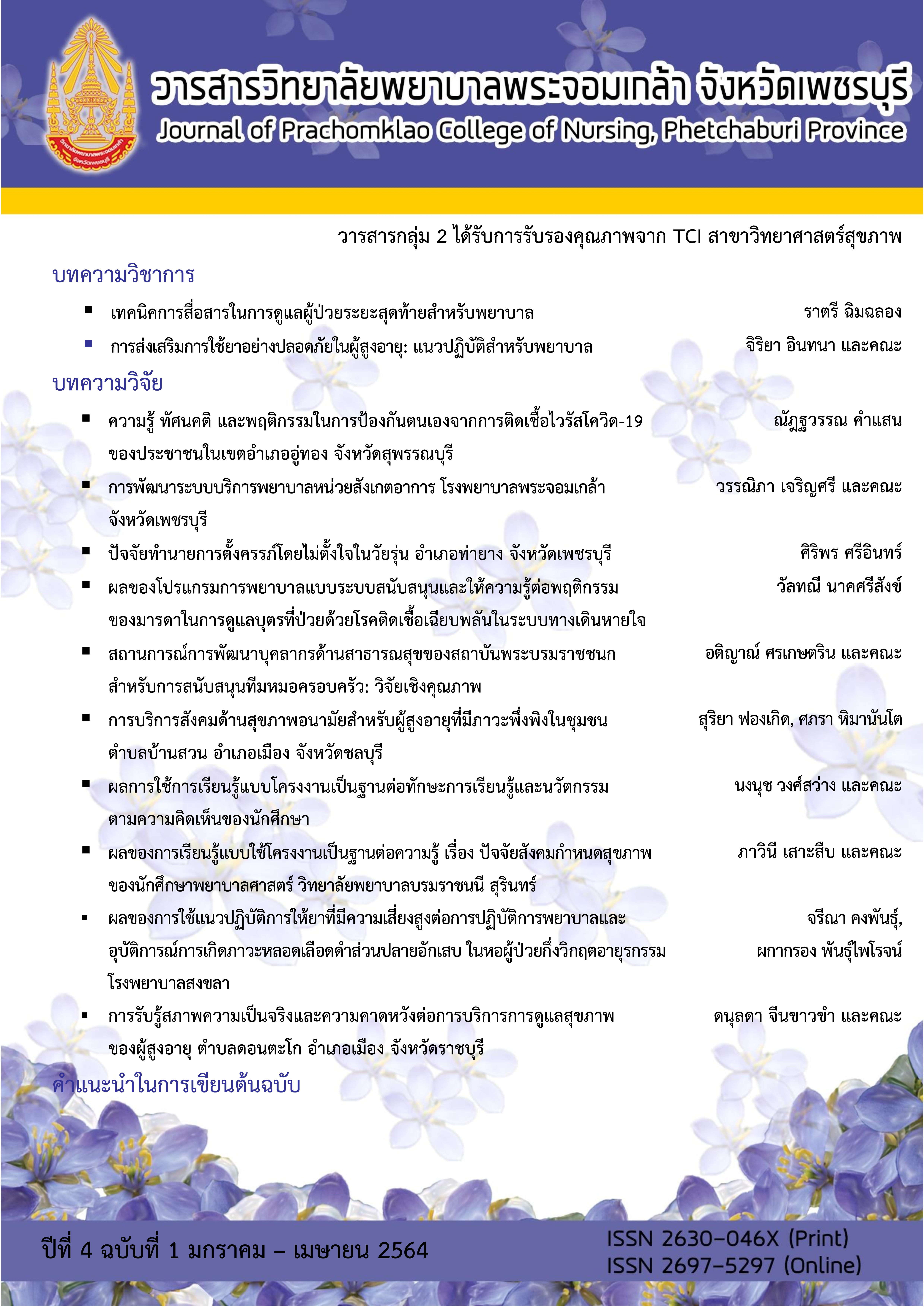
Knowledge, Attitudes, and Preventive Behaviors of COVID-19 among People Living in Amphoe U-thong, Suphanburi Province
Article Sidebar
Main Article Content
Abstract
This survey research aims to examine levels of knowledge, attitudes, and preventive behaviors of Covid-19 along with associations between the understanding and personal factors among people living in Amphoe U-thong, Suphanburi Province during the Covid-19 pandemic. A set of questionnaires focusing on knowledge, attitudes, and preventive behaviors of Covid-19 in order to collect needed data via Line application. The reliability ranged in value was .81 alpha. The representative sample was 455 persons, as well. The data gathered from the questionnaire mentioned in the aforesaid, after being analyzed by Pearson’s product-moment correlation, shows that:
1. Most of the respondents age between 30-49 years and graduated with bachelor degrees. 46.07% of them have high-leveled knowledge of Covid-19, 80.7% trust that Thailand can get through the pandemic and 83.40% are sure that finally the spread of Covid-19 can be controlled. 99.80% of the representatives wear a face mask when they are outside the houses.
2. Educational levels, knowledge of the disease, and attitudes toward Covid-19 are positively and significantly related to preventive practices of Covid-19 at level.05 (r =.10, .18, .16 respectively).
Healthcare providers can apply these findings in order to educate people about Covid-19 and to promote the appropriate preventive behavior among the Thai.
Downloads
Article Details
Content and information published in the Journal of Prachomklao College of Nursing, Phetchaburi Province are the comment and responsibility of the authors. Articles, information, images, etc. published in this journal are the copyright of the Journal of Prachomklao College of Nursing, Phetchaburi Province. If any person or entity wants to take all or part of it for publication for any purposes, please reference the Journal of Prachomklao College of Nursing, Phetchaburi Province.
References
กลุ่มงานพัฒนายุทธศาสตร์สาธารณสุข สำนักงานสาธารณสุขจังหวัดสุพรรณบุรี. (2563). ข้อมูลประชากรกลางปี (มิถุนายน 2563) จำแนกรายอำเภอ. สืบค้นจาก http://www.spo.moph.go.th/ web/dplan/images/info2564/popdistric63Ampher.xlsx.
กรมควบคุมโรค. กระทรวงสาธารณสุข. (2563ก). คู่มือการป้องกันและควบคุมโรคติดเชื้อไวรัสโคโรนา 2019 สำหรับประชาชน. กรุงเทพฯ: โรงพิมพ์ชุมนุมสหกรณ์การเกษตรแห่งประเทศไทย.
กรมควบคุมโรค กระทรวงสาธารณสุข. (2563ข). รายงานโรคติดเชื้อไวรัสโคโรนา 2019 (COVID-19). กรุงเทพฯ: โรงพิมพ์ชุมนุมสหกรณ์การเกษตรแห่งประเทศไทย.
บัญชา เกิดมณี, สุรชัย ธรรมทวีธิกุล, ญานพินิจ วชิรสุรงค์, บดินทร์ชาติ สุขบท, และสมบัติ ทีฆทรัพย์. (2563). แนวคิดและทิศทางการแก้ปัญหาโควิด-19. วารสารก้าวทันโลกวิทยาศาสตร์, 20(1), 1-12.
ศูนย์ปฏิบัติการภาวะฉุกเฉิน กรมควบคุมโรค กระทรวงสาธารณสุข. (2563). ข้อมูลสำหรับการป้องกันตนเองจากโรค COVID-19 เอกสารเผยแพร่สำหรับประชาชน. กรุงเทพฯ: โรงพิมพ์ชุมนุมสหกรณ์การเกษตรแห่งประเทศไทย.
สำนักงานสาธารณสุขจังหวัดสุพรรณบุรี. (2563). รายงานการติดเชื้อโคโรน่า 2019. HDC–Dashboard. สืบค้นจาก https://sp.hdc.moph.go.th/hdc/main/index.php.
สุรชัย โชคครรชิตไชย. (2563). โควิด-19: การระบาดระลอกใหม่ในประเทศไทยปลายปี 2563. วารสารสมาคมเวชศาสตร์ป้องกันแห่งประเทศไทย, 10(3), 1-2.
Al-Hanawi, M. K., Angawi, K., Alshareef, N., Qattan, A. M., Helmy, H. Z., Abudawood, Y., ... & Alsharqi, O. (2020). Knowledge, attitude, and practice toward COVID-19 among the public in the Kingdom of Saudi Arabia: A cross-sectional study. Frontiers in Public Health, 8, 217. doi: 10.3389/fpubh.2020.00217.
Azlan, A. A., Hamzah, M. R., Sern, T. J., Ayub, S. H., & Mohamad, E. (2020). Public knowledge, attitudes and practices towards COVID-19: A cross-sectional study in Malaysia. PLOS ONE, 15(5), e0233668. doi: 10.1371/journal.pone.0233668.
Bloom, B. S. (1964). Taxonomy of education objective: The classification of educational goals: Handbook II: Affective domain. New York: David Mckay.
Dong, E., Du, H., & Gardner, L. (2020). An interactive web-based dashboard to track COVID-19 in real time. The Lancet Infectious Diseases, 20(5), 533–534. doi: 10.1016/S1473-3099(20)30120-1.
Faul, F., Erdfelder, E., Lang, A. G., & Buchner, A. (2007). G*Power 3: A flexible statistical power analysis program for the social, behavioral, and biomedical sciences. Behavior research methods, 39(2), 175–191. doi.org/10.3758/bf03193146.
Hair, F. J., Black, C. W., Babin, J. B., & Anderson, E. R. (2010). Multivariate data analysis (7th ed). New Jersey: Pearson.
Harkness, A., Behar-Zusman, V., & Safren, S. A. (2020). Understanding the impact of COVID-19 on Latino sexual minority men in a US HIV hot spot. AIDS and Behavior, 24(7), 2017–2023. doi: 10.1007/s10461-020-02862-w.
Huang, Y., & Zhao, N. (2020). Generalized anxiety disorder, depressive symptoms and sleep quality during COVID-19 outbreak in China: A web-based cross-sectional survey. Psychiatry Research, 288, 112954. doi: 10.1016/j.psychres.2020.112954.
Hussein, N. R., Naqid, I. A., Jacksi, K., & Abdi, B. A. (2020). Assessment of knowledge, attitudes, and practices toward COVID-19 virus among university students in Kurdistan region, Iraq: Online cross-sectional study. Journal of Family Medicine and Primary Care, 9(9), 4809–4814. doi: 10.4103/jfmpc.jfmpc_870_20.
Li, S., Wang, Y., Xue, J., Zhao, N., & Zhu, T. (2020). The impact of COVID-19 Epidemic declaration on psychological consequences: A study on active Weibo users. International Journal of Environmental Research and Public Health, 17(6), 2032. doi: 10.3390/ijerph17062032.
Wiersma, W. & Jurs, S.G. (2009). Research methods in education. Boston, Massachusetts: Pearson.
Zhang, M., Zhou, M., Tang, F., Wang, Y., Nie, H., Zhang, L., & You, G. (2020). Knowledge, attitude, and practice regarding COVID-19 among healthcare workers in Henan, China. The Journal of Hospital Infection, 105(2), 183-187. doi: 10.1016/j.jhin.2020.04.012.
Zhong, B. L., Luo, W., Li, H. M., Zhang, Q. Q., Liu, X. G., Li, W. T., & Li, Y. (2020). Knowledge, attitudes, and practices towards COVID-19 among Chinese residents during the rapid rise period of the COVID-19 outbreak: A quick online cross-sectional survey. International Journal of Biological Sciences, 16(10), 1745–1752. doi: 10.7150/ijbs.45221.
